
How to Run Your First Influencer Campaign
Most guides treat this as a strategy problem. It is mostly a logistics problem. Here is the version that assumes a small budget, no agency and a month.
TL;DR
- The whole thing takes about four weeks. One week to plan and find people, one to brief and agree terms, one to two while they film and post, then a week to read the results properly.
- Budget by cost per view, not by follower count. At the small end, $100 to $300 per creator is normal, and ten small creators usually beats one large one for a first campaign.
- Brief for a hook, not a script. The single most common way first campaigns fail is brands writing the caption themselves.
- Track one number that matters. Pick it before you start, because you cannot add tracking to a post after it goes live.
- Expect a 20% to 30% reply rate on cold outreach, so contact three to four times as many creators as you need.
Most guides to this treat it as a marketing strategy problem. It is mostly a logistics problem. You need to find people, agree terms, get content made, and know afterwards whether it worked.
Here is the version that assumes you have a small budget, no agency, and a month.
What does a first influencer campaign actually cost?
Somewhere between $1,000 and $5,000 for something meaningful, and you can learn a lot for less.
The useful way to think about it is cost per view rather than cost per creator. A creator with 8,000 followers and a 7% engagement rate will often deliver more watched seconds per dollar than one with 200,000 followers and 1.5%, because small accounts have audiences that actually see their posts.
Rough rates at the small end, which is where first campaigns should live:
| Creator size | Typical rate per video | Why |
|---|---|---|
| 1,000 to 10,000 | $50 to $150 | Often product-only or a small fee. Highest engagement rates. |
| 10,000 to 50,000 | $100 to $300 | The sweet spot for most first campaigns. |
| 50,000 to 250,000 | $300 to $1,200 | Real reach, rates start climbing steeply. |
| 250,000+ | $1,500 and up | Usually agency-managed, slower, more negotiation. |
Treat those as a starting point rather than a rate card. Creators price by effort, exclusivity and usage rights as much as by audience size, and a video you can run as a paid ad costs more than one you cannot.
Ten creators at $200 beats one at $2,000 for a first campaign, almost every time. Not because the content is better, but because you get ten data points instead of one, and the first campaign is an experiment whether you meant it to be.
Step 1: Decide what you are measuring before anything else
This takes ten minutes and it is the step people skip.
Pick one primary number:
- Views if you want to know whether the creative works
- Clicks if you want traffic, using a unique link per creator
- Sales if you have a discount code per creator and a way to attribute them
- Content if the real goal is usable video for your own ads, which is a completely legitimate reason to run a campaign
You cannot add tracking after the fact. A post that is live without a unique code or link is a post you will be guessing about forever.
Step 2: Find creators, and find more than you need
Expect a 20% to 30% reply rate on cold outreach. If you want eight creators live, build a shortlist of thirty.
What to filter on, in order of how much it matters:
- Engagement rate, not follower count. Below 2% on a small account, be suspicious. We measured median engagement by follower tier across 1,500 creators if you want a benchmark.
- Average views per video. Follower count is what they have; views are what you are buying.
- Posting frequency. Someone posting twice a week has an audience in the habit of watching.
- Audience location. No use having 50,000 followers if your product only ships to one country.
- Recent brand work. Have they done this before, and did those videos perform like their normal ones?

Filtering by engagement rate and average views rather than follower count is the single highest-leverage change most people make to their first shortlist.
Check one thing manually before you contact anyone: open three of their recent videos and read the comments. Real audiences leave specific comments. Bought ones leave emoji.
Step 3: Write outreach that gets replies
Short, specific, and with the offer in it. The reason most brand outreach gets ignored is that it asks for a conversation before it says anything worth replying to.
What works:
- Name the video. "Your gym bag one from last week" proves you are not sending 200 identical emails.
- Say the money in the first message. Creators discount vague offers because vague usually means low.
- Say the deliverable precisely. One TikTok, 30 to 60 seconds, posted within two weeks, we can use it in ads for 90 days.
- Keep it under 120 words. Every extra paragraph costs you replies.
What does not work: sending a free product and asking them to post about it, unless the product is genuinely expensive. For most brands, gifting alone gets a low single-digit reply rate.
Step 4: Brief for a hook, not a script
This is where first campaigns actually fail.
A brand writes the caption, specifies the shots, mandates three key messages, and gets back a video that looks like an advert and performs like one. The creator's audience follows them for their voice, and the moment that voice disappears the video stops working.
A good brief is roughly one page:
- The one thing the video must communicate. One, not three.
- What must not be said, for legal or factual reasons. Keep this list short and real.
- The format and length, and where it will be posted.
- A disclosure requirement, which is not optional. Paid partnership label or a clear #ad.
- The deadline, and one round of feedback before posting.
Then let them make it. If you find yourself writing dialogue, stop.
Step 5: Track the campaign while it is live
Posts go up over a week or two rather than all at once, and the temptation is to check each one and form an impression. Impressions are not data.
Put every post in one place with its cost next to it, and let cost-per-view do the ranking for you. The creator you liked least will sometimes be the one that worked.
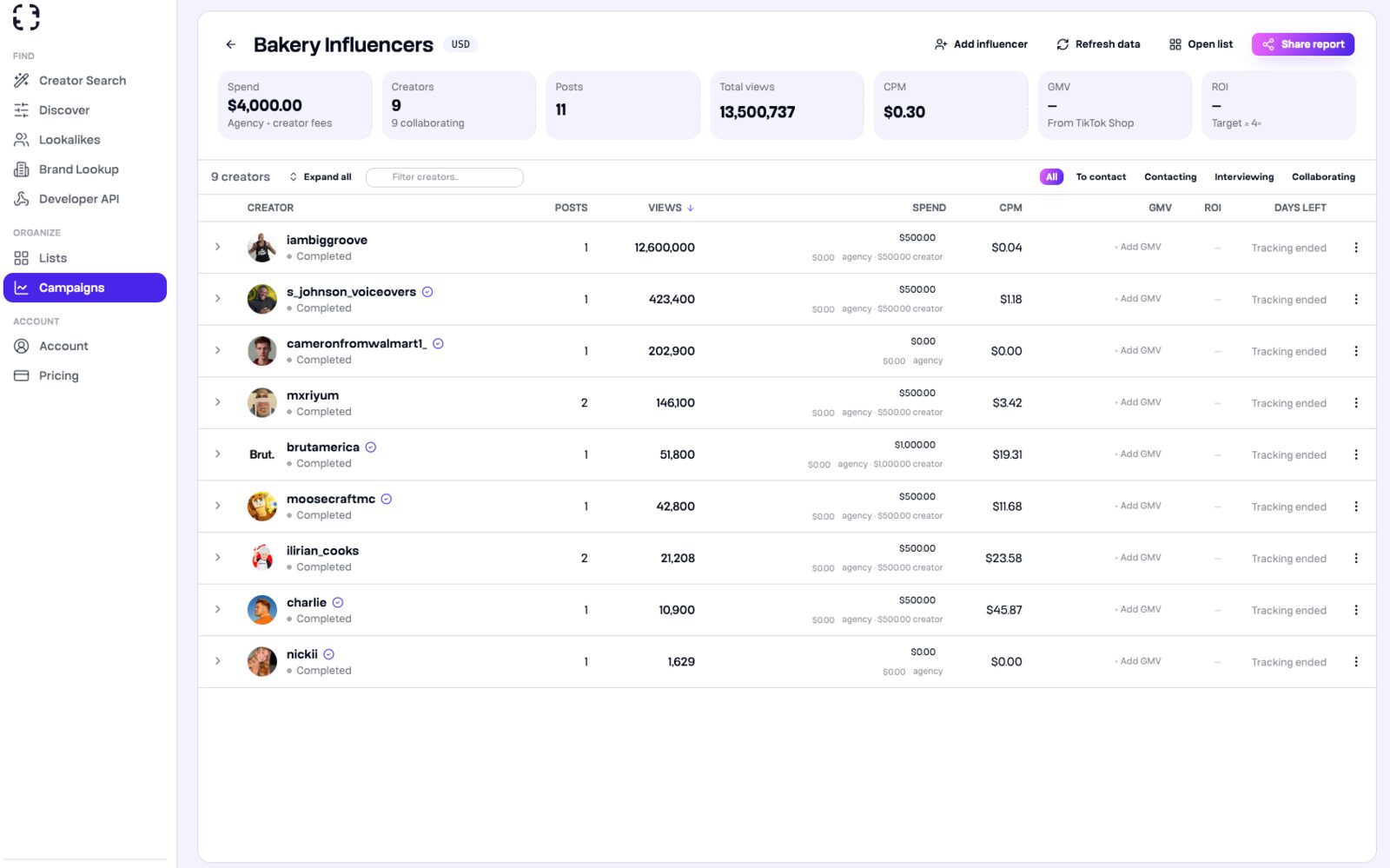
Cost-per-view across a campaign, with each post tracked by URL. The point is comparing creators on the same basis rather than judging videos one at a time.
Give each post at least 72 hours before judging it. TikTok in particular pushes content unevenly, and videos that look flat on day one sometimes find an audience on day three.
Step 6: Read the results honestly
Three questions, a week after the last post:
- Did the creative work? Look at watch time and comments, not just views. A video with 40,000 views and no comments reached people who did not care.
- Did the channel work? Compare the cost per view or per click against your other channels. If it is competitive at this small scale, it usually improves with volume.
- Which creators would you book again? This is the real output of a first campaign. You are not buying views, you are building a list of people who deliver.
Then do it again with the three who worked and five new ones. Influencer marketing compounds through relationships, and the second campaign is nearly always cheaper and better than the first.
What to skip on your first campaign
- Exclusivity clauses. They raise rates and you do not need them yet.
- Long usage-rights windows. Buy 90 days, extend later on the videos that performed.
- Complex multi-post deals. One video per creator, so you can compare like with like.
- Agencies. At this budget the fee is a large share of the spend. If you want the finding done for you without an agency retainer, an outreach service is the cheaper middle ground.
- Chasing large creators. Slower, pricier, and no more likely to work.
How long does a first influencer campaign take?
About four weeks, if nothing goes wrong:
| Week | What happens |
|---|---|
| 1 | Set the goal and tracking, build a shortlist of 30, start outreach |
| 2 | Replies come in, agree rates and deliverables, send briefs |
| 3 | Creators film and post, you review one round of drafts |
| 4 | Posts settle, results come in, decide who to rebook |
The two things that stretch it are outreach, because replies trickle, and creators who go quiet after agreeing. Building a shortlist three times larger than you need absorbs both.
Start smaller than feels serious. A first campaign's job is to teach you what your audience responds to, and you learn that just as well from eight small creators as from a launch you cannot afford to repeat.