
Upfluence pricing in 2026: what it really costs
Upfluence publishes no price at all. Not a starting figure, not a plan comparison, not a range. Everything below is either quoted from their own site or attributed to third-party reporting, and the page says which for every number. The most important thing here is not the price though. It is the term.
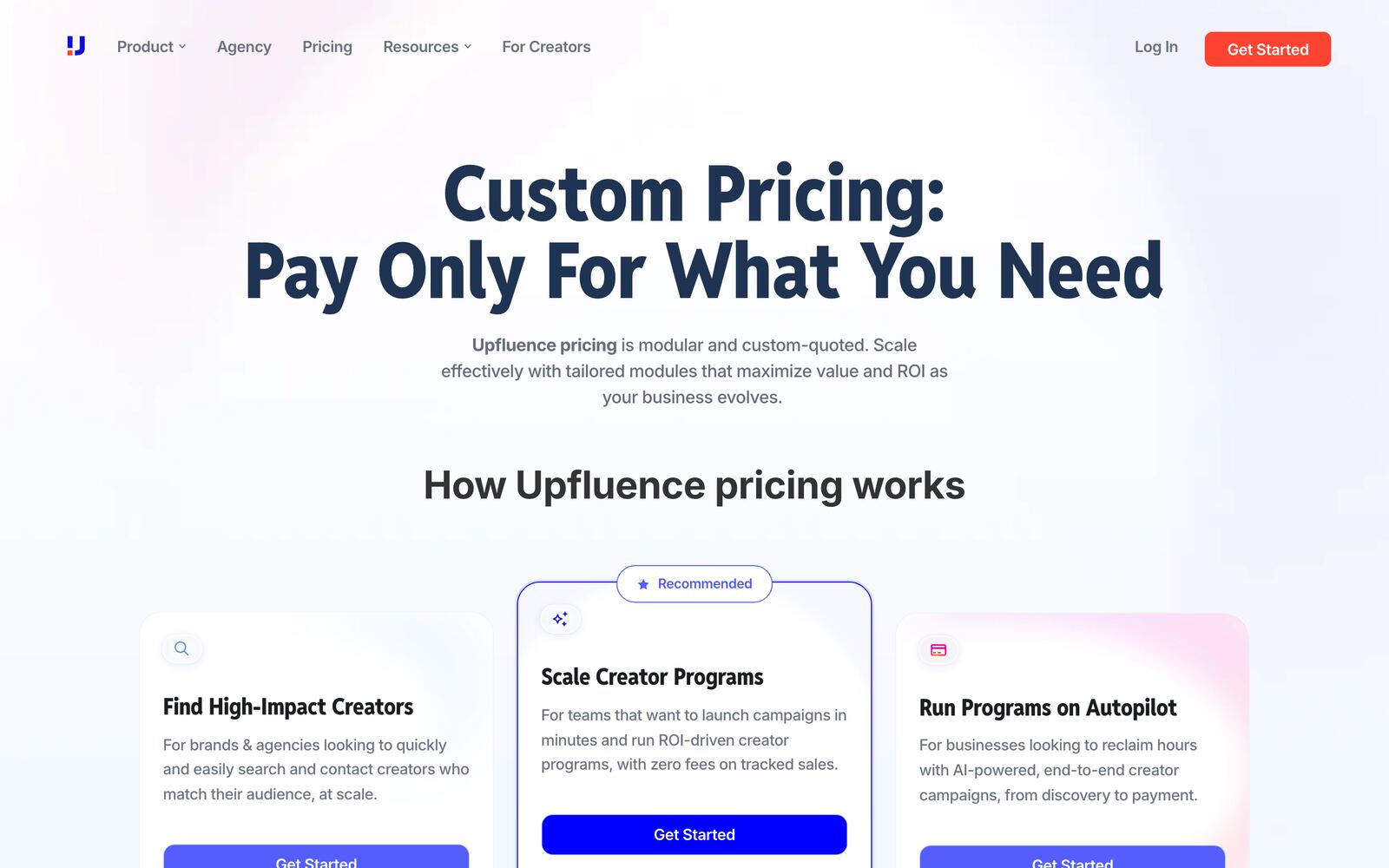
- There is no rate card. Their own pricing page says the model is modular and custom-quoted, and asks you to book a demo.
- The reported figures: around $399 a month per module, and roughly $1,276 a month once you have the modules needed to actually run a campaign.
- The term is the real story. 12-month minimum on annual plans, and buyers repeatedly report not realising that until after signing.
- The quote is not the cost. Extra seats are priced separately and API access is usually an add-on.
- The comparison: $99 a month, published, monthly, with a 3-day free trial you can start before speaking to anyone.
How we put this together
Every figure here is attributed. Where Upfluence states something on its own site it is quoted as such; where a number comes from third-party reporting or from customer reviews, the table says so. We have not been quoted by Upfluence and do not pretend to have been.
Read in September 2026. We build a competing tool, so the comparison near the bottom is informed rather than neutral. The parts above it are their own words and other people's reporting.
What Upfluence actually charges for
Pricing is built from modules rather than tiers. That is the detail that makes quotes hard to compare: a single module sounds affordable, and a single module rarely runs a campaign.
| Component | Reported price | What it covers | Source |
|---|---|---|---|
| Find Creators | Reported ~$399 / month | Discovery and the creator database. The module most buyers think they are buying on its own. | Third-party |
| Scale Programs | Reported ~$399 / month | Outreach, campaign workflow and affiliate management. | Third-party |
| Autopilot | Reported ~$399 / month | Automation across the programme, including recruitment from your own customer base. | Third-party |
| Seats beyond the base | Not published | Extra users are priced separately. Reviewers repeatedly name this as the gap between the quote and the invoice. | Reviews |
| API access | Not published | Typically a paid add-on rather than included. | Reviews |
Not one of these figures comes from Upfluence. That is the point of the table rather than a gap in it.
The 12-month minimum, and why it dominates the reviews
Upfluence rates 4.6 on G2 across 139 reviews and 3.4 on Trustpilot. Software almost never produces a gap that size. Commercial terms do.
The pattern in the low reviews is consistent enough to be worth stating plainly: buyers who believed they were trying the platform, or signing for six months, or paying month to month, discovering a twelve-month commitment with no early exit. Upfluence's own site confirms the 12-month minimum on annual plans, so the term itself is not in dispute. What people dispute is what they understood at the point of sale.
Practical advice, and it applies whoever you buy from: the term lives in the document, not in the call. Read it before you sign, and ask specifically what happens if you want out at month three.

What a first year actually costs
Working from the reported figures: three modules at roughly $399 each is about $1,276 a month, which is around $15,300 over the minimum term, before extra seats and before API access. Third-party reporting puts the first-year range at $5,700 to $21,000 depending on how much of the platform you take.
For a brand running an always-on programme with revenue attribution back to Shopify, that can be perfectly reasonable value. For a team that wanted a creator database, it is a large commitment to make before you have proven the channel works for you. Ours is $1,188 over the same twelve months, and you can stop paying in month two if it is not working.
Upfluence vs Tokfluence on cost
Upfluence figures attributed as above. Ours from our pricing page. Both read in September 2026.
| Upfluence | Tokfluence | |
|---|---|---|
| Published price | None. No rate card, no plan comparison | $99 / month on the website |
| Realistic minimum | Reported ~$1,276 / month across three modules | $99 / month |
| First-year commitment | Reported $5,700 to $21,000+ | $1,188, and cancellable monthly |
| Contract term | 12-month minimum on annual plans | Monthly, cancel in the app |
| Seats | Priced separately, per user | No seat pricing at any size |
| API access | Typically a paid add-on | Self-serve from $49 / month |
| Time to first search | Sales call, then onboarding | Sign up and search |
| Free evaluation | Trial configured after a call | 3-day free trial, no call |
| Verified email reveals | Not published | 10,000 / month |
| Ecommerce revenue attribution | Yes, tied to Shopify and others | No, we export clean data |
| Platforms covered | Multi-platform | TikTok, in depth |
The last two rows are differences rather than defeats: revenue attribution is a real capability we do not have. The feature comparison, rather than the cost one, is on the Upfluence alternatives page, and every competitor we have priced this way is on the platform comparisons hub.
Which should you pay for?
- You have not proven the channel yet: do not commit twelve months to find out.
- You only need discovery: you would be buying a suite to use one module of it.
- You need a number today: ours is on the pricing page, no call.
- Your team will grow: no seat pricing here at any size.
Pay for Upfluence if
- You need creator activity attributed back to ecommerce revenue. That is genuinely their strength.
- You run discovery, outreach, affiliate and reporting as one programme and want one vendor accountable.
- Your programme is large enough that $15,000 a year is a rounding error against creator spend.
- You have negotiated the term, which is where their pricing gets genuinely competitive.
The verdict
Upfluence's pricing is not unreasonable for what it is: an enterprise programme platform with real ecommerce attribution, sold the way enterprise software is usually sold. The problem is the mismatch between that model and the people arriving at it, most of whom wanted a creator database and did not expect a twelve-month signature.
If you need what it does, negotiate the term and buy it. If you mostly need to find and contact creators, $99 a month on a public page, with a 3-day free trial and no contract, answers the same question for about one thirteenth of the commitment.
Frequently asked questions
How much does Upfluence cost?
Upfluence does not publish a price. Their own pricing page describes the model as "modular and custom-quoted", scaled to the modules you pick, your team size and programme volume, and directs you to book a demo. Third-party reporting puts individual modules around $399 a month and a realistic all-modules minimum near $1,276 a month before seats. Read in September 2026; your quote will differ.
Does Upfluence require an annual contract?
Annual plans carry a 12-month minimum, per their own site. This is the single most-cited complaint about the company: buyers on Trustpilot repeatedly describe being sold what they understood as a trial, a six-month deal or month-to-month, then discovering a twelve-month term with no early exit. Whatever you are told verbally, read the term in the document.
Why does Upfluence not publish pricing?
Because the product is modular and priced per programme, which is a normal enterprise model. The practical consequence for a buyer is that you cannot compare Upfluence against anything without booking a call first, and you will usually have spent two or three meetings before you see a number.
Is Upfluence expensive?
Relative to its peers, it is mid-to-high, and the shape matters more than the level. One module sounds reasonable; you generally need more than one to actually run a campaign, extra seats are separate, and API access is usually an add-on. Reviewers consistently report the final figure landing above the initial quote for exactly those reasons.
What is a cheaper Upfluence alternative?
GRIN does the same full-programme job and publishes its pricing: Free, then $200 to $1,500 a month on credits. For discovery alone, Modash is $199 a month and Tokfluence is $99 flat with unlimited search and 10,000 verified reveals. All three bill monthly with no minimum term.