
How to Spot Fake Followers Before You Pay a Creator
Most fake follower checkers stop at a score, and some skip TikTok. Here is a two-minute manual check, the normal views-to-followers range by tier, and an honest tool table.
TL;DR
- The quick check: divide a creator's average views per video by their followers, then read the comments, the follower history and a TikTok Studio screenshot of audience location. Two minutes, no tool needed.
- What normal looks like: in 756 active TikTok skincare creators, the median creator got views equal to 12.1% of followers at nano level and 2.3% at mega. A creator below the bottom-quarter line for their tier is worth questioning.
- Engagement rate alone misses it: 55% of the creators in our sample had an engagement rate under 5%, and 44% of the creators with the weakest views still had an engagement rate of 5% or more.
- The tools: free checkers from Heepsy and HypeAuditor give TikTok a score. Modash's fake follower data covers Instagram only, by its own help centre. Tokfluence shows average views next to followers across its TikTok index, with a full audience report when you need one.
- The caveat: weak views are not proof of fake followers. They prove the follower count is not the reach you would be paying for, which is the part that matters before you pay.
Fake followers matter for one reason: a brand that pays by follower count pays for an audience that will never see the video. The good news is that you do not need a tool to catch most of it. This guide starts with a manual check anyone can run in two minutes, gives you a "normal" range to compare against, measured from our own creator index, then compares the fake follower checkers honestly, including where each one falls short on TikTok.
How do you spot fake followers on TikTok in two minutes?
Open the creator's profile and run five checks: views against followers, engagement, comment quality, follower growth, and audience location. The first three take a minute on the public profile. The last two need a question to the creator.
| # | Check | Where to look | What a real audience looks like | Red flag |
|---|---|---|---|---|
| 1 | Views vs followers | View counts on the last 10 to 20 non-pinned videos | Average views inside the normal range for the tier (table below) | Views far below the tier's bottom-quarter line |
| 2 | Engagement | Likes, comments and shares on the same videos | Engagement that rises and falls with views | High likes on very low views, or identical numbers video after video |
| 3 | Comment quality | Open the comments on three recent videos | Comments that react to what was said in the video | "Nice", "🔥🔥🔥", or the same short phrase from accounts with no profile picture |
| 4 | Follower growth | A follower history from an audience report or tracker, or ask the creator | Steady growth, or jumps that line up with a viral video | A jump of thousands with no video behind it, or a sudden drop |
| 5 | Audience location | A TikTok Studio screenshot of the Followers or Viewers tab | Your target country with a meaningful share, dated | Top countries that do not match the creator's language or market |
A few notes on each:
- Views vs followers is the fastest test. On TikTok most views come from the For You feed, so a real follower count and a creator's views are loosely linked at best. But an account with 400,000 followers and 900 views a video is not reaching most of those followers, whatever the reason.
- Engagement can be bought too. Likes and views are sold alongside followers. What is hard to fake is the pattern: real engagement moves with the content. A creator whose every video gets almost exactly the same likes regardless of views is worth a closer look.
- Comments are the hardest thing to fake well. Bot comments are short, generic and interchangeable. Real comments mention the product, the joke or the routine in the video. Scroll past the first few, which creators can pin.
- A follower drop can be a fake follower signal. TikTok says that "if we detect accounts or content with inauthentic metrics, we'll remove fake likes, followers, or other inflated signals" (TikTok Community Guidelines). A creator who lost a large share of followers overnight may have been cleaned up.
- Audience location can only come from the creator. TikTok shows a creator their audience's top locations in TikTok Studio, and labels those demographics as estimates (TikTok Creator Academy). Ask for a dated screenshot. An outside tool can estimate it; only TikTok actually knows.
If you are reading a creator's pitch deck rather than their profile, our guide to reading an influencer media kit covers which of its numbers to trust and which to check this way.
What is a normal views-to-followers ratio on TikTok?
For an active creator, average views per video usually land somewhere between a few percent and a quarter of the follower count, and the share falls as accounts grow. We measured the normal range in one niche, skincare, so you have something concrete to compare against:
| Tier | Creators in sample | Median followers | Bottom 10% | Bottom quarter | Median | Top quarter |
|---|---|---|---|---|---|---|
| Nano (1k to 10k) | 114 | 5,910 | 3.7% | 6.4% | 12.1% | 26.5% |
| Micro (10k to 50k) | 134 | 24,450 | 1.2% | 2.0% | 6.1% | 21.7% |
| Mid-tier (50k to 250k) | 155 | 156,700 | 0.7% | 1.4% | 4.7% | 15.7% |
| Macro (250k to 1M) | 178 | 456,900 | 0.2% | 1.0% | 4.0% | 13.1% |
| Mega (1M+) | 175 | 1,600,000 | 0.2% | 0.6% | 2.3% | 9.7% |
Average views per video as a share of followers. Measured: Tokfluence creator index, 16 October 2026, 756 active individual TikTok skincare creators. Method at the end of the article.
How to use it: divide the creator's average views by their followers and find their tier.
- Inside the middle band (bottom quarter to top quarter): normal. Move on to the other checks.
- Below the bottom quarter: ask questions. Is the account older, did the creator change niche, or did growth come from one viral video years ago?
- Below the bottom 10%: treat the follower count as close to meaningless for pricing, and price the deal on views instead.
A worked example: a skincare creator with 40,000 followers is micro tier. The median in our sample would put them at about 2,440 views a video (40,000 x 6.1%). If they average 600 views, that is 1.5%, below the micro bottom-quarter line of 2.0%. That is not proof of anything, but it is a reason to ask before you pay a follower-based rate.
The share of creators below a simple 2% line grows steadily with tier:
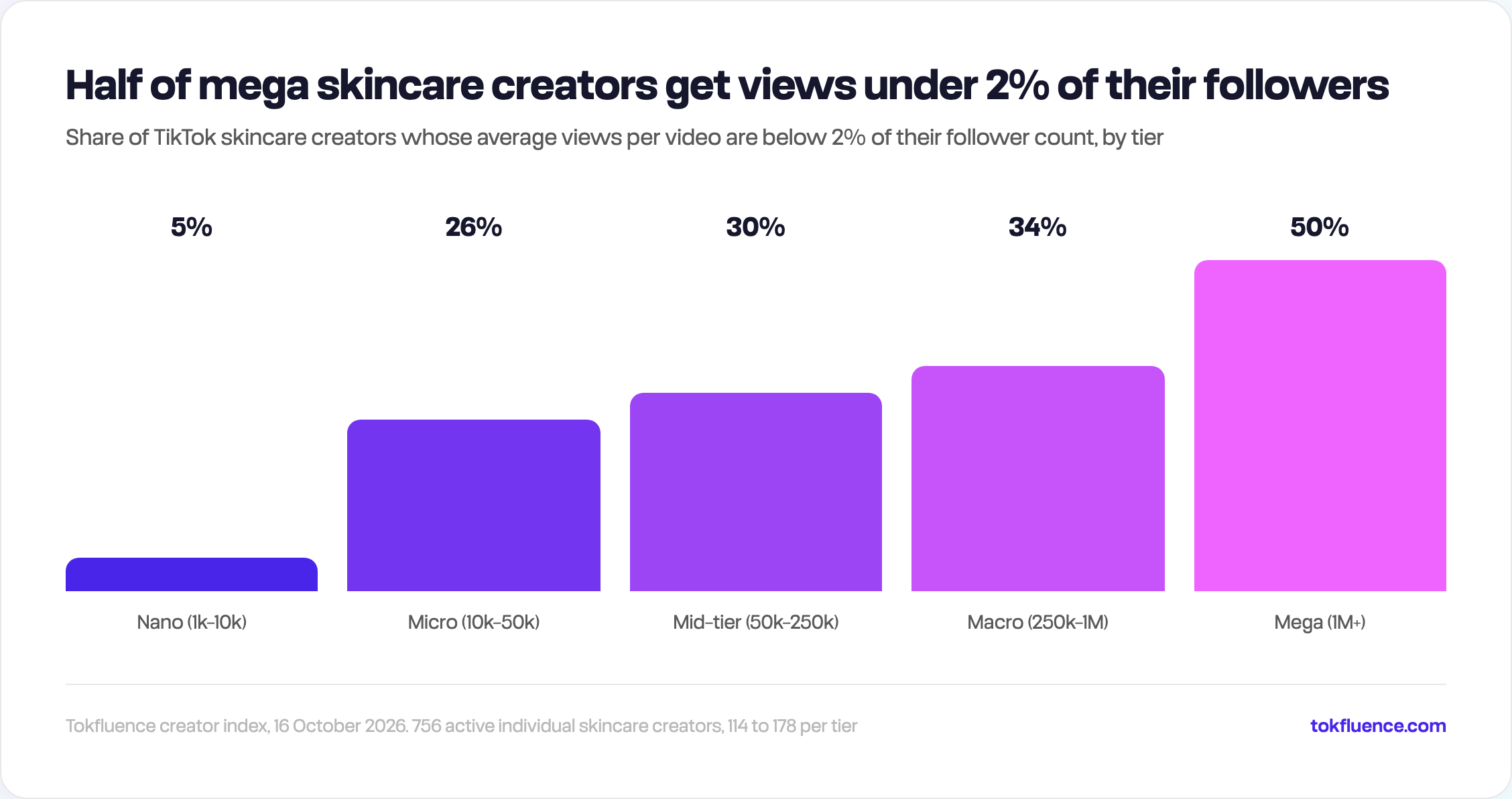
Measured: Tokfluence creator index, 16 October 2026, 114 to 178 active skincare creators per tier.
Half of the mega creators in the sample average views under 2% of their followers. Large accounts collect followers over years, and many of those people stop watching, so a low ratio at mega size is common and not suspicious on its own. At nano size it is rare: only 5% of nano skincare creators sit below 2%, so a small creator that low stands out.
The opposite also happens. Some small creators average more views than they have followers, because the For You feed reaches people who do not follow them. That is normal on TikTok, not a sign of bought views.
These ranges are for skincare. Our cross-niche sample in the creator rates by tier article found similar medians (14.5% at nano down to 2.5% at mega), but niches differ: recipes creators in another sample of ours got about twice the views per follower of fitness creators the same size. Compare a creator against their own niche when you can.
Is a low engagement rate a sign of fake followers?
Not on its own, and a high one does not clear a creator either. Engagement rate is the check most fake follower guides lead with, and on TikTok it is the weakest of the five.
HypeAuditor's free TikTok audit page says that "if a micro-influencer has unusually low ER, for example, less than 5% that is suspicious" (HypeAuditor). In our skincare sample, 55% of the creators with an engagement rate on record were under 5%, and among micro creators it was 61%. A 5% line would flag most ordinary creators in this niche. Engagement rate formulas differ between tools, so treat the comparison as indicative, but the point stands: a fixed threshold does not work across niches.
And the other direction: among the creators whose views were in the bottom 10% for their tier, 34 of 78 (44%) still had an engagement rate of 5% or more. A healthy-looking engagement rate sat on top of very weak reach for almost half of them. That is why views per video comes first in the checklist above.
To be fair to HypeAuditor, its Audience Quality Score does not rely on engagement alone: it combines "engagement rate, views spread, views to followers ratio, followers growth" (same page). That is close to the manual check in this guide, done for you.
Which fake follower checker should you use for TikTok?
Use a free checker for a quick score on one creator, and a creator database when you are vetting a shortlist. The catch is that several well-known checkers do less on TikTok than their names suggest:
| Tool | Works on TikTok? | What you get | Cost, as published | Pick it if | Skip it if |
|---|---|---|---|---|---|
| Tokfluence | Yes | Followers, average views, engagement rate and posting frequency for every creator, plus a full audience analysis report with fake-follower detection and follower growth, on demand | Pro $99 a month, 10,000 email reveals a month; audience reports on request | You are comparing many TikTok creators in a niche | You need deep Instagram audience analysis |
| The manual check (this guide) | Yes | The five checks above | Free | You are vetting one to five creators | You are vetting fifty |
| Heepsy free checker | Yes | An "Estimated Fake followers" percentage plus warning signals, no signup | Free; full report needs an account | You want a second opinion on one handle | You need the method behind the number |
| HypeAuditor free TikTok audit | Yes | Audience Quality Score (0 to 100), engagement rate, basic report | Free to start; paid plans from $299 a month billed annually (our HypeAuditor pricing breakdown) | You want a single score built from views, engagement and growth | You need to search for creators on a small budget |
| Modash fake follower checker | No, Instagram only | Fake follower percentage and audience type breakdown | Free checker; paid plans from $199 a month for 300 opened profiles (Modash pricing) | Your campaigns run on Instagram | You are vetting TikTok creators: Modash says fake follower detection and credibility scores are "currently available for Instagram only" (Modash help centre) |
| TikTok Studio screenshot | Yes | The creator's own audience location, age and gender | Free, ask the creator | You need audience location for a one-country campaign | Never skip it for a big fee |
On price, like for like per profile: Modash Essentials is $199 for 300 opened profiles, or $0.66 a profile ($199 / 300). Tokfluence Pro is $99 a month and includes 10,000 email reveals a month. A Modash opened profile includes its audience data, so the fairer comparison for a deep check is a Tokfluence audience report, at $1 to $3 a report depending on the pack (pack prices). For most creators on a shortlist, the views-to-followers check on the profile is enough, and you only buy a report for the few you are about to pay.
What no tool can do is see inside a creator's TikTok account. Every outside checker estimates from public data. That makes the free ones useful as a second opinion and dangerous as a verdict.
How do you check creators for fake followers in Tokfluence?
Search the niche, and every creator card shows followers, average views and engagement rate side by side, so the views-to-followers check from this guide takes a glance instead of a calculator. The numbers above come from the same data.
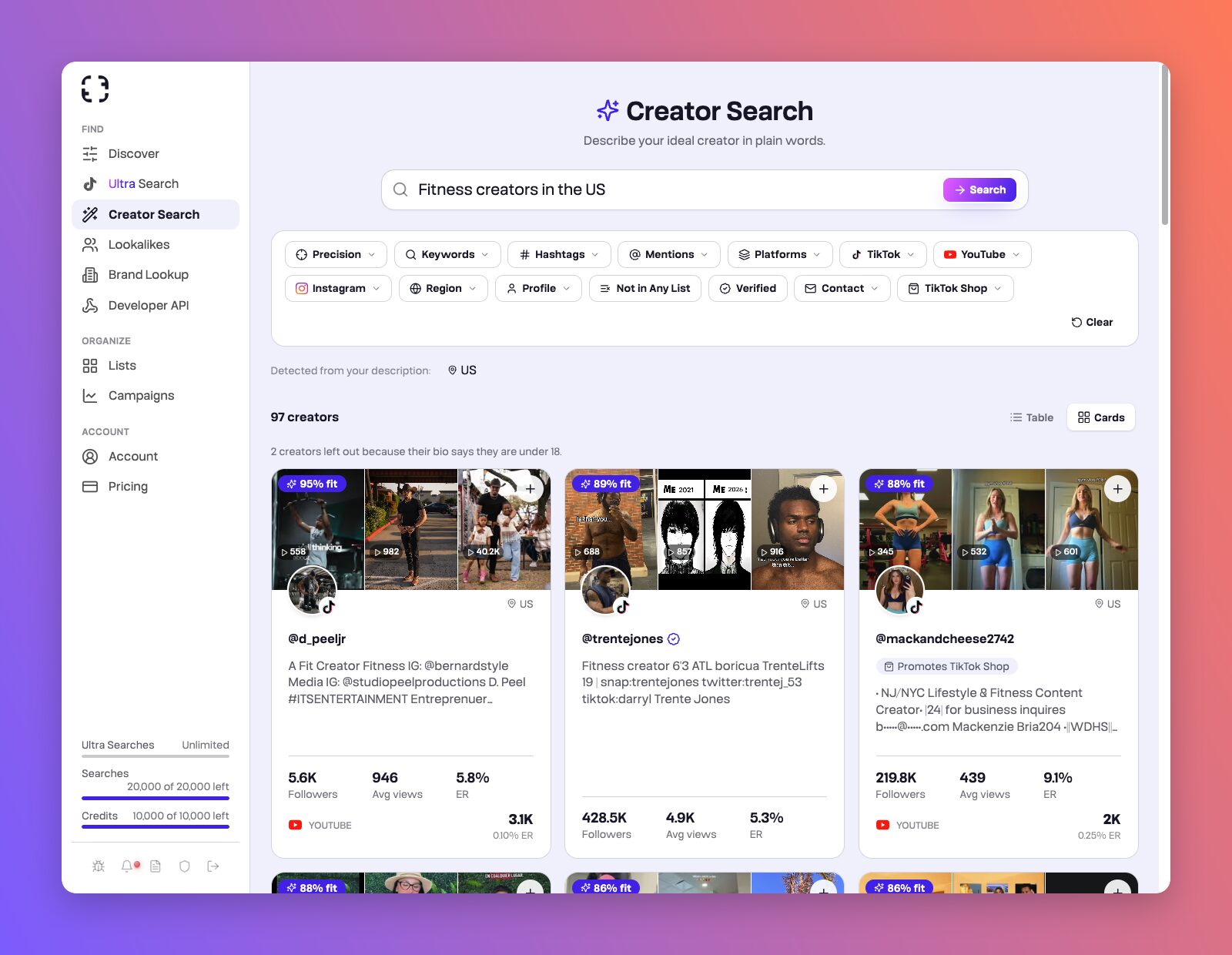
- Search the niche, not just the creator. Describe who you want in plain words, or search a keyword or hashtag, and set the follower range for the tier you can afford.
- Sort by average views. Creators with strong views for their size rise to the top, and the ones whose follower counts are not backed by views drop out of your way.
- Compare against the tier. Divide average views by followers for anyone you are about to pay, and check it against the table above.
- Request an audience report on the finalists. The audience analysis report, available on demand, adds fake-follower detection, follower growth and audience demographics for the few creators you are about to book.
- Save and share the shortlist. Add the creators who pass to a list and share it by link with whoever approves the budget. Tokfluence shows contact details where creators publish them, and you can filter for creators who list an email.
The bigger win is not checking one suspicious creator, it is starting from a pool where you can see real reach before anyone pitches you. If a niche looks thin, on Pro the Tokfluence MCP server can start a live TikTok crawl from a chat with an AI assistant for 250 credits, and the new creators become searchable a few hours later. No static database can fill a gap on request like that.
On price, one credit is one creator profile. Pro is $99 a month and includes 10,000 email reveals a month, plus 20,000 searches. Existing Agency subscriptions are a legacy plan and are not offered to new customers. There is a free plan with no card; you add a card only at checkout (pricing). Discovery Service is a legacy plan and is not offered to new customers.
Pick something else if you need deep Instagram audience analysis: Tokfluence's audience reports are for TikTok, and for Instagram, Modash's free checker is the better first stop.
What should you do if a creator fails the check?
Ask before you walk away. Most creators with weak views are not buying followers; their audience has gone quiet. The question is what you will pay for, not whether to accuse anyone.
- Ask for proof. A dated TikTok Studio screenshot of views over the last 28 days and audience location answers most doubts in one message.
- Price on views, not followers. If the reach is real but small, offer a rate based on the views they actually get. Our TikTok creator rates by tier article has cost-per-view benchmarks to anchor the offer.
- Pay part on results. A lower flat fee plus a bonus above a view threshold protects you without insulting anyone.
- Walk away from clear fakes. Generic comments, a follower spike with no video behind it and views far below the bottom 10% line together are a pattern, not bad luck. Buying fake followers to misrepresent influence is also now banned in the US: the FTC's rule, in force since October 2024, "prohibits anyone from selling or buying fake indicators of social media influence, such as followers or views generated by a bot or hijacked account" (FTC).
If you are about to contact the creators who passed, our influencer outreach guide has short first-message templates.
How we got these numbers
Measured figures come from the Tokfluence creator index, queried on 16 October 2026. We searched the keyword "skincare" in five follower bands (1,000 to 10,000; 10,000 to 50,000; 50,000 to 250,000; 250,000 to 1,000,000; over 1,000,000), individual accounts only (no brand accounts), last analysed within 180 days, and read the first 200 relevance-ranked creators in each band. We kept creators posting at least roughly once a month (0.25 posts a week or more) with a recorded average views figure, which left 756 of 998. Views-to-followers is average views per video divided by followers. We report percentiles because the ratio has a long right tail. Engagement rate is as recorded in our index; 748 of the 756 had one.
What this does not prove:
- Our index is not all of TikTok. It is a large sample of creators with 1,000+ followers, not a census, and these are the top of a relevance-ranked search, not a random draw.
- One niche. Skincare only, no region filter, so the sample mixes countries. Other niches will differ.
- We did not detect fake followers. These are reach ratios. A creator below the normal range may have fake followers, an inactive audience, or simply a slow month.
- Averages cover recent videos. One viral video can lift an average, and pinned videos can mislead if you count by hand.
Sources
- TikTok, Community Guidelines: Integrity and authenticity, read October 2026.
- TikTok, Creator Academy: analytics, read October 2026.
- HypeAuditor, Free TikTok audit, read 16 October 2026.
- Heepsy, Free TikTok fake follower checker, read 16 October 2026.
- Modash, Fake follower check, Fake followers 101 (help centre) and pricing, read 16 October 2026.
- US Federal Trade Commission, final rule banning fake reviews and testimonials, August 2024.
- Tokfluence, pricing and audience analysis, read 16 October 2026.