
What TikTok Creators Actually Charge, by Follower Tier
Published rate cards say what creators ask. We measured how many views each tier actually gets, so you can see what those rates cost per 1,000 views.
TL;DR
- The published rate card: roughly $50 to $200 per TikTok video for nano creators, $200 to $1,000 for micro, $800 to $5,000 for mid-tier, $800 to $10,000 for macro and $5,000 to $50,000+ for mega, from Influencer Marketing Hub and Modash's 2026 guides.
- What clears in practice is lower: on Collabstr's marketplace the average paid TikTok collaboration was $186, and nearly 80% of all collaborations cost under $300.
- Our measurement: across 1,542 active creators in our index, median views per video run from 553 (nano) to 75,200 (mega). At the cheapest published rate, that works out to $43 to $165 per 1,000 views.
- The fix is picking by views, not followers: creators in the top quarter of their tier for views bring the same rates down to $11 to $43 per 1,000 views.
- Add-ons move the price most: paid usage rights, whitelisting and exclusivity can add 15% to 300% to the base fee, so agree them before you agree a number.
Every brand asks the same first question about TikTok creators: what will this cost? Most answers are a rate card with no source, or a range so wide it is useless.
This article does two things differently. It puts the published rate cards side by side with their sources, and then it checks them against something we can measure: how many views creators in each tier actually get per video. Rate divided by views is the number that tells you whether a price is fair.
We are explicit throughout about which numbers are sourced (someone else published them), measured (we pulled them from our own index) and estimated (our arithmetic on the two).
How much do TikTok influencers charge per video?
Between $50 and $50,000+, depending on tier, with most small-creator deals landing under $300. Here are the two most recent published rate cards, using the tier bands from our influencer tiers breakdown:
| Tier | Followers | Influencer Marketing Hub (Aug 2026) | Modash (Oct 2026) |
|---|---|---|---|
| Nano | 1,000 to 10,000 | $50 to $200 | $50 to $200 |
| Micro | 10,000 to 50,000 | $200 to $800 (their band runs to 100k) | $200 to $1,000 (to 100k) |
| Mid-tier | 50,000 to 250,000 | $200 to $800 below 100k, $800 to $5,000 above | $200 to $1,000 below 100k, $1,000 to $5,000 above |
| Macro | 250,000 to 1,000,000 | $800 to $5,000 | $1,000 to $5,000 up to 500k, $5,000 to $10,000 above |
| Mega | 1,000,000+ | $5,000 to $50,000+ | More than $10,000 |
Sourced. Neither publisher discloses a sample or method. Modash describes its figures as "ballpark prices based on creators in North America".
The two cards agree on nano and roughly on micro, then drift apart. At macro they differ by up to 2x, because one card treats 100k to 1M as a single band and the other splits it at 500k. That alone should tell you how much weight a published rate card can bear.
What do brands actually pay?
Less than the rate cards suggest, at least on self-serve marketplaces. Collabstr's 2026 report, covering more than 21,000 collaborations and 200,000 creators on its own platform, found:
- $186: the average paid TikTok collaboration.
- Nearly 80% of all collaborations, across platforms, cost under $300. Another 18% fell between $301 and $1,000, and only 2% went above $1,000.
- TikTok's share fell from 41% to 21% of collaborations, while UGC work grew 133%.
Sourced: Collabstr 2026 Influencer Marketing Report, figures as reported by Net Influencer, January 2026.
A marketplace skews towards smaller creators who list themselves, so $186 is not a mega-creator price. But it is the best public evidence of what changes hands, rather than what gets asked. Treat a rate card as the opening position and a marketplace payout as closer to the clearing price.
How many views does a creator in each tier actually get?
Far fewer than their follower count implies. We sampled 2,082 individual creator accounts from our index across all five tiers, kept the 1,542 that posted at least about once a month and had view data, and read their average views per video:
| Tier | Median followers in sample | Median views per video | Middle 50% of creators | Views as a share of followers (median) |
|---|---|---|---|---|
| Nano | 5,604 | 553 | 279 to 1,160 | 14.5% |
| Micro | 25,500 | 1,573 | 537 to 6,493 | 7.5% |
| Mid-tier | 111,450 | 4,847 | 1,761 to 19,112 | 4.3% |
| Macro | 563,950 | 18,775 | 5,157 to 73,075 | 3.0% |
| Mega | 2,500,000 | 75,200 | 16,825 to 291,450 | 2.5% |
Measured: Tokfluence creator index, 16 October 2026. Method at the end of the article.
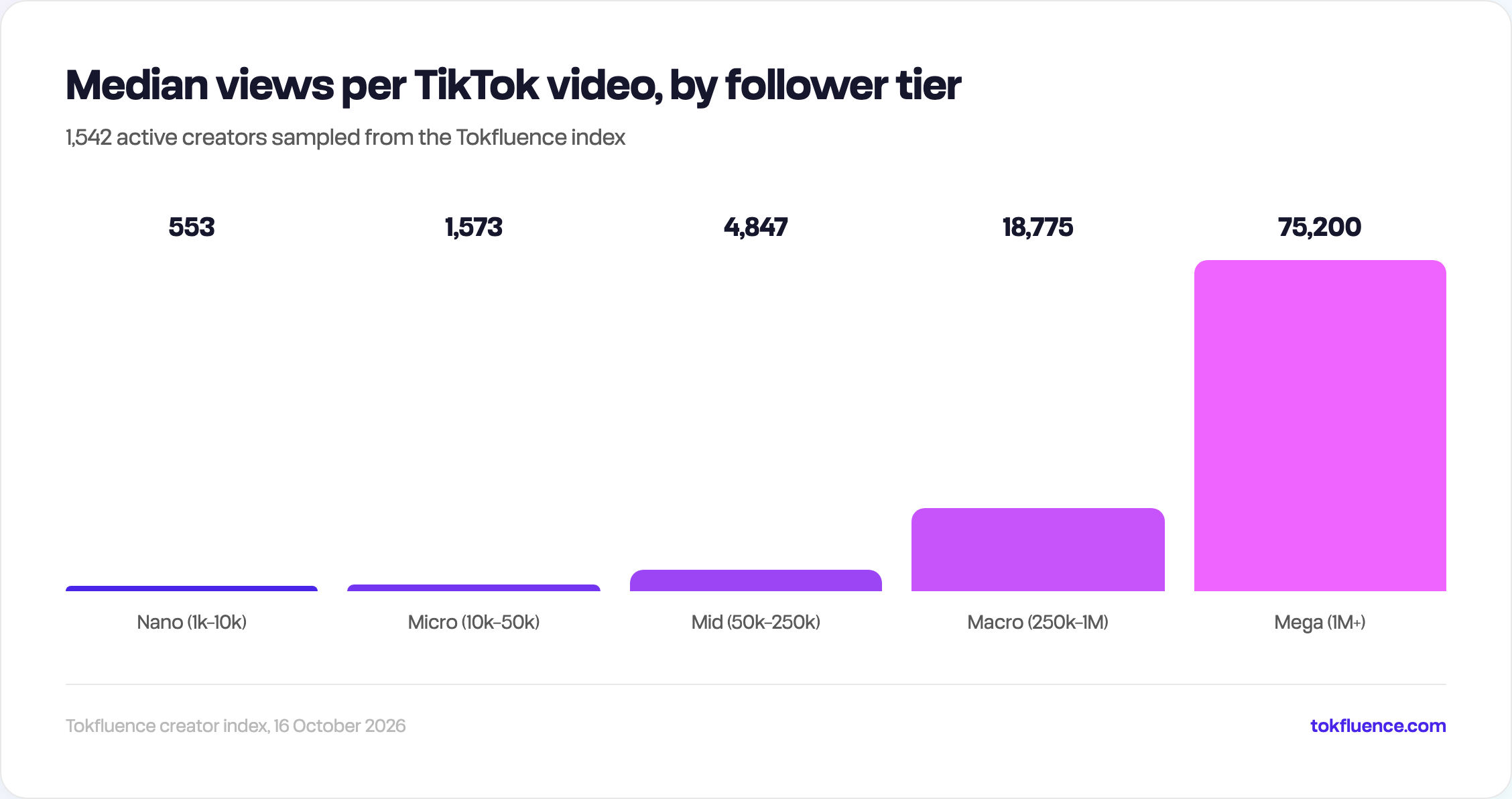
Median views per video rise with tier, but much more slowly than followers do.
Two things stand out. First, the spread inside each tier is enormous: the top quarter of micro creators gets more than 12 times the views of the bottom quarter. Second, views as a share of followers fall steadily as accounts grow, from about one in seven at nano to one in forty at mega. A follower count is a history of past hits. Views per video is what you are actually buying.
What is a fair cost per view on TikTok?
Divide the rate by the views. At the low end of the published ranges, a creator with median views in their tier costs between $43 and $165 per 1,000 views:
| Tier | Cheapest published rate | Median views | Cost per 1,000 views | Same rate, top-quarter creator |
|---|---|---|---|---|
| Nano | $50 | 553 | $50 / 0.553 = $90 | $50 / 1.160 = $43 |
| Micro | $200 | 1,573 | $200 / 1.573 = $127 | $200 / 6.493 = $31 |
| Mid-tier | $800 | 4,847 | $800 / 4.847 = $165 | $800 / 19.112 = $42 |
| Macro | $800 | 18,775 | $800 / 18.775 = $43 | $800 / 73.075 = $11 |
| Mega | $5,000 | 75,200 | $5,000 / 75.2 = $66 | $5,000 / 291.45 = $17 |
Estimated: sourced rates divided by measured views. "Top-quarter creator" means the 75th percentile for views in that tier. Mid-tier uses $800, not $200, because the median mid-tier creator in our sample (111,450 followers) sits above the 100,000 break where both rate cards step up.
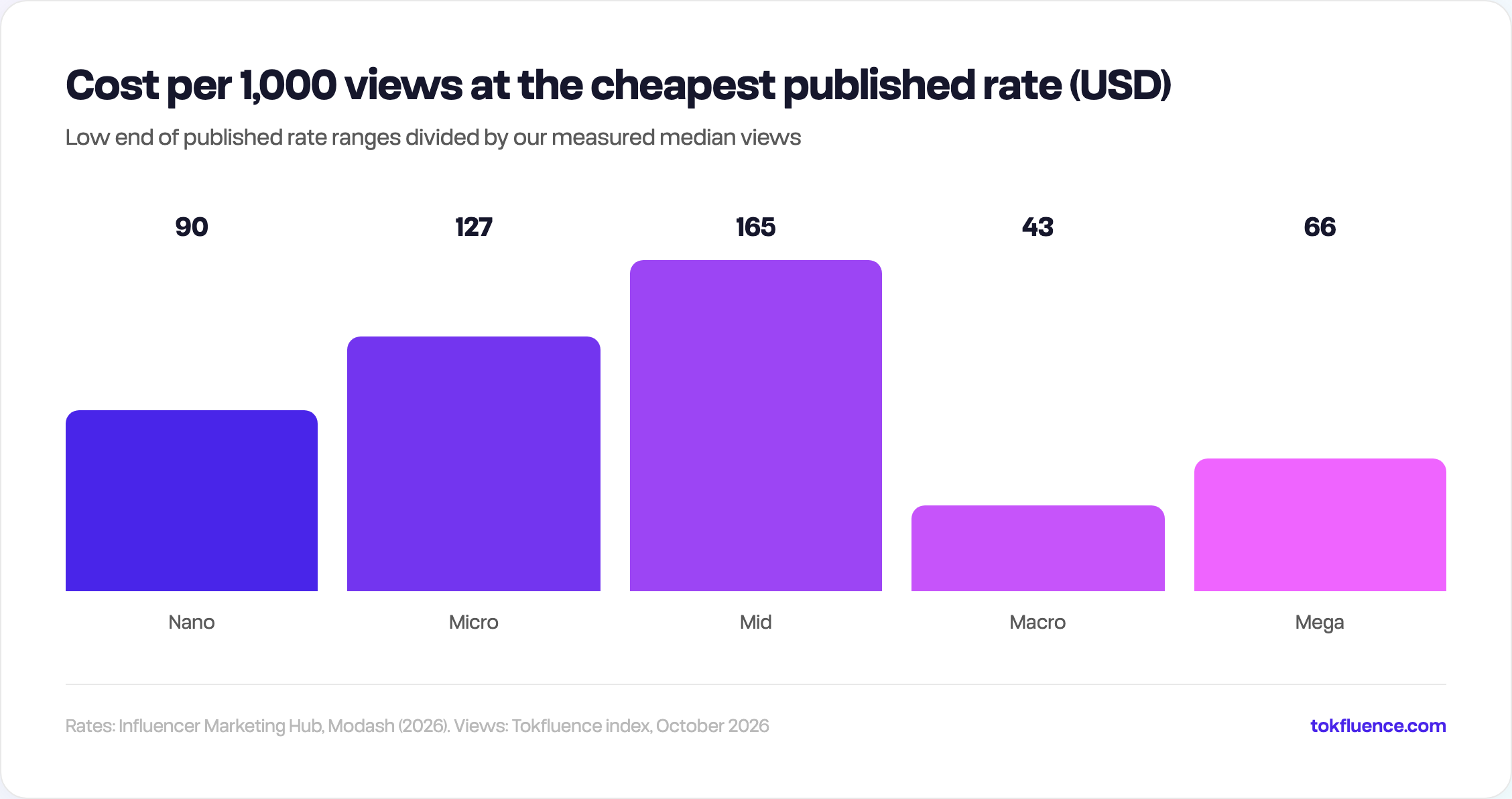
At published rates, a median creator in any tier is expensive per view. The gap closes once you pick for views.
For a sense of scale, one brand-side practitioner quoted by Modash uses a CPM (cost per 1,000 views) of "a maximum of $20" as a guide. That is one person's rule, not a market standard, but it is a useful yardstick: a median creator at the cheapest published rate is 2 to 8 times above it, and a top-quarter creator lands close to it.
The honest reading is not that creators overcharge. It is that a rate card priced on followers is mispriced for most of the creators in the tier, in both directions. The creators whose views beat their tier are the bargains, and the ones whose views lag are where budgets disappear.
What should you offer a creator, then?
Work backwards from views. Pick the cost per 1,000 views you are willing to pay, then multiply by the creator's average views:
Offer = average views per video × your target cost per 1,000 views ÷ 1,000
At a $20 target, here is what each tier's views justify:
| Tier | Median creator | Top-quarter creator |
|---|---|---|
| Nano | 553 × $20 / 1,000 = $11 | 1,160 × $20 / 1,000 = $23 |
| Micro | $31 | $130 |
| Mid-tier | $97 | $382 |
| Macro | $376 | $1,462 |
| Mega | $1,504 | $5,829 |
Estimated, using our measured views and a $20 target. Swap in your own target; a brand selling a $200 product can afford a higher one than a brand selling a $15 one.
This explains a pattern every brand runs into. At nano size, the views rarely justify a cash fee, which is why so many nano deals are product-only or a small flat fee. At micro and above, a creator in the top quarter of their tier can justify a rate inside the published range. The median creator usually cannot.
Views are not the only thing you are paying for. A creator who films well, writes their own hook and delivers on time saves you real money, and a creator whose audience matches your buyer is worth more per view than one whose audience does not. Use the formula to set the opening number, then adjust for those.
What changes the price of a TikTok creator?
The base rate covers one video, posted once, used organically. Anything beyond that is extra, and the extras can cost more than the video:
| Add-on | What it means | Typical premium on the base fee |
|---|---|---|
| Organic reposting | You share the video on your own channels for 30 to 90 days | 0% to 15%, often included |
| Paid usage rights | You run the video as an ad | 15% to 30% per 30 days; 70% to 100% for 12 months |
| Whitelisting (Spark Ads on TikTok) | You run ads through the creator's own account | 30% to 60% per 30 days on TikTok |
| Category exclusivity | The creator agrees not to work with competitors | 15% to 30% of deal value for 30 days, 25% to 50% for 90 days |
| Perpetual buyout | You own the content for every channel, forever | 150% to 300% |
Sourced: Gigapay, October 2026, which compiles benchmarks from UGC Bloom, InfluencerFee, CreatoHunt and Influencer Marketing Hub. These are compiled guidance, not transaction data.
A worked example: a micro creator quotes $400 for one video. You want to run it as a Spark Ad for 30 days (30% to 60%, so $120 to $240) with 30 days of category exclusivity (15% to 30% of deal value). The deal ends up somewhere around $600 to $830, before you have spent a cent on the ads themselves. Agree the licence term, channels and exclusivity window in writing before you agree a price, not after the video is filmed. Whitelisting has its own trade-offs beyond price, covered in our influencer whitelisting explainer.
The other things that move a quote:
- Deliverables. Three hook variations, raw footage or a second post each add to the price. Ask what the base rate includes.
- Country. Modash says its card reflects North American creators. Expect quotes elsewhere to differ, and judge them on views the same way.
- Management. A represented creator's quote goes through their manager, which adds a step to every change in scope. Check whether the contact in the bio is the creator or an agency before you send numbers.
How do you find creators whose views beat their tier?
Filter and sort on average views, not followers. In Tokfluence every creator profile shows average views per video next to followers and engagement rate, and you can set a minimum average views filter or sort a whole search by views. That turns the table above into a shortlist: search your niche, set the follower band you can afford, then keep only creators above that tier's median views.
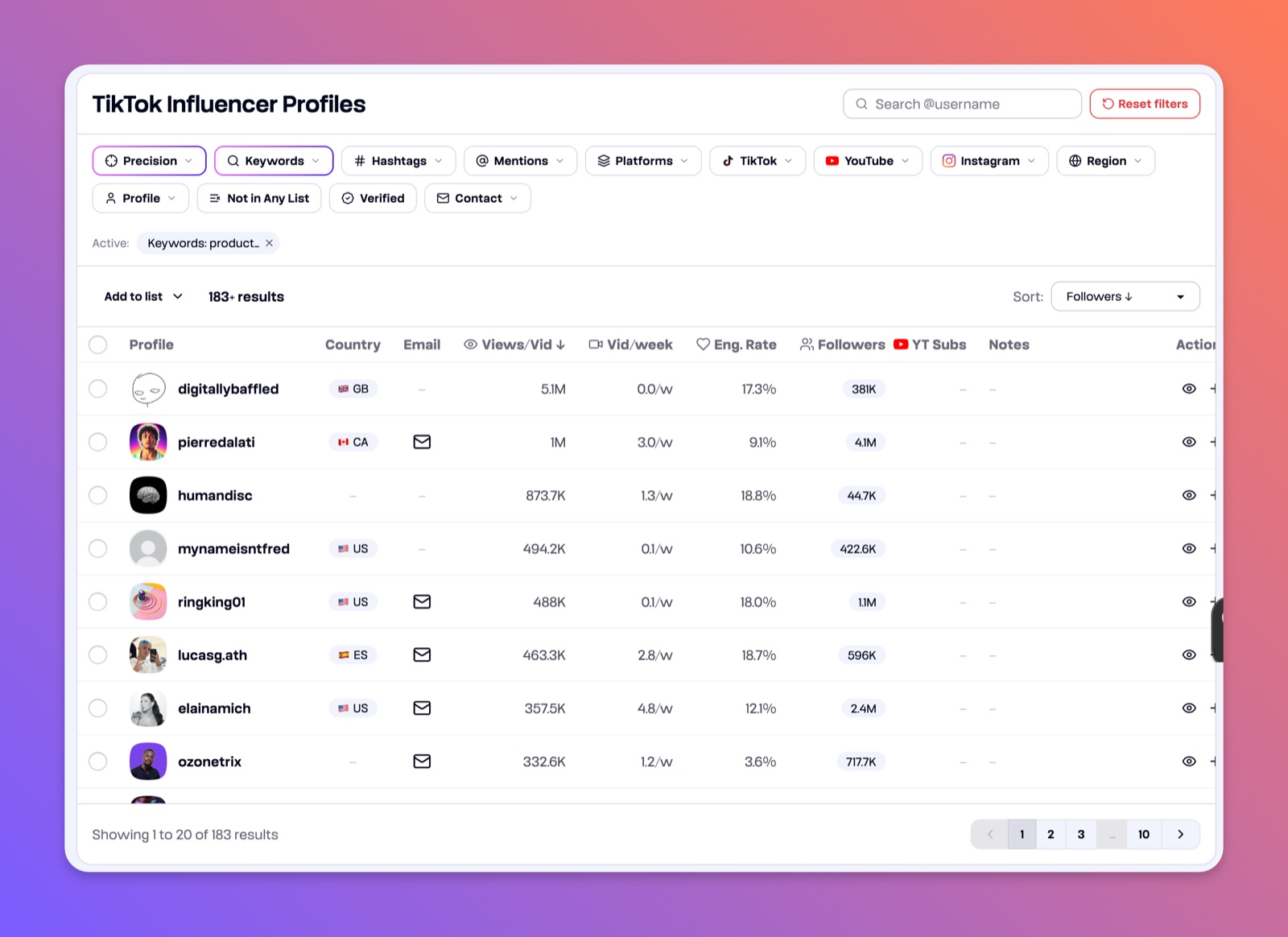
Views per video sits beside follower count on every row, so the creators who beat their tier are visible before you open a profile.
A few ways to do it, depending on how you work:
- In the dashboard. Search TikTok creators by keyword, follower band, minimum average views and region, save the keepers to a list and export them with their contact email.
- From an AI assistant such as ChatGPT. Our MCP server lets you ask for "fitness creators in the UK with 10k to 50k followers, sorted by average views" in plain language, and have the assistant work out the cost per 1,000 views for each one at your rates. If a niche is thin in the index, the MCP can start a live TikTok crawl from the chat (250 credits), and the new creators become searchable a few hours later.
- After the campaign. Campaign tracking reports cost per view on the posts that went live, so you can check whether the views you paid for actually turned up.
On cost: one credit is one creator profile. Pro is $99 a month for 10,000 credits, which is $99 / 10 = $9.90 per 1,000 profiles, with 20,000 searches. Agency is $199 a month for 20,000 credits ($9.95 per 1,000) with unlimited searches, and adds API and MCP access. There is a free plan with no card; you add a card only at checkout. If you would rather have the shortlist built for you, the Discovery Service ($499 a month) has our team run the searches and hand-filter the list. Full details on the pricing page.
Pick something else if you want the platform to handle the contract, payment and usage licence for you. Tokfluence finds creators and their contact details; you negotiate and pay them directly. A marketplace such as Collabstr does the paperwork, and charges a fee on each order for it.
How we got these numbers
Sourced figures are quoted from the publishers named under each table, read in October 2026. Where a publisher's tier bands do not line up with ours, the table says so rather than averaging them.
Measured figures come from the Tokfluence creator index, queried on 16 October 2026. For each tier we ran several follower-band slices (three for mid-tier, macro and mega, five or six for nano and micro, whose results bunched more tightly) and read up to 100 creators per slice. We kept individual accounts only (no brand accounts), last analysed within 180 days, posting at least roughly once a month (0.25 posts a week or more) and with a recorded average views figure. That left 1,542 of 2,082 sampled creators: 401 nano, 499 micro, 194 mid-tier, 232 macro and 216 mega. We report medians and quartiles because views have a long right tail, and a few viral accounts would drag an average somewhere unhelpful.
Estimated figures are our arithmetic on the two: published rates divided by measured views.
What this does not prove, so you know the limits:
- Our index is not all of TikTok. It is a large sample of creators with 1,000+ followers, not a census.
- The sample is not random. Creators were returned by our search ranking within each follower slice, and the slices bunch near particular follower counts. We spread slices across each band to limit that, but it is a sample with a shape, not a survey.
- Average views are across a creator's recent videos. A sponsored video can do better or worse than their average, and we did not measure sponsored posts separately.
- We did not measure rates. The rates are other people's published figures. The cost-per-view columns are only as good as those inputs.
If you want the same views benchmark cut for a specific niche or country, that is a filter in the search rather than a research project.
Sources
- Influencer Marketing Hub, TikTok Influencer Rates in 2026, August 2026
- Modash, Influencer Pricing: What Influencer Marketing Costs in 2026, October 2026 (rate table and the $20 CPM practitioner quote)
- Collabstr, 2026 Influencer Marketing Report, figures as reported by Net Influencer, January 2026
- Gigapay, Influencer Usage Rights and Whitelisting Fees in 2026, October 2026
- Tokfluence creator index, 1,542 active TikTok creators, 16 October 2026