
What Is an Influencer Media Kit? How Brands Should Read One
A media kit is self-reported. In our sample of 199 TikTok creators, 46% averaged views under 10% of their followers. Here is what to trust, what to verify, and how.
TL;DR
- The definition: an influencer media kit is a one or two page pitch document a creator sends to brands, with their bio, audience numbers, past work, packages and rates.
- What to trust: the content samples, the past brand work you can click through to, and the rates as an opening position. Everything else is self-reported.
- What to verify: followers, engagement rate and audience location. In a sample of 199 TikTok creators with 10,000 to 100,000 followers, 46% averaged views under 10% of their follower count, and 30% posted less than once every four weeks.
- How to check: read average views per video off the public profile or a creator index, and ask for a dated TikTok Studio screenshot for audience location, which no outside tool can see.
- The caveat: a weak number is not proof of fake followers. It means the follower count is not the reach you are paying for.
Almost every guide to media kits is written for creators who want to make one. This one is written for the other side of the email: the brand that has just received a PDF full of numbers and has to decide whether to pay. It covers what a media kit contains, which of those numbers you can take at face value, which ones to check, the red flags, and how to check a creator's real stats before you send money.
What is an influencer media kit?
An influencer media kit is a short document, usually a PDF or a link-in-bio page, that a creator sends to brands to pitch a paid partnership. It summarises who the creator is, how big and engaged their audience is, what they have made for other brands, and what they charge.
It does the same job as a media kit from a magazine or a podcast: give an advertiser enough to say yes or no without a call. The difference is that a creator's kit is almost always self-made and self-reported. Nobody audits it. That is not a reason to distrust it, but it is a reason to know which parts carry weight.
Brands usually meet media kits in three places: attached to a creator's reply to outreach, linked from the creator's bio, or sent by a talent manager alongside a rate.
What does an influencer media kit contain?
Most kits have the same seven sections. Here is what each one tells you, and how much weight it can bear:
| Section | What it usually shows | How much to trust it |
|---|---|---|
| Bio | Name, niche, location, a line about their content | Trust, then confirm the niche on the profile itself |
| Audience size | Followers per platform | Verify. True on the day it was written, says nothing about reach |
| Engagement | Engagement rate, average views or likes | Verify. Ask how it was calculated and over what period |
| Audience demographics | Age, gender and top countries of followers or viewers | Verify with a dated screenshot. TikTok itself calls these estimates |
| Content samples | Links or stills of their best posts | Trust, but click through: are these typical or the three viral outliers? |
| Past brand work | Logos of brands they have worked with, sometimes results | Trust only what you can find on their feed |
| Packages and rates | Price per video, bundles, usage rights, whitelisting | Treat as an opening position, not a final price |
Creator-side guides from Hootsuite, Shopify and impact.com recommend roughly this structure, so expect it. A kit that skips a section is not necessarily hiding something, but a kit with followers and no views is worth a second look.
Which media kit numbers should you trust?
Trust the parts you can see for yourself: the content, the past brand posts you can find on their feed, and the rate card as a starting point. Those are hard to fake and they tell you most of what matters, which is whether this person makes videos your buyers would watch.
- Content samples. Open the creator's profile and scroll past the pinned posts. If the last 20 videos look like the samples, the samples are honest.
- Past brand work. A logo strip is a claim. A sponsored post on their feed is evidence. Look for the disclosure label or #ad on the actual post.
- Rates. The number is what they are asking, and asking is fine. Published rate cards vary by up to 2x between sources, so check it against what TikTok creators actually charge by tier before you counter.
Which media kit numbers should you verify?
Verify the three numbers that decide what you are actually buying: followers, engagement rate and audience location. Each is self-reported, each goes stale, and each is easy to present in its best light without technically lying.
Followers vs real reach
A follower count records past hits. It does not forecast the next video. On TikTok most views come from the For You feed, so what a creator's next video will get depends on how their recent videos did, not on how many people once followed them.
We measured the gap in our own index. Across 1,542 active TikTok creators, the median video gets views equal to 14.5% of the creator's follower count at nano level, falling to 2.5% for creators with more than a million followers:
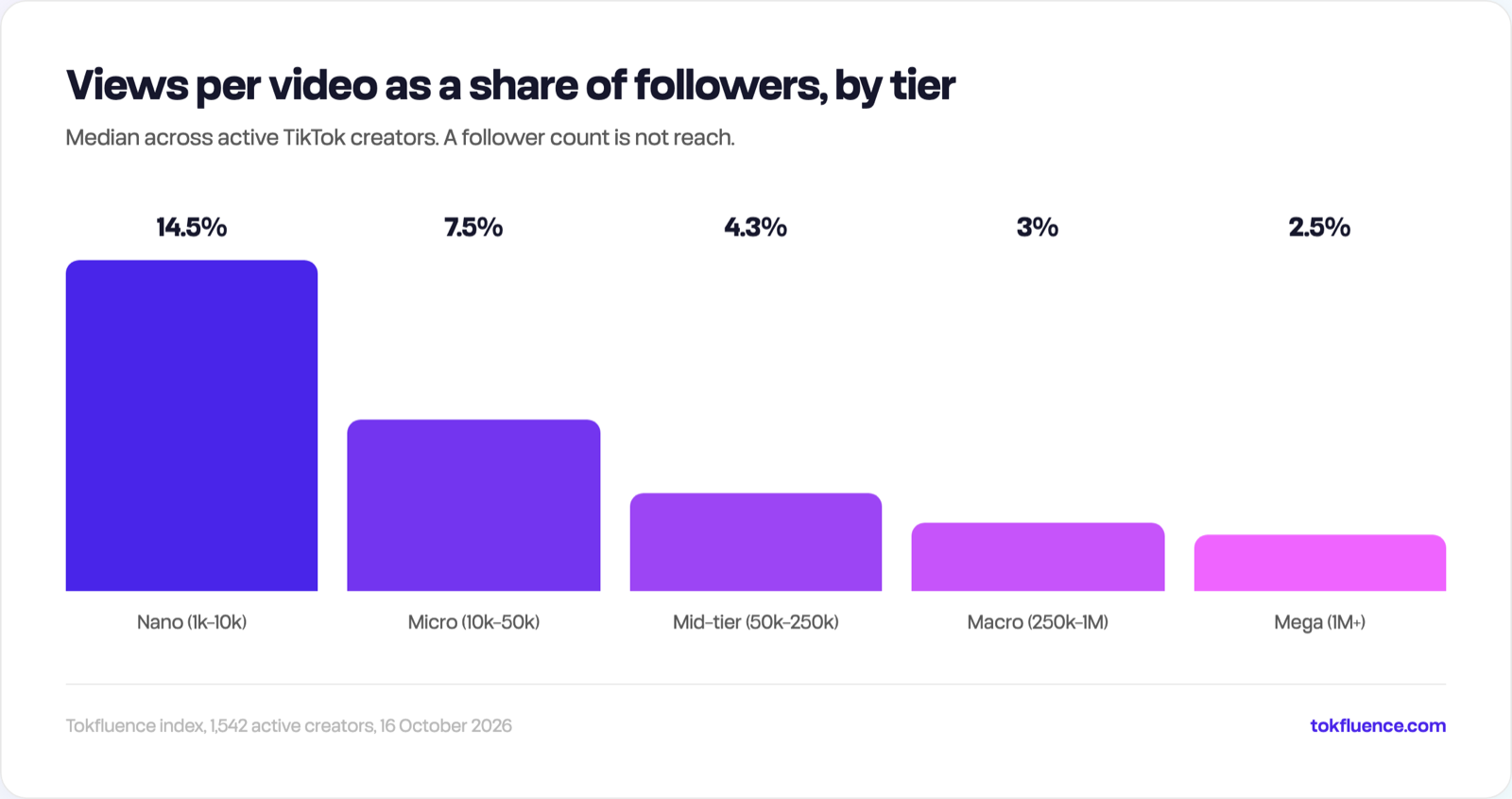
Measured: Tokfluence creator index, 16 October 2026, 1,542 creators who posted at least about once a month. Full method in our creator rates article.
The niche matters too. We pulled a fresh sample of creators with 10,000 to 100,000 followers, from two niches:
| What we measured | Fitness | Recipes | Both |
|---|---|---|---|
| Creators in the sample | 99 | 100 | 199 |
| Median views per video as a share of followers | 7.1% | 15.5% | 10.8% |
| Share averaging views under 10% of their followers | 58% | 35% | 46% |
| Share averaging under 1,000 views per video | 23% | 6% | 14% |
| Share posting less than once every four weeks | 40% | 20% | 30% |
Method: Tokfluence creator index, 16 October 2026. The first 100 relevance-ranked individual (non-brand) creators for the keywords "fitness" and "recipes", 10,000 to 100,000 followers, no region filter. 181 of the 199 had view data and 185 had posting frequency. These describe the top of each search, not every creator in the niche.
Two creators with the same follower count in a media kit can deliver very different reach. In this sample, a recipes creator with 50,000 followers typically got about twice the views of a fitness creator the same size. And nearly a third of the sample posts so rarely that their follower count mostly reflects work from months ago.
What to ask for instead: average views per video over the last 10 to 20 posts, excluding pinned videos. If the kit only gives followers, that is the first follow-up question.
Engagement rate
Engagement rate is a ratio, and the kit rarely says which one. Some creators divide likes, comments and shares by followers, some by views, and some quote their best month. Because most accounts get fewer views than they have followers, the same account can honestly report two very different numbers.
A high engagement rate on very few views is also common. In the sample above, 82 creators had an engagement rate of 5% or more, and a third of those (27) still averaged views under 10% of their followers. Ask how the number was calculated and over what period, then read it next to average views, never alone.
Audience location
Audience location is the number brands most often take on trust, and the one that matters most if you only ship to one country. It also cannot be checked from outside TikTok.
The data comes from the creator's own analytics in TikTok Studio, which shows the age, gender and top locations of viewers and followers. TikTok labels these demographics as inferred, not confirmed (TikTok Creator Academy). That is still the best source there is, so:
- Ask for a screenshot of the Viewers or Followers tab, showing top countries.
- Ask for the date range in the screenshot. Last 28 or 60 days beats an undated image.
- Check the share, not just the rank. "Top country: US" can mean 70% or 18%.
No third-party tool, ours included, can see a creator's audience demographics the way TikTok can. Tools can tell you where the creator is based and what language they post in. For where the viewers are, the screenshot is the evidence.
What are the red flags in an influencer media kit?
Most red flags are a missing number rather than a wrong one. Watch for these:
- Followers without views. View counts are public on every TikTok video and in every creator's analytics. Leaving them out is a choice.
- No dates. A kit with no "as of" date may be a year old. Ask when the numbers were taken.
- Engagement rate with no method. See above. Ask what it is divided by.
- Audience location as a claim, not a screenshot. "80% US audience" without the TikTok Studio view behind it is unverified.
- Samples that do not match the feed. If the kit shows three videos with millions of views and the profile shows hundreds, the samples are outliers.
- Logos you cannot find. If a brand logo is in the kit but no post with that brand is on the feed or in the tagged posts, ask for the link.
- Follower spikes with flat views. A sudden jump in followers with no viral video behind it can mean bought followers. The FTC's rule on fake reviews, in force since October 2024, also bans buying or selling fake indicators of social media influence, "such as followers or views generated by a bot or hijacked account", when they misrepresent influence for commercial purposes (FTC).
One weak signal is not proof of anything. A creator who posts once a month may simply be busy. Treat each flag as a question to ask, not a verdict.
Media kit checklist: what to check before you pay
Use this table on every kit before you agree a fee. It takes about ten minutes per creator.
| Check | Where to look | What good looks like | Red flag |
|---|---|---|---|
| Kit is recent | The kit itself | Dated within the last 60 days | No date at all |
| Average views per video | The profile, last 10 to 20 non-pinned posts, or a creator index | A stable number you can plan around | Only followers given, or views far below the samples |
| Views vs followers | Divide average views by followers | In line with the tier: around 7% for micro creators in our data | Far below the tier median with no explanation |
| Engagement rate method | Ask the creator | Clear formula and period | A single number with no method |
| Posting frequency | The profile | At least weekly, or a steady cadence | Long gaps, then a burst before the pitch |
| Audience location | TikTok Studio screenshot, Viewers or Followers tab | Your target country with a meaningful share, dated | A claim with no screenshot |
| Content fit | Recent videos, not the samples | Videos your buyer would watch to the end | Samples unlike the rest of the feed |
| Past brand work | Feed and tagged posts | Disclosed sponsored posts you can open | Logos with no posts behind them |
| Rates | Kit vs published benchmarks | Within the range for the tier, with usage rights priced separately | Usage rights or whitelisting buried in a bundle |
| Contact | Bio or kit | A business email or a manager | Only DMs for a paid deal |
How do you check a creator's real stats in Tokfluence?
Look the creator up in Tokfluence and you see their followers, average views per video and engagement rate side by side, with view counts on their recent posts, before you reply to the kit. That covers the average views, views vs followers and posting frequency rows of the checklist in one view.
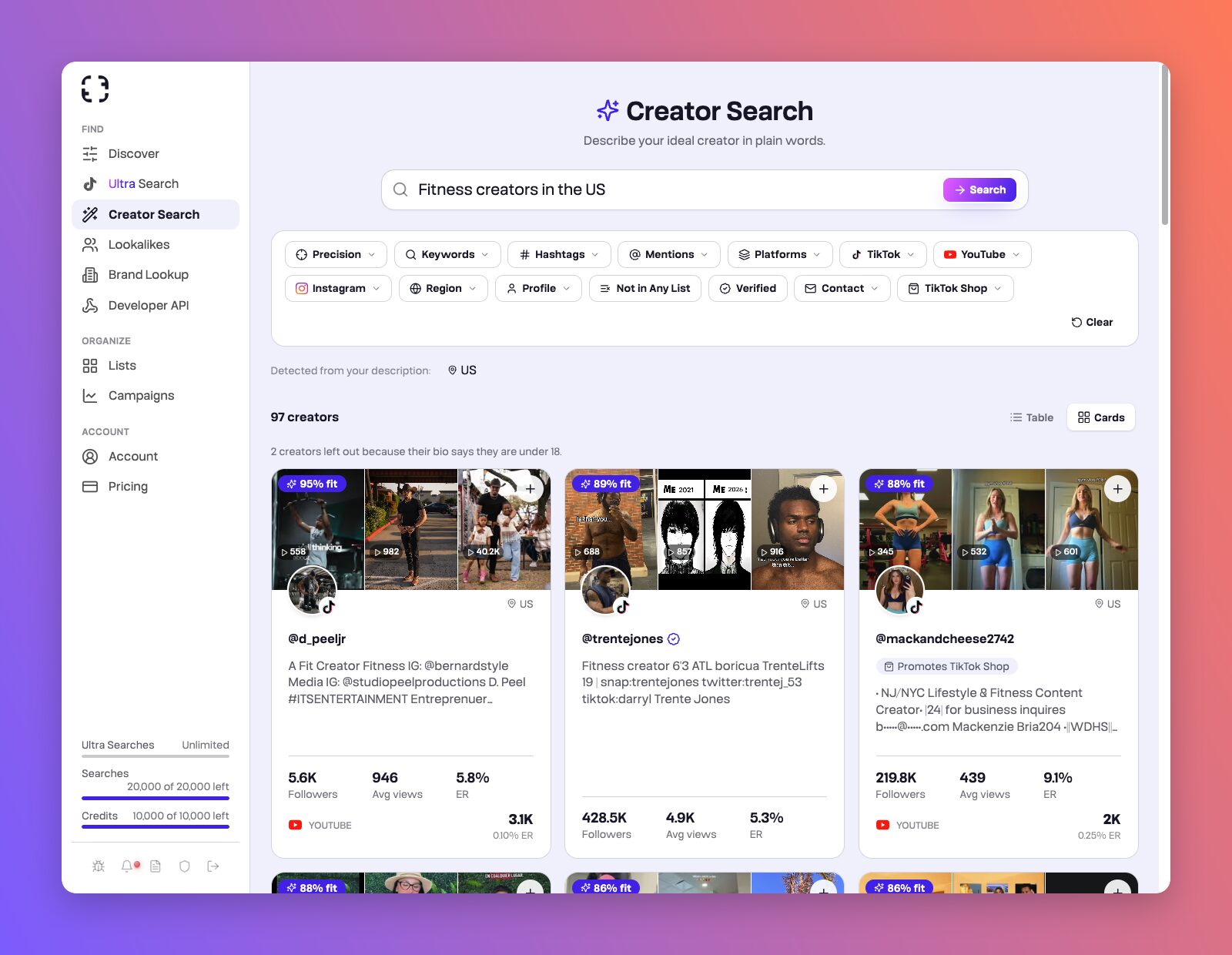
- Search the creator, or their niche. Describe the creator in plain words, or search a keyword or hashtag, and filter by region, follower range and engagement.
- Read views next to followers. The card shows followers, average views and engagement rate together, so a big follower count with low views stands out immediately.
- Compare against similar creators. Sort the niche by average views per video. If the creator in the kit sits well below others of the same size, you have your counter-offer, or your reason to pass.
- Check contact details. Tokfluence shows a creator's contact details where they have published them, and lets you filter for creators who list an email.
- Save and share the shortlist. Add the creators who pass to a list and share it by link with whoever signs off the budget.
Tokfluence reads public profile data, so it answers the reach questions, not the audience demographics question. For audience location, the TikTok Studio screenshot is still the step to ask for.
The more useful move is to stop relying on whoever happened to send a kit. Search the whole niche first, shortlist the creators whose views hold up, then ask those creators for their kits. If a niche looks thin, on the Agency plan the Tokfluence MCP server can start a live TikTok crawl from a chat with an AI assistant for 250 credits, and the new creators become searchable a few hours later.
On price, one credit is one creator profile. Pro is $99 a month for 10,000 credits plus 20,000 searches, which works out to $9.90 per 1,000 profiles ($99 / 10,000 x 1,000). Agency is $199 a month for 20,000 credits shared with the API and MCP, plus unlimited searches. There is a free plan with no card; you add a card only at checkout (pricing). If you would rather hand the whole job over, the Discovery Service ($499 a month) has our team run the searches and hand-filter the list.
Do you even need a media kit?
Not always. For small creators, a media kit is often a nice template with three-month-old numbers, and the profile itself tells you more. Here is when to lean on the kit and when to skip it:
- Lean on it for rates, packages and what the creator is willing to do, such as usage rights, whitelisting or exclusivity. Only the creator can tell you that.
- Skip it for reach and engagement. Read those off the profile or a creator index, where they are current.
- Ask for one when a manager or agency is involved, because the rates and terms in it will become the basis of the contract.
If you are contacting creators cold rather than waiting for kits to arrive, our guide to influencer outreach has short templates. Asking for a media kit in the first message slows replies; ask for it once the creator says yes.
Pick something other than a creator-by-creator check if you are booking one big name for a launch: at that size a talent agency or TikTok's own creator marketplace, which shows first-party audience data, is the better route. For brands booking many smaller creators, which is where most of the follower-versus-views gap lives, checking the numbers yourself is the step that saves the budget. Start with how to find micro-influencers whose views hold up.