
What Is Influencer Whitelisting? How It Works and What It Costs
Whitelisting means running paid ads from a creator's handle. Here is how it works on TikTok and Meta, what creators charge for it, and why engagement rate alone is the wrong screen.
TL;DR
- The definition: influencer whitelisting is when a creator gives a brand permission to run paid ads from the creator's own handle. The ad looks like the creator's post, but the brand pays for it, targets it and controls the budget.
- The platform names: TikTok calls it Spark Ads and works through an authorization code. Meta calls it partnership ads on Instagram and Facebook, and uses ad codes or account-level permissions.
- The cost: creators usually charge a whitelisting fee on top of their content rate. Published benchmarks put it at roughly 25% to 50% of the base rate per 30 days, and more for longer terms.
- The finding: high engagement alone does not make a creator worth whitelisting. Of the skincare creators in our index with 10,000 to 100,000 followers and an engagement rate of 5% or more, 29% average under 1,000 views per video.
- The caveat: the fee figures come from agencies and vendors, not from a neutral survey. Use them to open a negotiation, not to settle one.
Most explanations of influencer whitelisting spend three paragraphs before saying what it is, and then never tell you what creators charge for it. This one answers both up front, explains how it works on TikTok and on Meta, and shows how to pick creators whose handle is actually worth paying to advertise from.
What is influencer whitelisting?
Influencer whitelisting is a brand running paid ads through a creator's account, with the creator's permission. The ad appears under the creator's name and profile picture, not the brand's, and the brand sets the targeting, budget and schedule from its own ads account.
The point is trust. People scroll past brand ads and stop for creators they recognise, or for anything that looks like a real person's post. Whitelisting lets a brand buy that look at paid scale, reaching people well beyond the creator's own followers.
It is easy to confuse with two neighbouring deals:
| Usage rights | Whitelisting | A normal sponsored post | |
|---|---|---|---|
| What the brand gets | The right to reuse the video on its own channels and ads | The right to run ads from the creator's handle | One post on the creator's feed |
| Whose name is on the ad | The brand's | The creator's | The creator's (organic, not an ad) |
| Who controls targeting and spend | The brand | The brand | Nobody, it is organic reach |
| Who it reaches | Whoever the brand targets | Whoever the brand targets | The creator's followers and the For You feed |
| Typical extra fee | Yes, per channel and term | Yes, usually higher than usage rights | Included in the post rate |
The short version: usage rights let you post the creator's video as yourself. Whitelisting lets you post as the creator. A creator who grants whitelisting is lending you their name, which is why it costs more.
How does whitelisting work on TikTok?
On TikTok, whitelisting runs through Spark Ads, which TikTok describes as "a native ad format that allows you to leverage organic TikTok posts and their features in your advertising" (TikTok Business Help Center). The creator authorizes a specific post, and the brand promotes it from TikTok Ads Manager.
The flow:
- The creator opens the video in the TikTok app, goes to Ad settings, turns on ad authorization and picks how long the authorization lasts: 7, 30, 60 or 365 days (novoads.ai, September 2026).
- The creator generates a code and sends it to the brand.
- The brand pastes the code into Ads Manager and builds the campaign around that post.
- Likes, comments, shares and follows from the ad are credited to the creator's original post, not to a separate ad copy (TikTok Business Help Center).
Two practical consequences. The authorization is per post and time-boxed, so a code that lapses mid-campaign stops the ad and the creator has to issue a new one. And because engagement lands on the creator's real post, a winning ad also grows the creator's account, which is part of the appeal for the creator.
That is all this article covers on Spark Ads. Setting up the campaign itself, objectives and bidding is a separate topic.
How does whitelisting work on Instagram and Facebook?
On Meta, the format is called partnership ads. The creator either shares an ad code for a specific post, or grants the brand a standing permission, and the brand then runs the ad with the creator's handle in the header.
- Ad codes, per post. A creator can generate a code for a post and share it with the advertiser, which lets the advertiser boost that content, including archived Instagram posts, as a partnership ad. A code can be used by up to two partners at a time (Instagram Help Center).
- Account-level permissions. Brands can send partnership ad requests and manage creator permissions in Partnership Ads Hub (Meta Business Help Center). The brand needs permission from the partner whose handle the ad runs from, and the partner can revoke it at any time (Meta Business Help Center).
- Disclosure. A paid partnership post carries a "with" label naming the brand, and once it is boosted it also carries the usual "Sponsored" label (Meta Business Help Center).
The creator needs a professional account (a creator or business account on Instagram, or a Page or professional-mode profile on Facebook) to take part (Instagram Help Center).
TikTok vs Meta: what is the difference?
| TikTok | Instagram and Facebook | |
|---|---|---|
| Name of the format | Spark Ads | Partnership ads |
| How the creator grants access | An authorization code per post | An ad code per post, or an account-level permission |
| How long access lasts | 7, 30, 60 or 365 days, chosen by the creator | Until the permission is removed, which the creator can do at any time |
| What gets promoted | The creator's original post, which keeps the engagement | The creator's existing post (with an ad code) or ads the brand builds under the creator's handle |
The TikTok setup is stricter by design: every authorization has an end date. That protects the creator and forces both sides to agree a term up front, which is good practice on Meta too.
How much do creators charge for whitelisting?
Most creators charge a whitelisting fee on top of their content rate, usually as a percentage of that rate per 30-day window. Here is what has been published, and by whom:
| Source | Whitelisting fee | Basis |
|---|---|---|
| Modash, March 2026 | 25% to 30% of the base rate for 30 days | A competitor's guide to usage rights and whitelisting fees |
| Gigapay, October 2026 | 25% to 50% of the base rate per 30-day window; 150% to 300% for a perpetual buyout | A payments company's summary of published benchmarks |
| InfluencerFee, via Gigapay, October 2026 | TikTok Spark Ads 30% to 60% over the base rate per 30 days; Instagram partnership ads 50% to 100% | Rate guidance from a creator pricing site, by platform |
| CreatoHunt, via Gigapay, October 2026 | Flat $75 to $150 per 30 days for nano creators (5K to 25K followers), $150 to $400 for micro (25K to 100K) | Whitelisting access only, no content included |
A worked example. A micro creator charges $500 for a TikTok video. At 25% to 50% per 30 days, whitelisting adds $125 to $250 for one month. If they price per window, 90 days costs $375 to $750 on top, so the whole deal lands at $875 to $1,250. Ask whether a longer term gets a discount; some creators offer one, and it can work out cheaper than renewing three times.
Treat every number above as a starting point. These are vendor and agency figures, not a neutral survey, and what actually moves the price is the length of the term, whether you can edit the video, whether you want exclusivity in the category, and how hard you plan to push spend behind it.
If you are still working out what the base rate itself should be, our first influencer campaign guide has rates by follower size.
What are the risks of influencer whitelisting?
The risks are mostly about control: the brand controls the ad, but the name on it belongs to someone else.
For the brand:
- The creator's reputation becomes yours. If the creator is in a controversy while your ad is live, your budget is promoting it. Agree a pause clause.
- Ads stop when access ends. A TikTok code that expires, or a Meta permission that is revoked, stops delivery. Put the end date in your media calendar, not just the contract.
- Comments land on the creator's post. Customer complaints, refund requests and questions about your product appear under the creator's name, and you may not be able to moderate them.
For the creator:
- The brand speaks in their name. If the contract allows new captions or edits, the brand can say things the creator would never say. Approval rights on any edit are standard.
- Their own audience sees the ad too. Heavy frequency on a creator's existing followers can make them look like an advertising account. Creators can reasonably ask brands to exclude their followers, or to cap frequency.
- Disclosure still applies. The FTC's guidance for influencers says to disclose any financial relationship with a brand, and a paid ad from their handle is exactly that.
What should a whitelisting agreement cover?
Keep it to one page. These are the terms that cause arguments when nobody wrote them down:
| Term | What to agree |
|---|---|
| Duration | Start and end dates, and what happens at renewal |
| Platforms | TikTok, Instagram, Facebook, or all three |
| Content | Which posts, and whether the brand can edit captions, cut new versions or add text |
| Approval | Whether the creator approves each ad before it runs |
| Audience | Whether the creator's own followers are excluded, and any frequency cap |
| Exclusivity | Whether the creator can work with competitors during the term, and for how much extra |
| Exit | Who can pause the ads, and on what grounds |
| Fee | The whitelisting fee, separate from the content fee, and when it is paid |
How do you pick creators worth whitelisting?
Pick creators whose videos already hold attention and whose audience looks like your buyer. Follower count matters less than usual, because paid spend supplies the reach; you are buying the creator's credibility and their ability to make a video people watch.
Engagement rate is the obvious screen, and it is not enough on its own. We checked our own index on 16 October 2026, using TikTok creators who match "skincare" and have 10,000 to 100,000 followers:
| What we measured | Result |
|---|---|
| Share of matching creators with an engagement rate of 5% or more | 43% |
| Of the first 99 high-engagement creators returned, share averaging under 1,000 views per video | 29% |
| Of those same 99, share whose average views are under 10% of their follower count | 49% |
Engagement rate is a ratio, so it can look excellent on very few views. For whitelisting that is the wrong signal: what you want is a creator whose videos get watched, because the ad is the same video with money behind it. Read the two numbers together.
Method: counts from the Tokfluence index on 16 October 2026, keyword "skincare", 10,000 to 100,000 followers, no region filter. The view figures come from the first 100 relevance-ranked results (99 with view data), so they describe the top of the list, not the whole set. Emails on file are not all validated.
A checklist for the shortlist:
- Views per video, not just engagement. Look for creators whose average views are a healthy share of their followers.
- Audience fit. Region and language first, then whether the comments look like your customers.
- Videos that already sell. Creators who film product demos, routines or reviews make content that works as an ad without re-editing. Our UGC creators guide covers how to spot them.
- Posting consistency. A creator who posts every week has a back catalogue of posts you can test, not one.
- A way to reach them. A business email in the bio makes the negotiation start the same day.
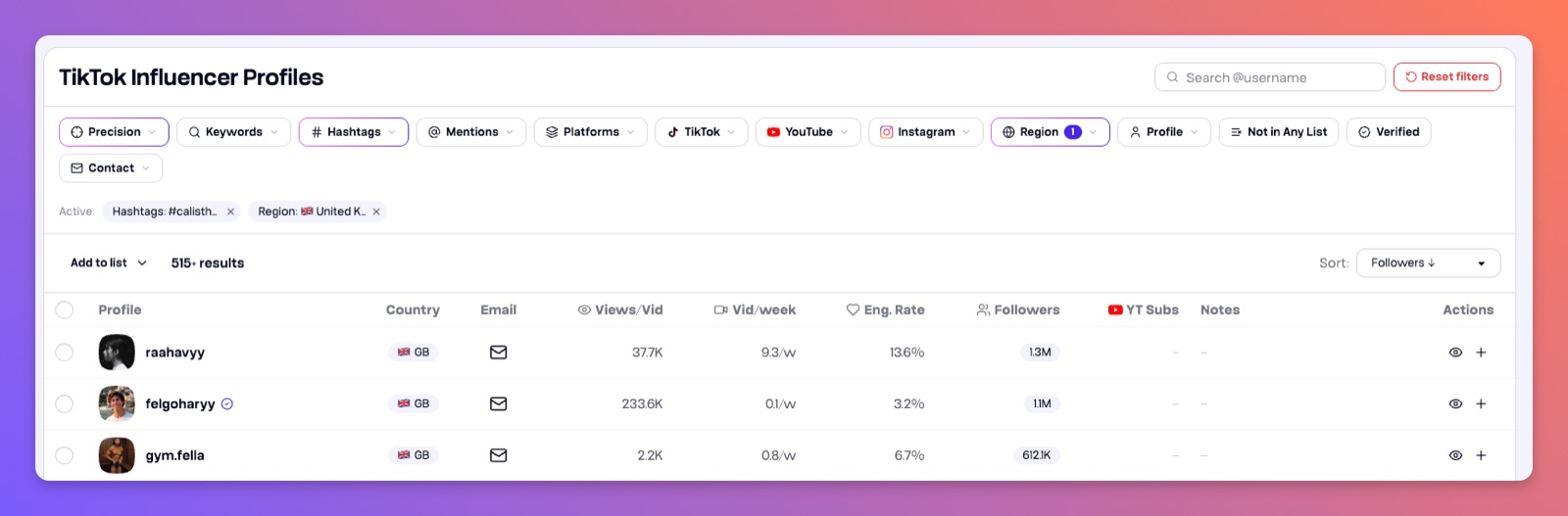
This is the job Tokfluence is built for. Search our index of more than 15 million TikTok creators by keyword, hashtag, region, follower range and engagement, then sort and compare views per video and engagement rate in the same table before you shortlist anyone. Save the creators to a list, export it with their contact emails, and start the whitelisting conversation. The influencer search tool page shows every filter.
What sets Tokfluence apart is that the index grows on demand. On the Agency plan, the Tokfluence MCP server lets you run the same search from Claude, and if a niche is thin it can start a live TikTok crawl from the chat for 250 credits; the new creators become searchable a few hours later.
On price, one credit is one creator profile. Pro is $99 a month for 10,000 credits plus 20,000 searches, which works out to $9.90 per 1,000 profiles ($99 / 10,000 x 1,000), enough to screen a whole niche rather than the first page of it. Agency is $199 a month for 20,000 credits, unlimited searches, and adds the API and MCP. There is a free plan with no card; you add a card only at checkout (pricing). If you would rather not do the screening yourself, the Discovery Service ($499 a month) has our team run the searches and hand-filter the list for you.
When is whitelisting not worth it?
Whitelisting is not the right deal for every brand, and it is worth saying when to skip it.
- You only need the video. If you are going to run the content from your own brand account anyway, buy usage rights instead. They cost less, and you do not need the creator's handle. That is a UGC deal, not a whitelisting one.
- You have no paid budget behind it. The fee buys the right to advertise. Without real ad spend, you are paying for a permission you will not use.
- The creator's audience is not your buyer. Paid targeting can reach new people, but the ad still carries the creator's face and style. If that style does not fit your customer, the handle is a cost, not an advantage.
- You are still testing creators. Run the creator's organic post first, see what it does, then whitelist the winners. Paying whitelisting fees on untested creators is the expensive way to learn.
For small brands starting out, the order that works is: find creators who fit, run organic posts, and whitelist the two or three whose videos actually performed. Most of those creators are small accounts; here is how to find micro-influencers in your niche.