
Nano Influencers: Who They Are and How to Find Them
77.3% of TikTok creators in our index are nano, but only about half of those matching a niche. When nano influencers win, when they lose, and how to find them.
TL;DR
- The definition: a nano influencer is a creator with roughly 1,000 to 10,000 followers. It is a convention, not a standard.
- They are most of TikTok's creators: 77.3% of the creators with 1,000+ followers in our index are nano, and 83% of those have fewer than 5,000.
- But fewer of them are niche creators: once you search by niche keyword, nano drops to between 44% and 51% of matches. Many small accounts are personal, not channels a brand can brief.
- They win on volume, trust and price: published TikTok rates are about $50 to $200 a video, and many deals are product only.
- They lose on predictability and management time: if you need a guaranteed number of views or have one person running the programme, book fewer, bigger creators.
A nano influencer is the smallest creator a brand can realistically work with: big enough to have an audience, small enough to answer their own messages and price a post in product rather than cash.
Most guides stop there, or tell you nano creators are always the smart choice. They are not. This article covers who they are, how many there are on TikTok, where they beat bigger creators and where they do not, what they charge, and how to find the right ones without scrolling the app for a week.
What is a nano influencer?
A nano influencer is a creator with roughly 1,000 to 10,000 followers. Below 1,000, most brands treat an account as a regular user; above 10,000, it moves into micro.
| Tier | Followers | What brands usually buy |
|---|---|---|
| Nano | 1,000 to 10,000 | Product seeding, local reach, many small bets |
| Micro | 10,000 to 50,000 | Paid posts at volume, the practical middle |
| Mid-tier | 50,000 to 250,000 | A floor on views with a considered creator |
| Macro | 250,000 to 1,000,000 | Awareness and launches |
| Mega | 1,000,000+ | A name that is itself the message |
No governing body sets these bands. Some agencies stop nano at 5,000, others run it to 15,000. If a deck calls someone "nano", ask for the follower count. Our influencer tiers breakdown covers every tier, with measured engagement rates for each.
What makes a nano creator different is less the number than the relationship. At this size a creator usually knows a good share of their regular commenters, posts about one or two things they genuinely do, and often has never been paid for a post. That is the appeal, and also the source of most of the problems below.
How many nano influencers are there on TikTok?
More than every other tier combined, several times over. In our index, 77.3% of creators with 1,000 or more followers are nano. Micro is 14.7%, and everything from 50,000 followers up adds up to 8%.
TikTok does not publish how many creators it has, so any total is an estimate. A floor is possible, though. TikTok's ads reached 1.59 billion people in January 2025 (DataReportal), and the nano creators in our index alone equal at least 0.8% of that audience, or about 1 in 124 people TikTok's ads reach. The real share is higher, because our index only counts accounts we have crawled.
Within nano, the pool is bottom-heavy:
| Nano band | Share of nano creators in our index | At least, on TikTok | Share of TikTok's 1.59B ad reach |
|---|---|---|---|
| 1,000 to 5,000 followers | 83.0% | 10.6 million | 0.67%, about 1 in 150 |
| 5,000 to 10,000 followers | 17.0% | 2.2 million | 0.14%, about 1 in 730 |
Measured: Tokfluence creator index. Tier shares as of 8 September 2026; nano split as of 16 October 2026. "At least" applies the split to the 12.8 million nano creators in our index (83.0% x 12.8M = 10.6M; 17.0% x 12.8M = 2.2M), so it is a floor: TikTok has more accounts than we have crawled. Reach figure from DataReportal, January 2025.
That split matters for planning. "Nano" in practice mostly means creators with a few thousand followers. If you want the upper end of the tier, you are fishing in a pool about a fifth of the size.
Are most nano accounts actually creators?
No, and this is the number most guides skip. The 77.3% counts every account with 1,000+ followers, including people who post their weekend and their dog. When we search the same index by niche keyword, nano's share of the matches falls sharply:
| Keyword | Nano share of matching creators (1,000+ followers) |
|---|---|
| Whole index, no keyword | 77.3% |
| "fitness" | 51.1% |
| "baking" | 49.9% |
| "skincare" | 43.5% |
Measured: Tokfluence creator index, 16 October 2026. Each keyword share is nano matches divided by all matches with 1,000+ followers for that keyword. Keywords match bios, hashtags and captions.
Larger accounts are more likely to describe themselves by a topic, tag it consistently and post about it often. Smaller accounts are more often personal. So the nano creators who are genuinely about your niche are a much smaller slice than the headline suggests: about half of each niche we checked, not three quarters.
The practical consequence: finding nano creators is easy, finding the right ones is the work. A keyword search alone will return plenty of accounts that mentioned "skincare" once. Filtering on niche strength, recent activity and engagement does the sorting.
When do nano influencers beat bigger creators?
When the campaign rewards many small, credible voices more than one loud one. The cases where nano is the right call:
- Product seeding at volume. Sending product to 100 nano creators costs the product and postage. Many will post, some will love it, and you learn which angle works before paying anyone.
- Niche and local products. A home baker with 3,000 followers in one city can reach more of your buyers for a local bakery supply shop than a 500,000-follower food account spread across 40 countries.
- Testing creative. Twenty nano videos give you twenty hooks to compare. The winners are the ones worth paying a bigger creator to remake, or running as ads.
- Authenticity where it is the product. In categories bought on trust, such as skincare, parenting or hobby gear, a recommendation from someone who feels like a peer often converts better than reach.
- Low budgets. If you have $1,000, it buys a handful of nano posts, not one mid-tier creator.
Engagement is part of the case too. In our tiers sample, nano had the highest median engagement rate of any tier, though with the widest spread; the full tier comparison has the numbers and the caveats.
When should you not use nano influencers?
When you need certainty, or when you do not have the people to run a large roster. Be honest with yourself about these before you commit:
- You need a guaranteed number of views. One nano creator's views can swing tenfold from post to post. At published rates, a median nano creator is also expensive per view; our TikTok rate card by tier works through the cost per 1,000 views.
- One person runs the programme. Fifty nano creators means fifty conversations, fifty shipments, fifty sets of usage terms and fifty posts to check. The management time, not the fee, is the real cost.
- You need polished production. Most nano creators film on a phone with whatever light they have. That suits TikTok, but not a brand that needs a reshoot-proof hero asset.
- The brief is complex. Regulated claims, strict talking points or exclusivity clauses are easier to manage with a creator who has done sponsored work before.
- You need fast reach for a launch date. Nano reach accumulates over weeks of many posts. A single macro post moves faster.
If two or more of those apply, start with micro or mid-tier creators instead, and keep nano for seeding alongside.
How much do nano influencers charge on TikTok?
About $50 to $200 per video, according to both Influencer Marketing Hub (August 2026) and Modash (October 2026). Neither publishes its sample or method, so treat those as asking prices.
What actually changes hands is often lower. On Collabstr's marketplace the average paid TikTok collaboration in 2026 was $186, and nearly 80% of all collaborations cost under $300 (Collabstr 2026 report, via Net Influencer).
Three ways nano deals are usually structured:
| Deal type | What the creator gets | Fits when |
|---|---|---|
| Product only (gifting) | The product, sometimes a discount code | The creator would genuinely want the product anyway |
| Flat fee plus product | $50 to $200 and the product | You want a specific deliverable and a posting date |
| Affiliate or commission | A share of sales from their link or code | The product sells online and you can track it |
Gifting is not free of obligations. Under US rules, a creator who gets a free product and then mentions the brand has to disclose it, whatever their follower count (FTC, Disclosures 101 for Social Media Influencers). Ask every creator to use TikTok's branded content toggle or a clear #ad.
How do you find nano influencers on TikTok?
Search by niche first, then narrow by size and quality. Browsing the TikTok app shows you whoever its algorithm is promoting that day, one video at a time. An index lets you start from the 77% instead. Here is how it works in Tokfluence:
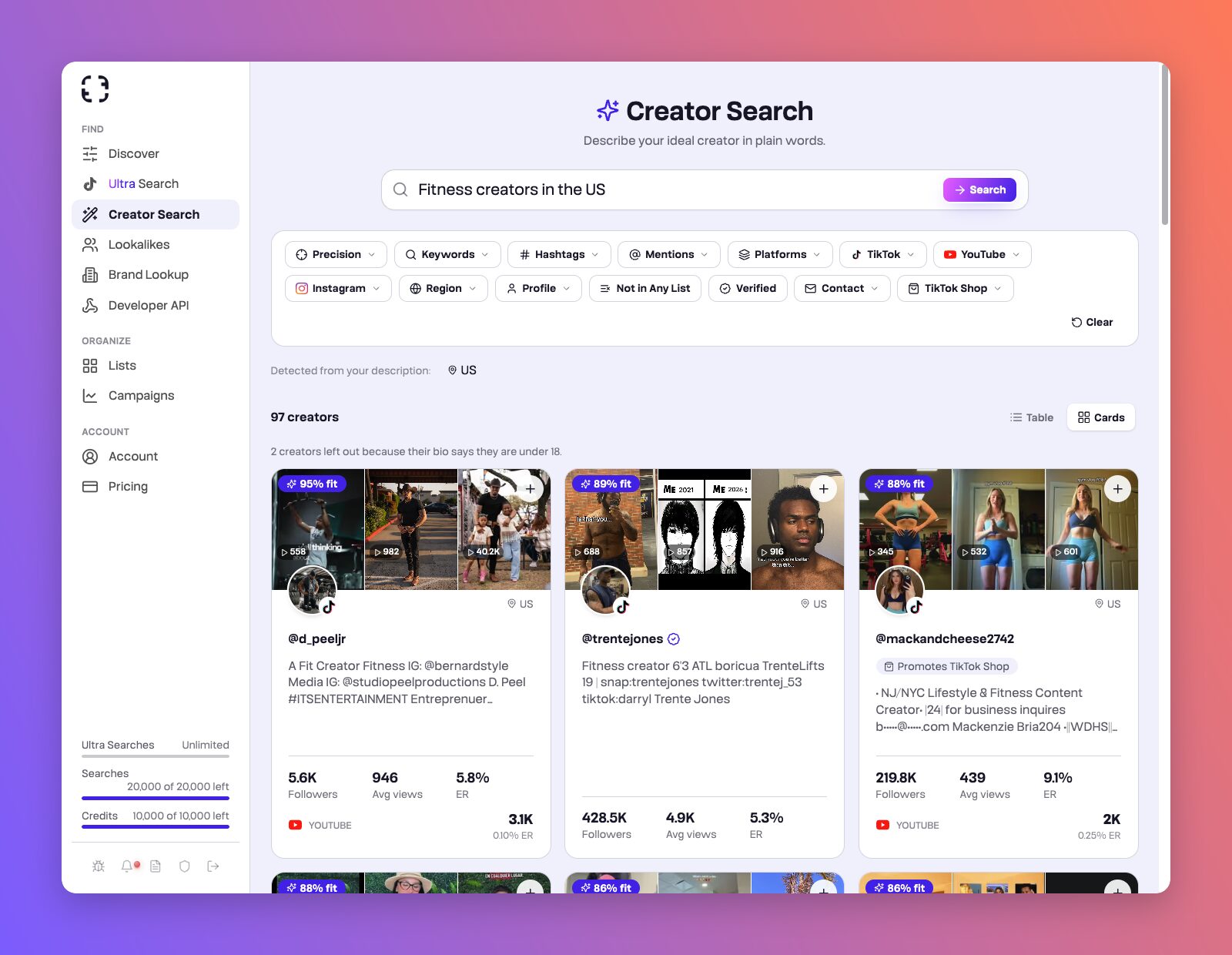
Describe the creator in plain words and the search turns it into filters you can then adjust.
- Describe the niche, not the size. Type a keyword or a plain-language brief, for example "home bakers in the UK who post sourdough". Run two or three variants; "baking" and "sourdough" find overlapping but different people.
- Set followers to 1,000 to 10,000. Or split it: 5,000 to 10,000 if you want larger audiences, 1,000 to 5,000 if you want the biggest pool.
- Filter out the personal accounts. Raise Precision so the keyword has to define the creator, set a minimum engagement rate and a minimum posting frequency, and exclude brand accounts.
- Check how they can be reached. Tokfluence shows a contact email where the creator publishes one, and you can filter by "has email". Smaller creators publish one less often, so expect to DM many of them; our influencer outreach guide has templates for both.
- Vet the shortlist, then save it. Open the profiles, request an audience analysis on demand if you need country and fake-follower checks, and save the keepers to a list you can export.
If you are working at the micro end too, our micro-influencer search guide walks through the same filters on a worked example.
From an AI assistant. Our TikTok MCP server lets you ask for "nano baking creators in the UK who post at least weekly" in plain language and get the list back in the chat. MCP access is on the Agency plan and above. When a niche is thin in the index, the MCP can start a live TikTok crawl from the chat (250 credits), and the new creators become searchable a few hours later. That is the part no static database can do: if the nano creators you need have not been indexed yet, you can go and get them.
What it costs. One credit is one creator profile. Pro is $99 a month for 10,000 credits, which is $99 / 10 = $9.90 per 1,000 profiles, plus 20,000 searches. Agency is $199 a month for 20,000 credits ($199 / 20 = $9.95 per 1,000) with unlimited searches and API and MCP access. There is a free plan with no card; you add a card only at checkout. For a roster of a few hundred nano creators, that is enough credits to look at thousands of candidates and keep the best. If you would rather not do the searching, the Discovery Service ($499 a month) has our team build and hand-filter the list. Details on the pricing page.
Pick something else if you want one platform to ship the products, collect the posts and pay creators for you. Tokfluence finds and vets creators; you contact and pay them directly. A seeding or marketplace platform handles the logistics, and charges for doing so.
How we got these numbers
Measured figures come from the Tokfluence TikTok creator index. Tier shares (77.3% nano, 14.7% micro) are total matches per follower band on 8 September 2026, out of all creators with 1,000 or more followers; they are the same figures used in our tiers article. The nano split (83.0% / 17.0%) and the keyword shares were counted on 16 October 2026, as total index matches for each follower band and keyword, without other filters.
The extrapolation divides the nano creators in our index on 8 September 2026 by DataReportal's 1.59 billion TikTok ad reach. It is a floor, not an estimate of the total.
What these numbers do not prove:
- Our index is not all of TikTok. It covers creators we have crawled, so every share here describes our index, and the TikTok-wide figure is a minimum.
- Keyword matches are loose. A match means the word appears in a bio, hashtag or caption. Some matches in every tier are shops or one-off mentions, so the keyword shares compare tiers rather than counting real niche creators.
- Index dates differ. The tier shares and the nano split were measured five weeks apart, while the index kept growing. Each is internally consistent, but do not add them together.
- We did not measure rates. Prices are other people's published figures, cited where they appear.
Sources
- DataReportal, TikTok statistics and trends, January 2025 (1.59 billion ad reach)
- Influencer Marketing Hub, TikTok Influencer Rates in 2026, August 2026
- Modash, Influencer Pricing: What Influencer Marketing Costs in 2026, October 2026
- Collabstr, 2026 Influencer Marketing Report, figures as reported by Net Influencer, January 2026
- US Federal Trade Commission, Disclosures 101 for Social Media Influencers
- Tokfluence creator index, 8 September and 16 October 2026