
Building a UGC Campaign From Scratch, Step by Step
Finding creators is the easy part. Here is the rest: the goal, a one-page brief, three budgets with the maths shown, the licence terms to agree before filming, and how to read the results.
TL;DR
- A UGC campaign is seven decisions in order: goal, brief, budget, creators, usage rights, review, measurement. Most campaigns that fail skipped the first one or the fifth one.
- Budget per usable video, not per creator: at the published $212 average per UGC video, ten videos cost about $2,120 before usage rights, and a 12-month paid-ads licence can add another 70% to 100%.
- Agree usage rights before anyone films. Channels, duration, paid or organic, and whether the ad runs from the creator's handle. Retro-fitting a licence costs more and sometimes cannot be done at all.
- Measure the hook, not the creator: on TikTok, 2-second views over impressions tells you if the opening works, and 6-second views over 2-second views tells you if the rest holds.
- The caveat: every rate here is a published benchmark from a vendor or marketplace, not transaction data. Use them to set an opening number, then negotiate.
Most guides to UGC campaigns stop at "find creators and send a brief". That is the easy part. The parts that go wrong are the budget nobody wrote down, the licence nobody agreed, and the results nobody could read because the campaign had no goal.
This is the brand-side version, start to finish: seven steps, a brief you can copy, three worked budgets with the maths shown, a usage rights checklist, and the four numbers that tell you whether it worked. If you only need to find the people, our guide on how to find UGC creators covers that step in depth. This article is about running the whole campaign around them.
What is a UGC campaign?
A UGC campaign is a project where a brand pays creators to make videos that look like real customer content, then uses those videos on its own channels: paid ads, product pages, email or its own social accounts. You are buying the video and the right to use it, not the creator's audience.
The term has a second meaning, and the search results mix the two up:
| Paid creator UGC campaign | Customer UGC campaign | |
|---|---|---|
| Who makes the content | Creators you brief and pay | Your existing customers, unpaid |
| How you get it | A brief, a fee, a licence | A hashtag challenge, a contest or a review request |
| Control over the result | High: you brief it and approve it | Low: you pick from what arrives |
| Best for | Ad creative, product page video, launches | Social proof, community, reviews |
| Rights | Agreed in a contract | You still need permission to reuse each post |
This guide covers the first kind, which is what most brands mean when they budget for "UGC". If you run a customer campaign, steps 1, 5 and 7 still apply.
How do you run a UGC campaign, step by step?
Seven steps, in this order. Each one produces something you need for the next:
| Step | The decision | What you have at the end | Rough time |
|---|---|---|---|
| 1. Goal | What the videos are for | One primary metric and the channel they run on | An hour |
| 2. Brief | What a good video looks like | A one-page brief | Half a day |
| 3. Budget | How many videos, at what price | A budget per usable video | An hour |
| 4. Creators | Who makes them | A shortlist three to four times the size you need | Two to five days |
| 5. Usage rights | Where and for how long you can use them | A signed licence per creator | Alongside step 4 |
| 6. Review and launch | Which videos ship | Approved files, live ads or posts | One to two weeks |
| 7. Measure | What worked | A ranked list of hooks and creators to rebook | Two weeks after launch |
The times are our rough planning guide for a campaign of five to ten creators, not a benchmark. Our first influencer campaign guide has the same four-week shape for campaigns where creators post to their own audience.
Step 1: What is the campaign for?
Decide where the videos will run before you write a word of the brief, because an ad, a product page and an organic post need different videos. Pick one primary goal:
| Goal | Where the videos run | What to ask for | The number that decides success |
|---|---|---|---|
| Paid ad creative | TikTok, Meta or YouTube ads | 15 to 30 second clips, several hook variations, raw files | Cost per acquisition, then hook rate |
| Product page and email | Your site, product pages, email | Demonstration and unboxing, vertical and square crops | Conversion rate on the page, compared with the page without video |
| Organic social | Your brand's own TikTok or Instagram | Native-feeling clips with on-screen text, no hard sell | Views and saves per post |
| Creator posts plus a licence | The creator's account first, then your ads | One post on their account, plus the right to run it as an ad | Views on their post, then cost per acquisition on the ad |
The last row is the hybrid deal: the creator posts the video to their own audience and licenses it to you for ads. It costs more than a pure UGC video and less than buying the two separately, and it is where small creators are the best value.
Step 2: What goes in a UGC brief?
One page, written for someone who has never used your product. A brief that runs to five pages gets skimmed, and a brief that writes the script gets videos that sound like ads. Copy this and fill it in:
- The product, in one sentence. What it is and who it is for.
- The one thing to get across. Not three. The single reason a customer buys it.
- The goal and where it runs (from step 1). A creator films differently for a product page than for a TikTok ad.
- Hook ideas, not a script. Two or three opening lines or situations you think will work, and permission to try their own.
- Must-shows. The product in hand within the first few seconds, the packaging, the result.
- Must-avoids. Claims you cannot make, competitor names, music you cannot license for ads.
- Deliverables. Number of videos, length, aspect ratio, number of hook variations, raw or edited, captions or not.
- Usage rights (from step 5). Channels and duration, written in the brief so the creator prices it correctly.
- Deadlines and revisions. Draft date, number of revision rounds included, final delivery date.
- Disclosure. If the creator posts to their own account, they must disclose the paid partnership, per the FTC's endorsement guidance.
The most valuable line in the brief is item 7's hook variations. Three different opening seconds on the same video lets you test three ads for the price of one, so ask for them up front and ask whether they are included in the rate.
Step 3: How much does a UGC campaign cost?
Budget per usable video, then add the licence. The formula:
Budget = videos × rate per video + usage rights + product cost + ad spend to test them
For the rate, here is what has been published:
| Source | Figure | Note |
|---|---|---|
| ppc.io, January 2026 | $212 average per UGC video, most between $150 and $300 | Compiled from six marketplaces' published rates |
| Influee | $92 average for a 30 second US video | A marketplace's own figure for its own creators |
| Collabstr 2026 report, via Net Influencer | $186 average paid TikTok collaboration | Includes creators posting to their own account |
Usage rights are priced on top, usually as a percentage of the base fee. Gigapay's October 2026 summary of published benchmarks puts organic reposting at 0% to 15% (often included), paid usage at 15% to 30% per 30 days or 70% to 100% for 12 months, and a perpetual buyout at 150% to 300%.
Three worked budgets, using those figures:
| Campaign | Videos | Creator fees | Usage rights | Creator spend |
|---|---|---|---|---|
| First test, organic only | 3 creators × 1 video | 3 × $212 = $636 | Organic reposting, 0% to 15%: $0 to $95 | $636 to $731 |
| Ad creative test | 5 creators × 2 videos | 10 × $212 = $2,120 | 12 months paid, 70% to 100%: $1,484 to $2,120 | $3,604 to $4,240 |
| Hybrid: creators post, you license | 5 creators × 1 post | 5 × $186 = $930 | 30 days paid, 15% to 30%: $140 to $279 | $1,070 to $1,209 |
Estimated: published averages multiplied out. Product cost and ad spend come on top, and both depend on your product and your market, so we have not guessed them.
The middle row is the one that surprises people: the licence can cost as much as the videos. That is why step 5 comes before anyone films. For what creators charge to post to their own audience, by follower size and per 1,000 views, see our TikTok creator rates by tier.
Step 4: Where do you find creators for a UGC campaign?
From three places: UGC marketplaces, creator search tools, or TikTok itself. Marketplaces are fastest when you want volume from whoever is available. A search tool is better when you need creators in a specific niche or country who already film your product category. TikTok search works for a first test of a handful.
We compared all three, with published fees, in how to find UGC creators. Two rules carry over to any route:
- Shortlist three to four times what you need. Cold outreach to creators gets roughly a 20% to 30% reply rate, so eight finished videos needs a list of about thirty. Our influencer outreach guide has templates and a follow-up schedule.
- Judge the portfolio, not the follower count. For pure UGC you are not buying reach. Look for talking to camera, usable light and sound, and an opening that stops a scroll.
Step 5: How do you handle usage rights for UGC?
Put them in writing, per creator, before filming starts. A one-page licence covering these terms prevents almost every argument:
| Term | What to agree | Why it matters |
|---|---|---|
| Channels | Organic social, paid ads, website, email, or all of them | Paid ads cost more than organic, so name them |
| Duration | 30 days, 90 days, 12 months or perpetual | Fees are usually priced per 30-day window |
| Paid or organic | Whether you can put ad spend behind the video | The biggest single driver of the licence fee |
| Whitelisting | Whether the ad runs from the creator's own handle | Priced separately, and on TikTok it needs the creator to authorize it |
| Edits | Whether you can cut, re-caption or combine clips | Most brands want this for ad testing; ask for it explicitly |
| Raw files | Whether you get the unedited footage | Raw files let you build new hooks later without rebooking |
| Exclusivity | Whether the creator can work with competitors during the term | Adds a premium; only ask for it if you need it |
| Payment | Fee for the content and fee for the licence, as separate lines | Makes renewals simple when the term ends |
If the plan is to run ads from the creator's own account rather than your brand account, that is whitelisting, which has its own fees, setup and risks. We cover it in what is influencer whitelisting, including how TikTok's Spark Ads authorization works.
Step 6: How do you review and launch UGC?
Review drafts against the brief, not your taste, then launch the variants side by side so you learn something from the first week.
Before you approve a video, check:
- The first two seconds. Does something happen, or is it a slow logo shot?
- The claims. Nothing the creator says about the product should go beyond what you can back up. The FTC guidance above applies to claims in endorsements too.
- The deliverables. Length, aspect ratio, hook variations and captions, as listed in the brief.
- Audio rights. A trending sound that works on a creator's organic post is not necessarily cleared for your paid ads. Check before the video goes into Ads Manager.
When you launch:
- Test hooks before creators. Run the hook variations of the same video against the same audience and budget, so the only thing that changes is the opening.
- Name every file consistently. Creator, video, hook number. You will thank yourself when you read the results.
- Pay on time. Creators talk to each other, and a brand that pays late gets worse rates on the next campaign.
Step 7: How do you measure a UGC campaign?
With four numbers for ads, and one for the campaign as a whole. TikTok reports 2-second and 6-second video views on every ad; dividing them gives you the two numbers that matter most for UGC:
| Metric | Formula | What it tells you |
|---|---|---|
| Hook rate | 2-second video views ÷ impressions | Whether the opening stops the scroll |
| Hold rate | 6-second video views ÷ 2-second video views | Whether the video keeps people once they have stopped |
| Click-through rate | Clicks ÷ impressions | Whether the offer and the call to action land |
| Cost per acquisition | Ad spend ÷ purchases (or sign-ups) | Whether the video sells, which is the point |
| Cost per usable video | Total creator spend ÷ videos you actually ran | Whether the creative budget was well spent |
TikTok defines a 2-second view as at least two seconds of play in one impression, replays excluded, and a 6-second view as six seconds of play, a full play of a shorter video, or an engagement in the first six seconds (TikTok Ads Manager help). "Hook rate" and "hold rate" are industry shorthand for these ratios, not TikTok metric names.
Read them in order. A video with a weak hook rate never gets a chance to sell, so fix the opening first. A strong hook with a weak hold rate means the opening promised something the rest did not deliver. Only once both look healthy is the cost per acquisition telling you about the product and the offer rather than the edit.
Cost per usable video is the number most brands never calculate, and it is the one that tells you which creators to rebook. If you paid for ten videos and only four were good enough to run, your real rate was 2.5 times the one on the invoice.
For hybrid deals, where creators also post to their own account, track those posts too: views, engagement rate and cost per 1,000 views per creator.
How do you run a UGC campaign with Tokfluence?
Tokfluence covers step 4 and the organic half of step 7: finding creators who already film your category on TikTok, and tracking the posts once they go live. It is the tool we build, so weigh this section accordingly.
Find the creators. Describe the creator in plain words, for example "home espresso creators in the UK who review gear on camera", and the search turns it into filters across the TikTok creators in our index. Then narrow it:
- Follower range. For pure UGC, 1,000 to 50,000 is usually enough, because you are buying the video, not the reach.
- Has email. Tokfluence shows contact details where creators publish them, and the filter keeps only creators you can email instead of DM.
- TikTok Shop. If you sell through TikTok Shop, this filter narrows to creators who use TikTok Shop hashtags or mention it in their bio. It is a signal, not a sales figure.
- Recent posts. Open each profile and check the three things from step 4: talking to camera, light and sound, and the opening seconds.
- Save and export. Save the keepers to a list and export a CSV for whichever tool you send email from.
When the niche is thin, fill it. If your category barely shows up, Ultra Search reads TikTok live from a one-sentence brief, for niches the index does not cover yet. On the Agency plan, the Tokfluence MCP server lets you run the same search from an AI assistant and start a live TikTok crawl from the chat for 250 credits; the new creators become searchable a few hours later. That on-demand crawl is the main thing that sets Tokfluence apart.
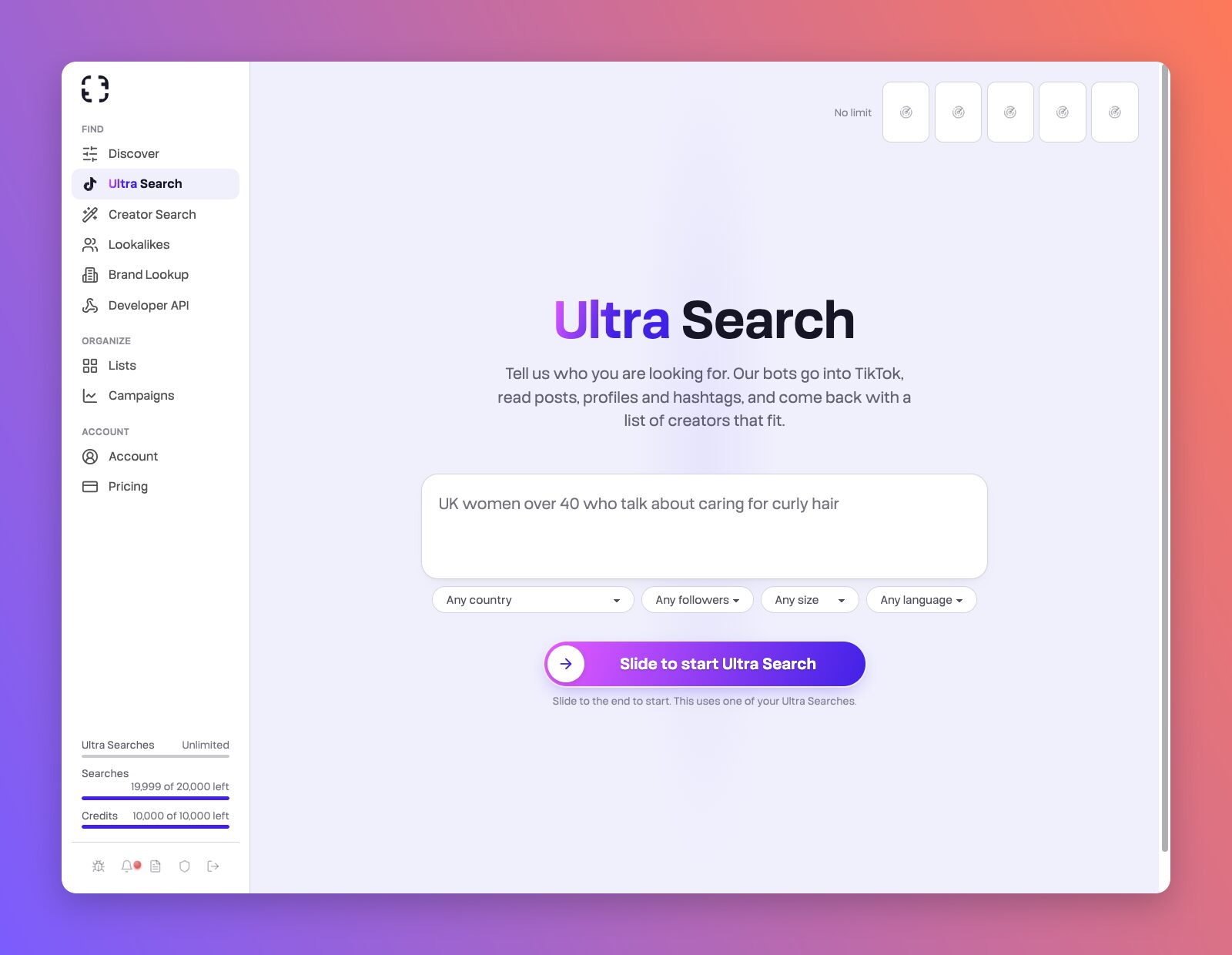
Ultra Search takes the brief as one sentence and searches TikTok live when the index is thin.
Track the posts. For hybrid deals, paste the TikTok post URLs into campaign tracking. It pulls views, likes, comments, shares and engagement rate per creator, works out cost per 1,000 views from what you paid, refreshes for 30 days, and gives you a report link you can share without a login. It tracks the posts on TikTok, not your ads in Ads Manager, so the ad metrics above still come from TikTok's own reporting.
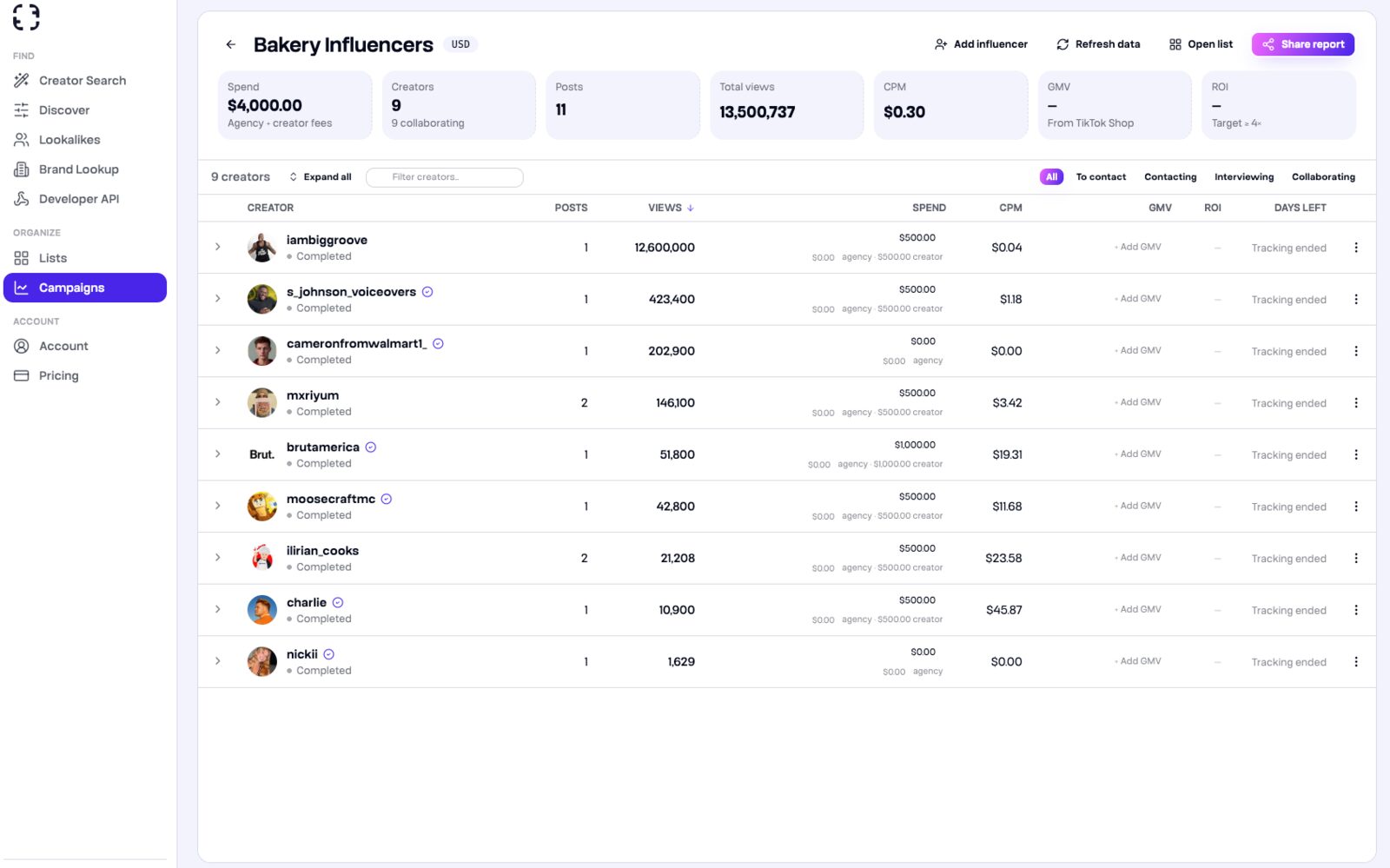
One dashboard for every creator post in the campaign, with CPM worked out from what you paid each creator.
What it costs. One credit is one creator profile. Pro is $99 a month for 10,000 credits, which is $9.90 per 1,000 profiles ($99 ÷ 10,000 × 1,000), plus 20,000 searches and 3 Ultra Searches. Agency is $199 a month for 20,000 credits shared with the API and MCP, unlimited searches and 15 Ultra Searches, which is $9.95 per 1,000 profiles. There is a free plan with no card; you add a card only at checkout (pricing). If you would rather hand over the sourcing, the Discovery Service ($499 a month) has our team run the searches and hand-filter the list.
When is a UGC marketplace the better pick?
When you want someone else to run the deal. Tokfluence finds and vets TikTok creators and tracks their posts; it does not write briefs, pay creators or hold licence contracts. If you need twenty ad variations next week from whoever is available, with payment and usage rights handled in one place, a UGC marketplace fits better. Our UGC creators guide compares their fees.
What are the most common UGC campaign mistakes?
Four, and each one maps to a step above:
- No goal (step 1). Videos made "for content" end up used nowhere, because nobody decided where they would run.
- A script instead of a brief (step 2). Creators reading your copy sound like your ads, which is the thing UGC exists to avoid.
- Rights agreed after filming (step 5). The creator has no reason to give you a good price on a licence once you are attached to the video.
- Judging creators on one video (step 7). Test the hooks first. A good creator with a weak opening is a cheap fix; a weak creator is not.
Sources
- UGC rate average: ppc.io, UGC Rates in 2026, January 2026
- Influee average video price: influee.co/pricing, read October 2026
- Collabstr average TikTok collaboration: Collabstr 2026 Influencer Marketing Report, as reported by Net Influencer, January 2026
- Usage rights premiums: Gigapay, Influencer Usage Rights and Whitelisting Fees in 2026, October 2026, compiling benchmarks from UGC Bloom, InfluencerFee, CreatoHunt and Influencer Marketing Hub
- 2-second and 6-second video view definitions: TikTok Ads Manager help, video play metrics
- Disclosure rules: FTC, Endorsement Guides: What People Are Asking
- Outreach reply rates: our first influencer campaign guide
- Tokfluence plans and credits: tokfluence.com/pricing, read October 2026