
Influencer Gifting and Product Seeding
Under 7% of niche TikTok creators tag a gift. When gifting beats paying, the break-even post rate, the disclosure rules, and a message to send before you ship.
TL;DR
- The definition: influencer gifting is sending a creator free product with no obligation to post. Product seeding is the same thing done at scale, to dozens or hundreds of creators at once. A paid post is a contract: fee, deliverable, deadline.
- Where it works: nano and micro creators in a niche that films products, with a product people actually want on camera. In our index, the share of creators using #ad or #sponsored doubles or triples from nano to micro size, while gifting hashtags rise less: bigger creators expect a fee.
- The cost is not just the product: add packaging and postage, then divide by the share who post. If too few post, a gifted post can cost as much as a paid one.
- Gifted still means disclosed: the FTC, the UK's ASA and TikTok's own rules all treat a free product as something to disclose. "Gifted" on its own is not enough in the UK; "Ad" up front is.
- The caveat: our hashtag numbers count creators who tag gifts, not everyone who has received one. Many disclose with TikTok's toggle instead.
Influencer gifting is the cheapest way to get a product in front of creators, and the easiest to waste money on. Boxes go out, a few posts come back, and nobody can say whether it worked.
This guide covers the parts that decide whether it works: what gifting is and is not, which creators it suits, what it really costs per post, the disclosure rules, how to pick the creators, a message to send before you ship anything, and how to track the results. It also includes something we measured ourselves: how often TikTok creators in three niches tag gifted content, by follower size.
What is influencer gifting?
Influencer gifting is sending a creator your product for free, with no contract and no required post. You are hoping they like it enough to talk about it. Product seeding is the same approach run as a programme: one product, sent to a large group of chosen creators in one wave.
The line that matters is not gifting versus seeding; it is gifting versus paying.
| Gifting | Product seeding | Paid post | |
|---|---|---|---|
| What the creator gets | The product | The product, sent as part of a batch | A fee, usually plus the product |
| Can you require a post? | No | No | Yes, in the contract |
| Can you approve the content? | No | No | Usually, within limits |
| Typical scale | A handful of creators | Dozens to hundreds | One to a few dozen |
| Cost per creator | Product, packaging, postage | Same, per box | Fee plus product |
| Best for | Relationships, warm leads | Testing creators and angles at volume | Guaranteed deliverables and dates |
If you need a post on a set date, with set talking points, you need a paid deal, not a gift. Once you ask for a deliverable in return for the product, most of the rules and expectations of a paid deal apply anyway.
When does influencer gifting work?
When the creator would plausibly have bought the product anyway, and is small enough that a free one still feels like a nice surprise. In practice that means four conditions:
- Nano and micro creators. Roughly 1,000 to 50,000 followers. Bigger creators are sent so much product that an unsolicited box rarely gets opened on camera. Our nano influencers guide covers who sits at the small end and why they suit seeding.
- A product that films well. Skincare, food, gadgets, fitness gear and home products show their value in a 30-second video. Software, insurance and anything that needs a long explanation rarely do.
- A niche where people review products. Some niches are built on reviews and hauls. Others, such as many fitness accounts, are mostly workouts, where a product appears only if it fits the routine.
- Enough margin to send a lot. Seeding is a numbers game. If you can only afford ten boxes, a small paid deal will usually teach you more.
Gifting is the wrong tool when you have a launch date, a fixed message, or a need to prove return on spend to someone who will ask for a guaranteed number. Pay for those.
How common is gifted content on TikTok?
Less common than you would think, and less common among the smallest creators. We searched our index in three niches and counted the share of creators who have posted under a gifting hashtag, and the share who have posted under #ad or #sponsored.
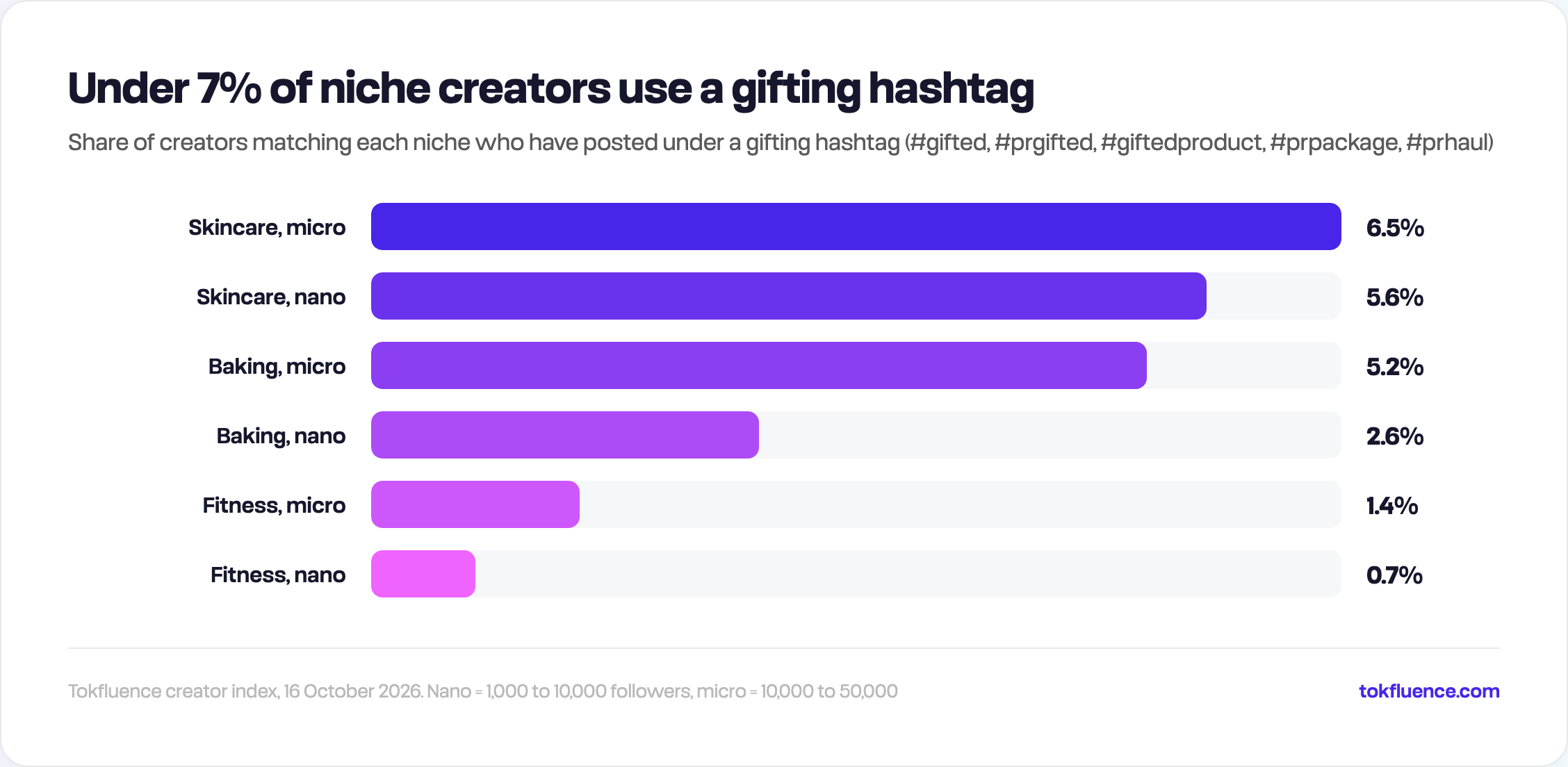
| Niche and tier | Use a gifting hashtag | Use #ad or #sponsored | Gifting tags per paid tag |
|---|---|---|---|
| Skincare, nano | 5.6% | 4.9% | 1.14 |
| Skincare, micro | 6.5% | 9.8% | 0.66 |
| Baking, nano | 2.6% | 3.4% | 0.78 |
| Baking, micro | 5.2% | 10.2% | 0.51 |
| Fitness, nano | 0.7% | 1.6% | 0.47 |
| Fitness, micro | 1.4% | 4.5% | 0.30 |
Measured: Tokfluence creator index, 16 October 2026. Nano is 1,000 to 10,000 followers, micro 10,000 to 50,000. Gifting hashtags are #gifted, #prgifted, #giftedproduct, #prpackage and #prhaul. Method at the end of this article.
Three things follow:
- Most niche creators have no visible history of gifted content. Even in skincare, the most product-heavy niche we checked, fewer than 7% tag a gift. A well-chosen box is still a novelty for most of the people you will send it to.
- Paid tags double from nano to micro; gifting tags do not keep up. In every niche, the share using #ad or #sponsored roughly doubles or triples between the two tiers. At micro size, paid tags outnumber gifting tags by 1.5 to 3.3 times in all three niches. Above a certain size, a free product is no longer the default deal.
- The niche matters more than the tier. Fitness creators tag gifts at a fifth to an eighth of the rate of skincare creators. If your category is not one where people unbox and review, expect a lower post rate and plan the volume accordingly.
How much does product seeding cost?
The real cost is the cost per box divided by the share of creators who post. The box is the product at cost, packaging, any insert, and postage. Use your own figures; the ones below are placeholders to show the maths.
| Line | Example |
|---|---|
| Product, at your cost | $12 |
| Packaging and printed note | $3 |
| Postage (check your carrier's current rates) | $10 |
| Cost per box | $25 |
| Boxes sent | 100 |
| Total spend | $2,500 |
Now divide by the posts you actually get:
| Share of creators who post | Posts | Cost per post |
|---|---|---|
| 50% | 50 | $2,500 / 50 = $50 |
| 25% | 25 | $2,500 / 25 = $100 |
| 10% | 10 | $2,500 / 10 = $250 |
Compare that with paying. Published TikTok rates for nano creators are about $50 to $200 a video, according to Influencer Marketing Hub and Modash; our TikTok creator rates by tier goes through what those figures do and do not show. So in the example above, against a $100 paid post, gifting wins only while a quarter or more of the creators post.
That gives you a simple break-even:
Break-even post rate = cost per box / what you would pay per post. At $25 a box against a $100 paid post, you need 25% of creators to post.
Published post-rate benchmarks for seeding vary widely and rarely show their sample, so do not plan on one. Send a first wave of 20 to 30 boxes, measure your own rate, then decide whether to scale, change the creators, or switch to paid.
Two costs are easy to forget. Management time: every box means an address to collect, a shipment to chase and a post to check. Returns and losses: some parcels go missing, and some creators never reply after giving an address.
What are the disclosure rules for gifted products?
A free product counts as something of value, so a creator who mentions it should disclose it, in the US, the UK and on TikTok itself. This is general guidance, not legal advice.
| Who | What it says about gifts | What to ask creators to do |
|---|---|---|
| US, FTC | "If a brand gives you free or discounted products or other perks and then you mention one of its products, make a disclosure even if you weren't asked to mention that product." (FTC) | Disclose clearly in the video and caption; #ad or #sponsored is fine. Avoid vague tags like "sp" or "collab" |
| UK, ASA and CMA | When a brand gives an influencer "a payment or any other incentive (requested or unsolicited)", content about the brand must be "obviously identifiable as advertising". "Gifted" on its own is listed as unlikely to be clear enough. (ASA) | Put "Ad" up front, for example "Ad, gifted by [Brand]" |
| TikTok | Content posted in exchange for something of value, including free products, should be disclosed with TikTok's content disclosure setting. (TikTok Help Center) | Switch on the branded content toggle, as well as a written label |
The FTC also says not to rely on a platform's tool alone, so the safe instruction is both: toggle on, plus a clear label in words. Put it in the note inside the box and in your first message, so it never comes as a surprise after the post goes up.
How do you pick creators for gifting?
Start from people who already talk about your category, then filter for fit and reach. Five checks, in the order that removes the most wrong fits:
- Brand mentions. Creators who already tag your brand are your warmest list. Creators who tag your competitors already buy and film your category. Our brand ambassador guide found that about half of the creators tagging big brands such as Glossier or CeraVe have under 50,000 followers, which is the gifting sweet spot.
- Niche, not size. Search by what the creator films. A 4,000-follower account that only posts sourdough beats a 40,000-follower lifestyle account that bakes once a month.
- Region. Only send where you can ship cheaply and sell. A creator whose audience is in another country is a box that cannot convert.
- A way to reach them. A published email makes the address and follow-up easy. Without one, you are working in DMs.
- Recent, real engagement. Check the last ten posts. Steady views and comments that talk about the content are a better signal than one viral video.
Skip creators whose recent posts are a wall of #gifted hauls with no opinion attached. A box that becomes one of twelve products in a haul is not the review you are paying postage for.
How do you find gifting creators with Tokfluence?
Use Tokfluence to build the shortlist; the shipping and the relationship stay with you. Tokfluence is a TikTok creator search tool, and it is the tool we build, so weigh this section accordingly.
- Search by niche, in plain words, for example "clean skincare routine" or "home sourdough". Run two or three phrasings; different words find different people.
- Add brand mentions. Put your own handle and two or three competitors' handles in the mentions filter, or use Brand Lookup, to find creators already tagging them.
- Add the gifting hashtags. Put #gifted, #prgifted, #giftedproduct, #prpackage and #prhaul in the hashtag filter, the same tags measured in the table above, to find creators who already post gifted content and accept boxes. Skip the ones whose feed is all hauls.
- Set followers to 1,000 to 50,000, or 1,000 to 10,000 for a nano-only wave.
- Set the region to the countries you ship to, and filter on has email. Tokfluence shows contact details where creators publish them, so you can send the address request by email; the rest go on a DM list.
- Check recent posts and engagement, save the best fits to a list and export it as a CSV for your outreach and shipping sheet.
If your niche comes back thin, that is where Tokfluence differs from a static database: it can crawl TikTok for it on demand. API and MCP access is not included in Pro. A live crawl can be started from an AI assistant through our TikTok MCP server, for 250 credits, and the new creators become searchable a few hours later. Our micro-influencer search guide shows the same filters on a worked example.
| Plan | Price | What you get | Cost per 1,000 profiles |
|---|---|---|---|
| Pro | $99 a month | 10,000 email reveals a month, 20,000 searches, 3 Ultra Searches | API and MCP access is not included in Pro |
| Agency (legacy) | not offered to new customers | existing subscribers keep their plan |
One credit is one creator profile, so a month of Pro lets you look at thousands of candidates for a 100-box wave and keep the best. There is a free plan with no card; you add a card only at checkout. Discovery Service is a legacy plan and is not offered to new customers. Details on the pricing page.
What should a gifting outreach message say?
Ask before you ship. An unannounced box is easy to ignore; a creator who said yes to it has already half-committed to opening it. Keep it short enough to read on a phone.
First message (email or DM):
Hi [name], I loved your [specific video], especially [one detail]. I work at [Brand]; we make [product, in five words]. Could I send you one to try? It is a gift, no post required. If you do share it, please tag it as an ad, since it was free. Just reply with a shipping address if you would like one.
After delivery (5 to 7 days later):
Hi [name], your [product] should have arrived. No pressure at all, I just wanted to check it got there safely. If you have any questions about it, I am here.
Why it works: the compliment proves you watched their content, the offer and the "no post required" are in plain words, and the disclosure ask comes before the gift, not after the post. The follow-up checks delivery rather than asking for content, which is the honest version of a nudge. For the email-or-DM decision at each follower size and a full follow-up schedule, see our influencer outreach templates.
How do you track a gifting campaign?
Log every box with its cost, then record every post that comes back and judge the wave on cost per view and cost per post. Without that, seeding feels busy and proves nothing.
Track four numbers per wave:
| Metric | How to get it | What it tells you |
|---|---|---|
| Post rate | Posts received / boxes delivered | Whether your creator selection and product fit |
| Cost per post | Total wave cost / posts | Whether gifting beats paying, against your break-even |
| Cost per 1,000 views | Total wave cost / total views x 1,000 | Reach efficiency, comparable with paid and ads |
| Sales or code uses | A unique code or link per creator | Whether anyone bought |
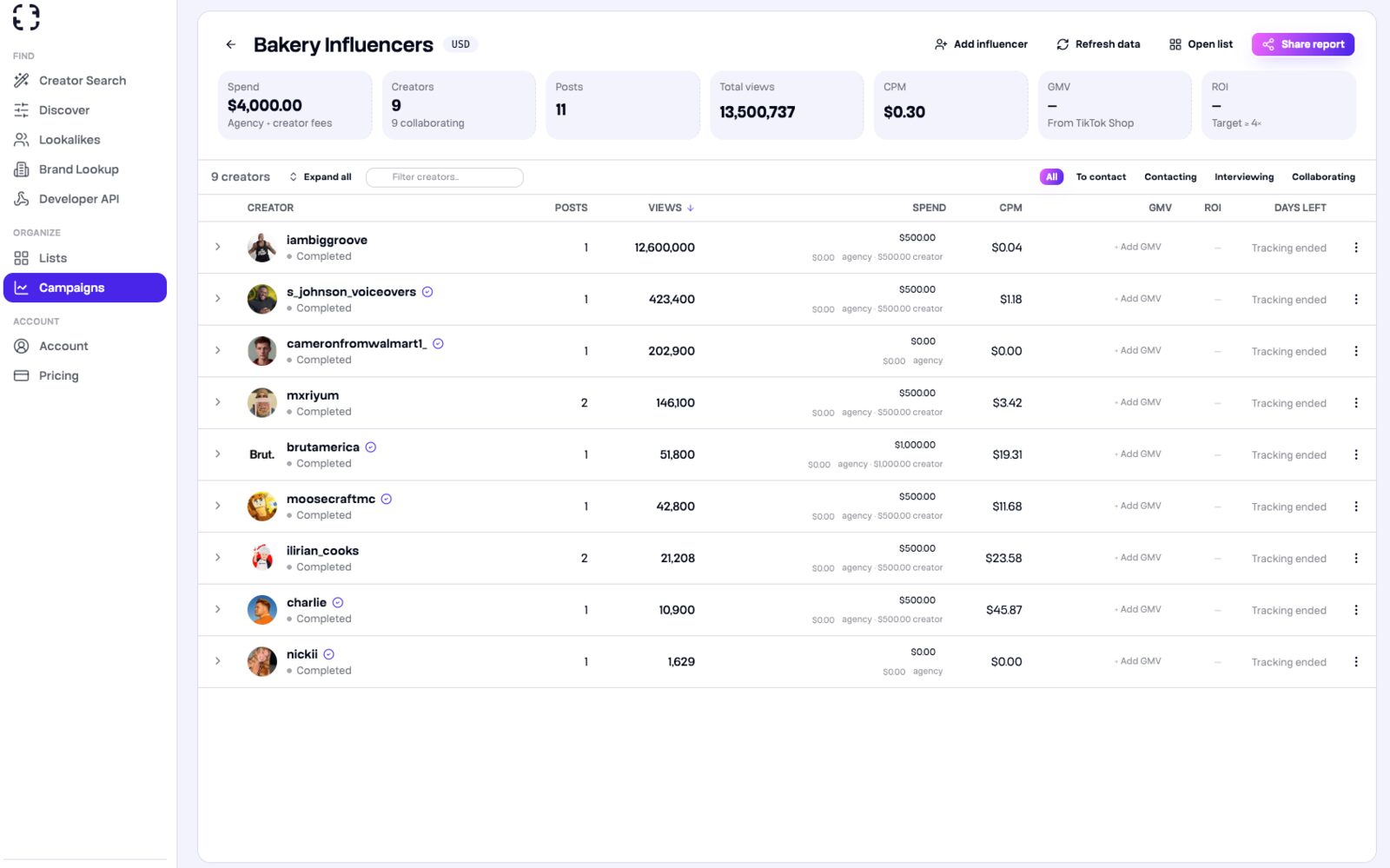
Campaign tracking: paste the post URLs, set each creator's spend to the cost of their box, and views and cost per 1,000 views update for the whole wave.
Tokfluence's campaign tracking does this for TikTok posts: add the post URLs in bulk, enter the spend per creator (for a gift, the cost of the box), and it collects views and engagement and works out cost per view. A shareable report link lets someone else read the results without a login.
The creators who post without being asked, and get good views, are the ones to offer a paid deal or an ambassador role next. That is the real output of a seeding wave: a short list of proven people.
When is gifting the wrong call?
When you need certainty. Gifting cannot promise a post, a date, a message or a number of views, so it is a poor fit for a launch, a regulated product with strict claims, or a team that has to justify every dollar against a guaranteed result.
It is also hard work at scale with no tooling: addresses, shipments and posts across a hundred creators is a spreadsheet that breaks quickly.
Pick something else if you want one platform to collect addresses, ship the product and gather the posts for you. Tokfluence finds and vets the creators and tracks the posts; it does not run your shipping or pay creators. Dedicated seeding and creator-management platforms bundle those pieces, and charge for them.
How we got these numbers
- Source: the Tokfluence creator index, queried on 16 October 2026.
- Niches: creators matching the keyword "skincare", "baking" or "fitness" in their bio, hashtags or captions.
- Tiers: nano is 1,000 to 10,000 followers, micro is 10,000 to 50,000.
- Gifting hashtag: the creator has posted under at least one of #gifted, #prgifted, #giftedproduct, #prpackage or #prhaul. Paid hashtag: at least one of #ad or #sponsored. Each share is matching creators divided by all creators matching the niche keyword in that tier.
What these numbers do not prove:
- Hashtags undercount. Many creators disclose with TikTok's toggle or in words, and some do not disclose at all. These are shares of creators who tag, not of creators who have been gifted or paid.
- #ad is not only paid. UK creators are told to label gifts "Ad" too, so some #ad posts are gifts.
- Keyword matches are loose. A match includes some shops and creators who mentioned the niche once.
- Our index is not all of TikTok. These are shares of the creators we hold, and three niches are a small sample. Your category may look different.
Sources
- US Federal Trade Commission, Disclosures 101 for Social Media Influencers, read October 2026
- Advertising Standards Authority, Recognising ads: Social media and influencer marketing, read October 2026
- TikTok Help Center, Branded content on TikTok, read October 2026
- Influencer Marketing Hub, TikTok Influencer Rates in 2026, August 2026
- Modash, Influencer Pricing: What Influencer Marketing Costs in 2026, October 2026
- Tokfluence pricing, tokfluence.com/pricing, read October 2026
- Hashtag shares: Tokfluence creator index, 16 October 2026 (method above)