
How to Build a Brand Ambassador Program
About half the creators who tag big brands on TikTok have under 50,000 followers. Here is how to turn people like that into ambassadors: structure, pay, contract and KPIs.
TL;DR
- The definition: a brand ambassador program is a standing group of creators who post about you repeatedly, for months, under one set of terms. A one-off influencer deal buys a single post; a program buys a relationship.
- Pick one structure to start: gifting for nano creators, affiliate commission for creators whose audience already buys online, a monthly retainer only for the few you are sure about. In Modash's survey, three-fifths of brands paid 10% to 14% per sale.
- Recruit from people who already talk about you: customers first, then creators who tag you or your competitors. In our index, roughly half of the creators who tag big brands such as Glossier, Gymshark or CeraVe have under 50,000 followers.
- Write the terms down: deliverables, term, exclusivity, usage rights and disclosure. On TikTok, ambassadors must switch on the branded content toggle when a post is made in exchange for something of value.
- The caveat: retainer "benchmarks" that circulate online are rarely sourced. Price a retainer from per-post rates and the number of posts you want, not from a published table.
Most brand ambassador guides are written for community software or referral programs: a signup form, a points system, a leaderboard. This one is for a brand that wants TikTok creators posting about its product every month, and it covers the four decisions that actually shape the program: the structure, who to recruit, what goes in the contract, and how you will know it is working.
It also includes something we could measure ourselves: who tags big consumer brands on TikTok, by follower size, and why that matters when you go looking for ambassadors.
What is a brand ambassador program?
A brand ambassador program is an ongoing arrangement where a group of creators or customers promote your brand repeatedly, usually for three months or more, in exchange for product, commission, a fee, or a mix. The difference from a normal influencer campaign is time: you are building a bench of people who know your product, not booking one post at a time.
| One-off influencer deal | Brand ambassador program | |
|---|---|---|
| Length | One post or one campaign | Months, often renewed |
| Number of creators | Whoever fits this campaign | A standing group, added to over time |
| How they are paid | Usually a flat fee per post | Gifting, commission, retainer, or a mix |
| What you get | Reach for one launch | Repeated mentions, a steady flow of content, product feedback |
| What the audience sees | One ad | The same person using your product over time |
| Work for your team | Brief, approve, pay, done | Onboarding, a calendar, payouts, regular check-ins |
Repetition is the point. A creator who mentions your product in March, May and August is far more believable than one who posts once and moves on to a competitor. It is also why marketers have been shifting budget this way: in Modash's 2026 pricing research, 75% of influencer marketers said they ran more long-term partnerships in 2024 than in 2023.
Which ambassador program structure should you choose?
Start with the one that matches your margins and the size of creator you want. Most programs end up hybrid, but launching with one clear offer makes recruitment far easier.
| Structure | How it works | Best for | Cost to you | Watch out for |
|---|---|---|---|---|
| Gifting | Free product, sometimes early access or exclusives | Nano creators and existing fans | Product plus shipping | You cannot require a post or a deadline. Treat it as seeding |
| Affiliate commission | A code or link, paid per sale | Creators whose audience buys online, TikTok Shop sellers | A share of each sale, only when it sells | Weak if your product converts poorly; creators know their numbers |
| Monthly retainer | A fixed fee for an agreed number of posts per month | Micro and mid-tier creators you already trust | Fixed, whether or not posts perform | Hardest to unwind. Start with a short term |
| Hybrid | Product plus commission, or a lower retainer plus commission | Your best performers, after a trial period | Mixed | More moving parts to track and pay out |
A simple way to decide:
- Tight margins, unproven product: gifting, and watch who posts without being asked.
- E-commerce with healthy margins: affiliate commission, with a tiered bonus for top sellers.
- You need a fixed volume of content each month: a retainer, but only for creators who have already posted for you once.
How much should you pay brand ambassadors?
It depends on the structure, and only commission has a usable public benchmark.
Commission. In Modash's survey of brands, three-fifths paid influencers 10% to 14% per sale, and the rest paid 15% or more. If you sell through TikTok Shop, the seller sets the rate: TikTok's Seller Center lets you choose an affiliate commission between 1% and 80% of GMV per order, and a targeted collaboration with named creators overrides the open rate, so you can pay your ambassadors more than anonymous affiliates.
Retainer. Build it from per-post rates rather than from a published "retainer benchmark". The tables that circulate online for monthly ambassador fees rarely say where their numbers come from. A defensible method:
- Decide the deliverables per month, for example two TikToks and one story-style repost.
- Look up what that creator's tier typically charges per video. Our TikTok creator rate card puts published ranges at roughly $50 to $200 for nano and $200 to $1,000 for micro creators, with sources.
- Multiply, then offer a modest discount in exchange for guaranteed monthly work. A creator trades a lower per-post price for predictable income.
- Price usage rights separately. If you want to run their videos as ads, that is an add-on, covered in our influencer whitelisting explainer.
Gifting. The cost is the product and shipping. Cheap per creator, but you are paying for a chance of a post, not a post.
Where do you find brand ambassadors?
Start with people who already use and mention your product, then widen. Four pools, in the order we would work them:
- Your existing customers. Look at who reviews, tags or emails you. They need no persuading, and an ambassador who genuinely uses the product shows it on camera.
- Creators who already tag your brand. Search TikTok, or a creator index, for accounts mentioning your handle. These are your warmest leads.
- Creators who tag your competitors. They already buy in your category and film it. Some will be under contract; many are not.
- Micro and nano creators in your niche. Search by what they film, not by follower count. Smaller creators are more likely to say yes to a long-term deal and cheaper to keep.
Who tags big brands on TikTok?
We looked at creators in our index who mention five well-known consumer brands, and checked what share of them have under 50,000 followers.
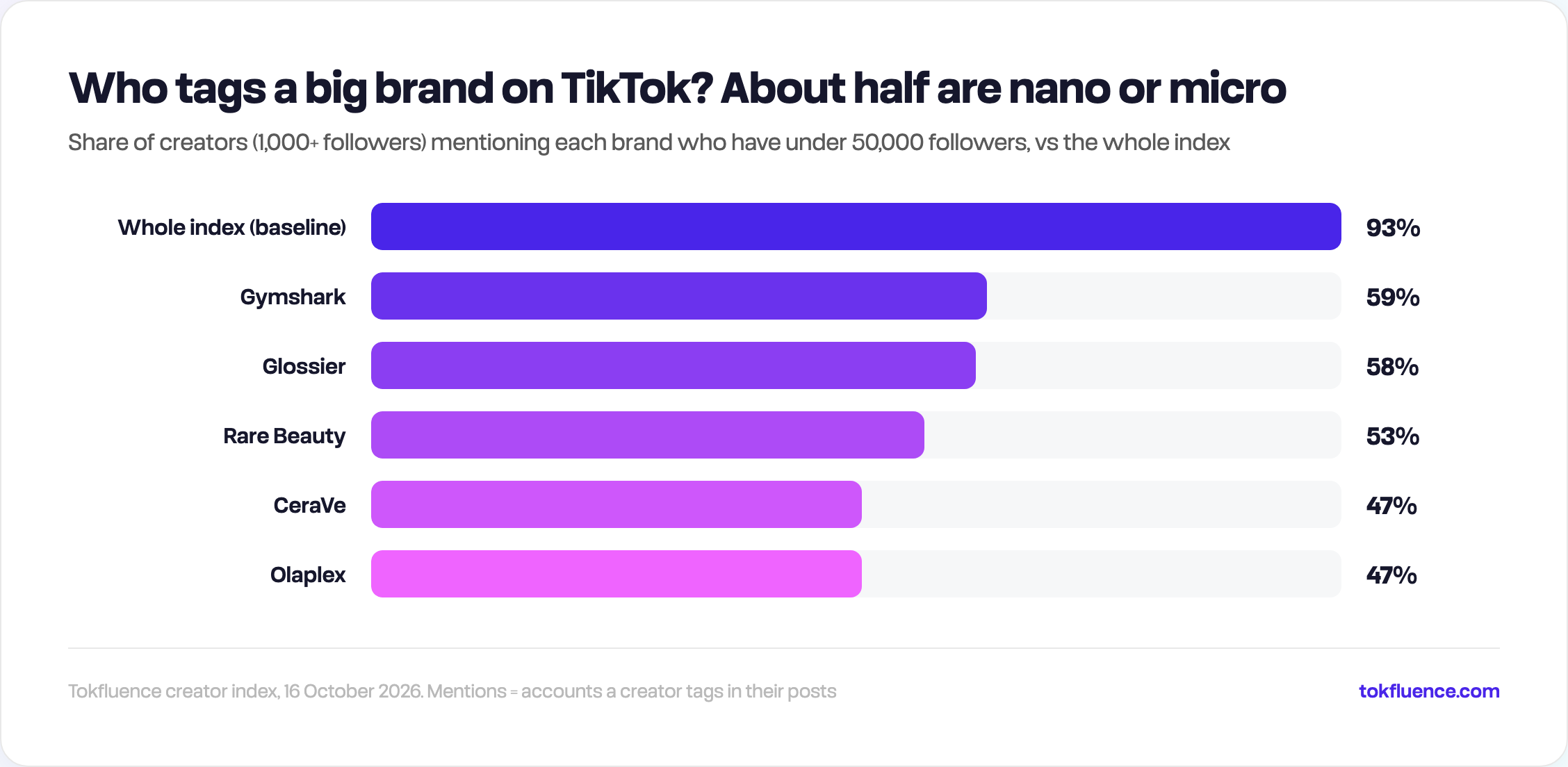
| Brand | Creators (1,000+ followers) mentioning it who have under 50,000 followers |
|---|---|
| Gymshark | 59% |
| Glossier | 58% |
| Rare Beauty | 53% |
| CeraVe | 47% |
| Olaplex | 47% |
| Whole index, for comparison | 93% |
Measured. Tokfluence creator index, 16 October 2026. Method at the end of this article. At least, on TikTok: the nano and micro creators (1,000 to 50,000 followers) in our index on 8 September 2026 come to 15.3 million (12.8M nano + 2.4M micro), about 1% of TikTok's 1.59 billion ad reach (DataReportal, January 2025). That is a floor: TikTok has more accounts than we have crawled.
Two things follow from this:
- About half of the people tagging a big brand are nano or micro creators. That is your ambassador pool: people already filming the product, at a size where a long-term deal is affordable and welcome.
- Brand mentions skew much bigger than TikTok in general. Across our whole index, 93% of creators with 1,000+ followers are under 50,000, which means at least 15.3 million such creators on TikTok. Among those tagging these brands, it is closer to half. Some of that gap is paid work: larger creators tag brands because brands pay them to. So when you search competitor mentions, filter to under 50,000 followers to find fans rather than someone else's sponsored talent.
For more on what separates the tiers, see our nano, micro and macro influencer breakdown.
How do you find brand ambassador candidates with Tokfluence?
Use Tokfluence to build the candidate list, then recruit from it. Tokfluence is a TikTok creator search tool. It is also the tool we build, so weigh this section accordingly.
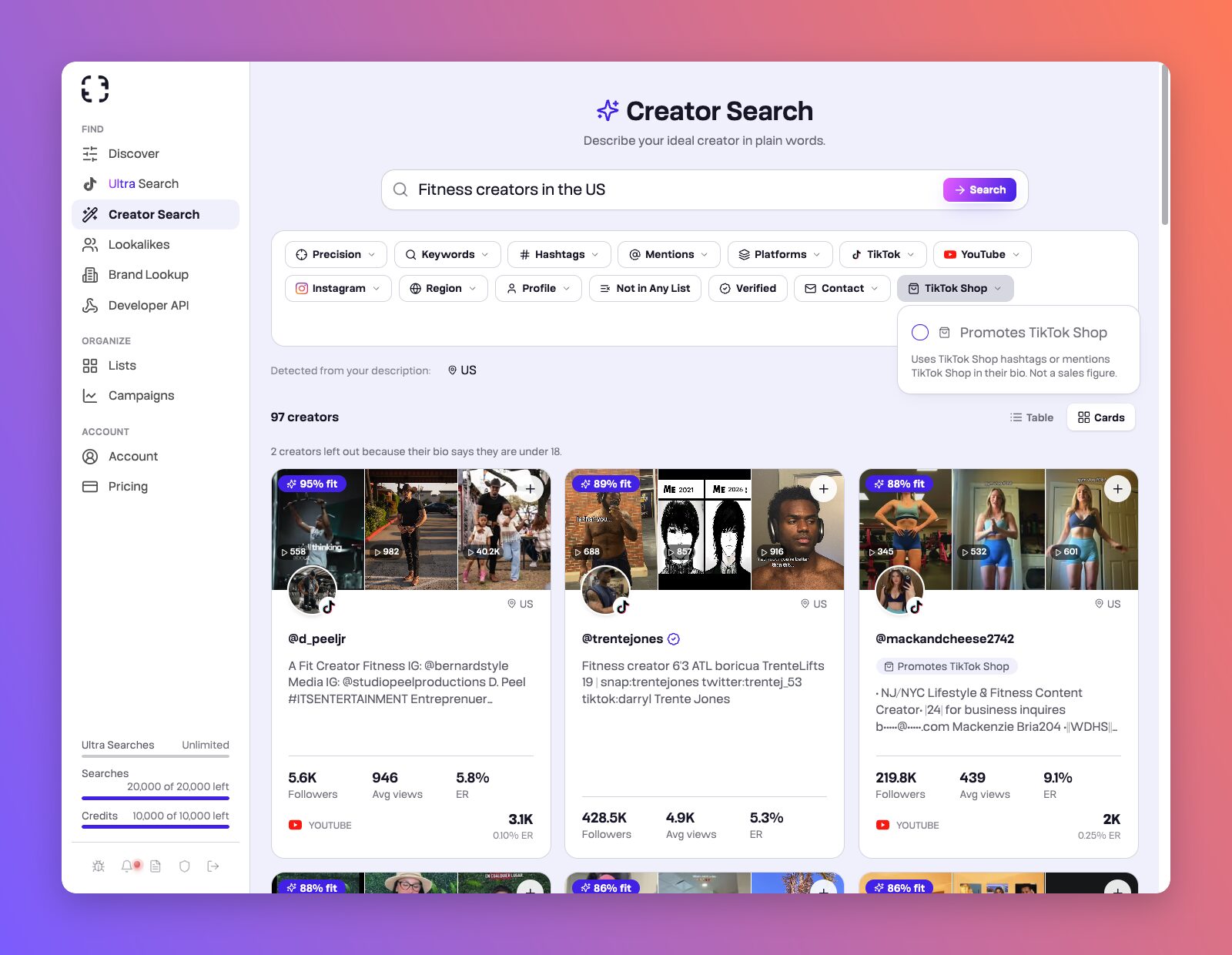
- Search by what the creator films, in plain words, for example "clean skincare routine" or "home gym". Run three or four phrasings; different words find different people.
- Filter by brand mentions. Add your own handle to find people who already tag you, then your competitors' handles to find people already buying in your category.
- Set a follower range. 1,000 to 50,000 for nano and micro ambassadors. This also screens out much of the paid talent described above.
- Filter on "has email" to keep creators who publish a contact address, so recruitment goes by email. Tokfluence shows contact details where creators publish them; everyone else goes on a DM list.
- Add the TikTok Shop filter if your ambassadors will sell through TikTok Shop. It keeps creators who use TikTok Shop hashtags or mention TikTok Shop in their bio. It is a signal that they already sell, not a sales figure.
- Check recent posts, save the best fits to a list, and export a CSV for your outreach tool.
If your niche comes back thin, Tokfluence can crawl TikTok for it on demand. On the Agency plan you can start that crawl yourself from an AI assistant through our MCP server, for 250 credits, and the new creators become searchable a few hours later. Our guide to finding micro-influencers covers the search side in more detail.
| Plan | Price | What you get | Cost per 1,000 profiles |
|---|---|---|---|
| Pro | $99 a month | 10,000 credits, 20,000 searches, 3 Ultra Searches | $99 / 10 = $9.90 |
| Agency | $199 a month | 20,000 credits shared with the API and MCP, unlimited searches, 15 Ultra Searches | $199 / 20 = $9.95 |
| Discovery Service | $499 a month | 100,000 credits; our team runs the searches and hand-filters the list for you | $499 / 100 = $4.99 |
One credit is one creator profile. There is a free plan with no card; you add a card only at checkout. Source: tokfluence.com/pricing, read October 2026.
When you write to candidates, our influencer outreach templates cover which channel to use at each follower size and how often to follow up.
What should a brand ambassador contract include?
Seven things, in writing, before the first post. A short agreement is fine for gifting; anything with money or ad rights needs a proper one, reviewed by someone qualified in your jurisdiction.
| Clause | What to agree | Why it matters |
|---|---|---|
| Term | Start date, length (three to six months is a sensible first term) and renewal | A short first term lets both sides walk away cleanly |
| Deliverables | Posts per month, format, rough timing, whether stories or lives count | "Some posts" becomes an argument by month two |
| Compensation | Product, commission rate, retainer amount, when and how you pay | Late or unclear payouts are the fastest way to lose good ambassadors |
| Exclusivity | Which competitors they cannot promote, and for how long | Exclusivity costs money; keep it narrow, by category, not "any brand" |
| Usage rights | Whether you can repost, and whether you can run their videos as ads | Paid ad use is an add-on, priced separately |
| Disclosure | How every paid or gifted post is labelled | It is required, and it protects both of you |
| Termination | Notice period, and what happens to unpaid commission | Decide the exit before you need it |
On disclosure, two rules apply. The FTC's endorsement guidance covers gifted product as well as paid posts, and TikTok requires creators to turn on its branded content toggle, which labels the post as a paid partnership, whenever they post branded content. Put both in the contract so nobody has to remember.
Which KPIs should you track for an ambassador program?
Pick one primary goal and two or three numbers that prove it, then review them monthly per ambassador.
| Goal | Primary KPI | Supporting numbers |
|---|---|---|
| Sales | Revenue per ambassador, from their code or link | Orders, conversion rate, average order value |
| Content | Usable videos per month | Share you repost or turn into ads |
| Awareness | Views per post, against that creator's usual average | Engagement rate, saves, shares |
| Retention of ambassadors | Share still active after three months | Posts delivered vs agreed |
| Efficiency | Cost per 1,000 views, or cost per sale | Total program cost per month |
Two habits make these numbers useful:
- Compare each ambassador with their own baseline, not with the program average. A nano creator with 800 views a post who gets 3,000 on your video has done well.
- Cut and replace quarterly. Every program has a long tail of people who stop posting. Renew the top performers on better terms, let the rest lapse, and refill from your candidate list.
If you want to report on posts without spreadsheets, Tokfluence's campaign tracking collects views, engagement and cost per view for a list of TikTok post URLs.
When is an ambassador program the wrong call?
When you need one big moment rather than a steady drumbeat. A product launch with a fixed date, or a short seasonal push, is usually better served by a one-off campaign: our guide to running your first influencer campaign covers that path.
It is also hard going if you cannot ship product reliably, cannot track sales per creator, or have no one to look after the program weekly. Ambassadors notice when a brand goes quiet.
And if you want recruitment, contracts, payments and affiliate links in one system, Tokfluence is not that system. We find and vet creators at volume and hand clean data to the tools you already use. Dedicated creator-management platforms bundle those pieces; check that payments and affiliate tracking are on the plan you are quoted. The same goes for deep Instagram audience analysis: we are TikTok-first, and show the Instagram and YouTube profiles creators link rather than analysing those audiences.
How we got the brand-mention numbers
- Source: the Tokfluence creator index, queried on 16 October 2026.
- Mentions: accounts a creator tags in their own posts, as captured in our index (handles
gymshark,glossier,rarebeauty,cerave,olaplex). - Population: creators with 1,000 or more followers. "Under 50,000" means 1,000 to 50,000 followers.
- Baseline: the same follower split across every creator in our index with 1,000+ followers.
- Limits: our index is not all of TikTok, so these are shares of the creators we hold, not TikTok-wide counts. The one TikTok-wide figure, 15.3 million creators under 50,000 followers, is the nano plus micro count in our index (12,820,941 + 2,434,184 on 8 September 2026), so it is a floor, not a census. A mention does not say whether the post was paid, gifted or organic, and the counts include some shop and brand accounts. Five brands is a small sample, chosen because they are well-known and widely tagged; your category may look different.
Sources
- Commission survey and long-term partnership trend: Modash, Influencer Pricing: What Influencer Marketing Costs in 2026, October 2026
- TikTok Shop commission range and targeted collaborations: TikTok, About open collaborations in Seller Center, read October 2026
- Disclosure rules: FTC, Endorsement Guides: What People Are Asking
- TikTok content disclosure setting: TikTok Help Center, Branded content on TikTok, read October 2026
- Brand-mention shares: Tokfluence creator index, 16 October 2026 (method above)
- TikTok ad reach: DataReportal, TikTok statistics and trends, January 2025 (1.59 billion)
- Tokfluence plans and credits: tokfluence.com/pricing, read October 2026