
Influencer Contract Template (Free Download) and What to Negotiate
A complete influencer contract you can copy or download, with a clause-by-clause guide to what creators push back on and a fair default for each.
TL;DR
- The template: a complete influencer contract is below, ready to copy, and as a Word download. It covers parties, deliverables, timeline and approval, payment, usage rights and whitelisting, exclusivity, disclosure, IP, confidentiality and termination.
- The clauses that cost money: usage rights, whitelisting and exclusivity. Price each one as its own line in the fee, with a term in days, instead of folding them into "the fee".
- The clause brands skip: disclosure. The FTC and the UK's ASA hold brands responsible too, so the contract should require a clear "Ad" label and TikTok's disclosure setting, not just "comply with the law".
- Who it is not for: gifting with no required post, UGC that never goes on the creator's feed, and year-long ambassador deals. Each needs a different document.
- The caveat: this is a starting point, not legal advice. Have a lawyer in your country review it before you sign anything.
Many of the templates that rank for this search are a separate download kit, or a questionnaire that only hands over the contract after a trial or a fee. This one is on the page. Copy it, or download the Word file, fill in the brackets and send it.
Below the template is the part most templates leave out: what each clause does, what creators usually push back on, and a fair default for each. That is where a contract actually gets negotiated.
Not legal advice. This template is a practical starting point written by a marketing team, not by lawyers. Laws on advertising, contracts and tax differ by country and state. Have a qualified lawyer review your final contract before either side signs.
Where can I download a free influencer contract template?
Right here: download the influencer contract template as a Word file (.docx). It opens in Microsoft Word, Google Docs and Apple Pages, and it has the same text as the template below, with every value you need to fill in shown in [square brackets].
The template is written for a brand paying one creator for posts on TikTok (and optionally Instagram), with an optional add-on for paid usage and Spark Ads. It works for a creator signing directly or through a manager.
What should an influencer contract include?
Twelve things. The first eight decide what you pay for; the last four protect both sides when something goes wrong.
| # | Clause | What it settles |
|---|---|---|
| 1 | Parties | Who is signing, and that the creator is not an employee |
| 2 | Deliverables | How many posts, on which platforms, with which must-haves |
| 3 | Timeline and approval | Draft date, feedback window, revision rounds, post date |
| 4 | Fee and payment | How much, when, and what happens if it is late |
| 5 | Usage rights and whitelisting | Whether you can run the content as an ad, where, and for how long |
| 6 | Exclusivity | Which competitors the creator cannot work with, and for how long |
| 7 | Disclosure | How the post is labelled as an ad |
| 8 | Intellectual property | Who owns the video, and who owns the logos |
| 9 | Confidentiality | What both sides keep quiet, and until when |
| 10 | Termination | How either side can exit, and what gets paid |
| 11 | Liability | Who is responsible for which claims |
| 12 | General terms | Governing law, changes in writing, signatures |
The full influencer contract template
Copy everything from "Influencer Agreement" to the signatures. Delete any optional clause you do not need, and keep the clause numbers in order.
Influencer Agreement
This Influencer Agreement (the "Agreement") is made on [date] between:
[Brand legal name], a [company type] registered at [address] ("Brand"); and
[Creator legal name], who publishes as [@handle], of [address] ("Creator").
Brand and Creator are together "the parties".
1. Parties and relationship
1.1 Creator is an independent contractor. Nothing in this Agreement makes Creator an employee, agent or partner of Brand. Creator is responsible for their own taxes and social charges.
1.2 If Creator is represented by a manager or agency, [agency name] signs below on Creator's behalf and confirms it has authority to do so. Payments go to [Creator / agency].
2. Deliverables
2.1 Creator will create and publish the following content (the "Content"):
- [number] TikTok video(s), [length] seconds or longer, on [@handle];
- [optional: number] Instagram Reel(s) and [number] Stories on [@handle];
- [optional: other deliverables, for example raw footage or a link in bio for [number] days].
2.2 Each post will show [product] for at least [number] seconds, follow the brief in Schedule A, tag [@brand], and include the link or discount code [code], where the platform allows it.
2.3 Creator keeps creative control over the style, voice and format of the Content, within the brief in Schedule A.
2.4 Creator will keep each post live and public for at least [90] days after it is published.
2.5 Creator will send screenshots of each post's analytics (views, likes, comments, shares, saves and link clicks where available) [7] days and [30] days after it is published.
3. Timeline and approval
3.1 Brand will deliver the product to Creator by [date].
3.2 Creator will send a draft of each video and caption to Brand by [date].
3.3 Brand will approve the draft or request changes within [2] business days. If Brand does not reply in that time, the draft is treated as approved.
3.4 Brand may request up to [2] rounds of changes per video. Changes are limited to factual accuracy, the brief in Schedule A, brand safety and disclosure. A reshoot requested for any other reason is paid at [amount].
3.5 Creator will publish the approved Content on [date or date range], between [time] and [time] [time zone].
4. Fee and payment
4.1 Brand will pay Creator a total of [amount and currency] (the "Fee"), broken down in Schedule B. The Fee covers the deliverables in clause 2 and only the rights listed in Schedule B.
4.2 Brand will pay [50%] of the Fee within [7] days of signature and the remaining [50%] within [14] days of the last post going live, each against Creator's invoice.
4.3 Creator may keep the product. The product is not part of the Fee and does not reduce it.
4.4 If a payment is more than [14] days late, Creator may pause the remaining deliverables until it is paid, and late payments carry interest at [rate], where the law allows.
4.5 Brand will reimburse expenses only if Brand approved them in writing beforehand.
4.6 The Fee is [inclusive / exclusive] of VAT or sales tax.
5. Usage rights and whitelisting
5.1 Organic sharing. Brand may repost and share the Content on Brand's own organic social media accounts, crediting [@handle], for [12 months / the life of the post] at no extra fee.
5.2 Paid usage (optional). Brand may use the Content in paid advertising on [channels, for example TikTok, Instagram, Facebook] in [territories] for [30] days from the date it is first published (the "Usage Period"), for the usage fee in Schedule B. Any extension must be agreed in writing and is charged at [amount] per [30] days.
5.3 Whitelisting and Spark Ads (optional). Creator will give Brand a TikTok Spark Ads authorization code [and Instagram partnership ad access] for the posts listed in Schedule B, valid for [30] days, for the whitelisting fee in Schedule B. Brand controls the ad budget and targeting. Brand will not change the caption, publish new content from Creator's account, or reply to comments as Creator.
5.4 Edits. Brand may trim, crop, resize, add subtitles and add a Brand end card to the Content. Brand will not change its meaning or make Creator appear to say something they did not say.
5.5 When the Usage Period ends, Brand will stop starting new paid campaigns with the Content. Organic reposts made during the Agreement may stay up.
5.6 Brand may use Creator's name, handle and image only to identify Creator as the author of the Content, and only for this campaign.
6. Exclusivity (optional)
6.1 From [start date] to [end date] (the "Exclusivity Period"), Creator will not publish paid or gifted content for [named competitors, or a narrowly defined category, for example "plant-based protein powders"] on [platforms].
6.2 Exclusivity is paid for by the exclusivity fee in Schedule B.
6.3 Exclusivity does not apply to the existing partnerships Creator has listed in Schedule B.
7. Disclosure
7.1 Creator will clearly disclose the paid relationship with Brand in every post, in line with the rules of the countries the Content is aimed at, including the US Federal Trade Commission's Endorsement Guides and the UK CAP Code.
7.2 As a minimum, Creator will (a) put "Ad" or "#ad" at the start of each caption, (b) say or show that the post is an ad within the video, and (c) switch on TikTok's content disclosure setting, or the equivalent paid partnership tool on other platforms.
7.3 Brand will never ask Creator to hide, shorten or soften a disclosure. If a disclosure is missing or unclear, Creator will fix it within [24] hours of Brand's request.
7.4 Creator will only share honest opinions based on their own use of the product, and will not make any claim about the product (for example health, results or comparison claims) that is not listed as an approved claim in Schedule A.
8. Intellectual property
8.1 Creator owns the Content and its copyright. Brand receives only the rights set out in clause 5.
8.2 [Optional alternative: Creator assigns all rights in the Content to Brand on full payment of the buyout fee in Schedule B.]
8.3 Brand owns its trademarks, logos and product images, and gives Creator a limited right to use them only to make the Content.
8.4 Creator confirms the Content is original, and that Creator has permission from anyone who appears in it and the rights to any music, footage or images used, including for paid use under clause 5 where that applies.
9. Confidentiality
9.1 Both parties will keep confidential the Fee, the terms of this Agreement, and any unreleased product or campaign information, until [launch date] for campaign information and indefinitely for the Fee.
9.2 This does not cover information that is already public, or that a party must disclose by law. Creator may share the Agreement with their manager, accountant or lawyer.
10. Termination
10.1 Either party may end this Agreement by written notice if the other party materially breaches it and does not fix the breach within [7] days of being asked to.
10.2 Brand may end this Agreement immediately if Creator publicly engages in illegal, hateful or seriously offensive conduct that would reasonably damage Brand's reputation. Creator may end it immediately on the same basis about Brand.
10.3 Brand may cancel for any other reason by written notice. If it does, Brand will pay [25%] of the Fee if no Content has been created yet, and the full fee for every deliverable already drafted or published.
10.4 On termination, Brand pays for all work completed, and the rights in clause 5 continue only for Content that has been paid for.
11. Liability
11.1 Brand is responsible for the accuracy of the product information and approved claims it provides, and for the safety of its product.
11.2 Creator is responsible for anything Creator says or shows in the Content beyond the brief and the approved claims.
11.3 Neither party is liable for indirect or consequential loss. Each party's total liability under this Agreement is limited to [the Fee], except where the law does not allow this to be limited.
12. General terms
12.1 This Agreement and its Schedules are the whole agreement between the parties about this campaign.
12.2 Any change must be agreed in writing. Email from both parties counts.
12.3 Neither party may transfer this Agreement to someone else without the other's written consent.
12.4 This Agreement is governed by the law of [country or state], and the courts of [place] decide any dispute.
12.5 Notices go to: Brand at [email]; Creator at [email].
Signed for Brand: [name, title, signature, date]
Signed by Creator (or the agency on Creator's behalf): [name, signature, date]
Schedule A: Campaign brief
- Product: [product name, variant, value]
- Campaign goal: [awareness / clicks / sales]
- Key messages: [two or three points, in plain words]
- Approved claims: [the exact claims Creator may make]
- Do not: [topics, words or competitors to avoid]
- Must include: [@brand tag, link, code, hashtags]
- Dates: [product delivery, draft, approval, go-live]
Schedule B: Fee breakdown
| Item | Detail | Amount |
|---|---|---|
| Content fee | [number and type of posts] | [amount] |
| Paid usage | [channels], [territories], [30] days | [amount, or "not included"] |
| Whitelisting / Spark Ads | Posts [list], [30] days | [amount, or "not included"] |
| Exclusivity | [competitors or category], [start] to [end] | [amount, or "not included"] |
| Buyout (optional) | Full assignment of rights | [amount, or "not included"] |
| Total Fee | [amount] |
Creator's existing partnerships excluded from exclusivity: [list, or "none"].
What should you negotiate in each clause?
The fee, usage, whitelisting and exclusivity. Those four clauses decide most of what a deal costs, and they are where creators and their managers push back hardest. The table gives a fair default for each clause, which is the position most likely to get signed without three rounds of email.
| Clause | What creators usually push back on | A fair default |
|---|---|---|
| Deliverables | Vague counts ("content across socials") and must-haves that script the video | Name the number, platform and length. Keep must-haves to product on screen, tag, link and disclosure |
| Approval | Unlimited revisions, and approval that never arrives | Two rounds, a 2 business day reply window, silence counts as approval |
| Payment | 60 to 90 day terms after posting, and paying only after analytics arrive | 50% upfront, 50% within 14 days of the last post |
| Post lifetime | Being asked to keep a post up forever | 90 days, then the creator's choice |
| Usage rights | "Perpetual, worldwide, all media" with no extra fee | Organic reposts included; paid usage priced per channel, per 30 days |
| Whitelisting | Open-ended access to their account | Per post, time-limited code, brand cannot comment or post as the creator |
| Exclusivity | A whole category ("beauty") for months, unpaid | Named competitors or a narrow category, for the campaign window plus 30 days, paid |
| Ownership | Buyouts that hand the brand the copyright for a flat fee | Creator keeps copyright, brand gets a licence. A buyout is a separate, higher fee |
| Termination | Cancellation after filming with nothing paid | A kill fee before filming, full pay for anything drafted |
| Analytics | Screenshots on demand, forever | Two snapshots, at 7 and 30 days |
Two of these move the price more than the rest. Paid usage and whitelisting turn an organic post into an ad asset, and exclusivity stops a creator earning from your competitors. Published benchmarks put paid usage at 15% to 30% of the base fee per 30 days, whitelisting on TikTok at 30% to 60% per 30 days, and category exclusivity at 15% to 30% of the deal for 30 days (Gigapay, October 2026, compiling creator pricing sites). Those are guidance, not transaction data, but they are a sensible place to open. Our breakdown of what TikTok creators charge by follower tier puts the base fee next to the views you are actually buying, which is the number to check before you agree it.
Our take: put every right that costs money in Schedule B as its own line, with its own term in days. A single "all-in" fee hides what you paid for, makes the next negotiation start from zero, and is how brands end up running a creator's video as an ad for a year on a contract that never mentioned ads.
How do usage rights and whitelisting differ in a contract?
Usage rights let you run the creator's video as your own ad, from your brand account. Whitelisting lets you run ads from the creator's account, under their name. They are separate clauses (5.2 and 5.3 in the template) because they are separate permissions with separate prices.
On TikTok, whitelisting runs through Spark Ads: the creator generates an authorization code for a specific post and picks how long it lasts, and you paste the code into TikTok Ads Manager (TikTok Business Help Center). That is why clause 5.3 names the posts and the number of days. If the code expires mid-campaign, the ad stops, so match the authorization length to the term in the contract.
We cover the difference in full, including what creators charge for each, in what is influencer whitelisting, and the ads side in our TikTok Spark Ads guide.
What disclosure does an influencer contract need?
A clear, upfront ad label on every post, plus the platform's own disclosure tool. "The creator will comply with all applicable laws" is not enough, because the regulators hold the brand responsible as well as the creator.
| Rule | What it says | What to write in the contract |
|---|---|---|
| US, FTC | Disclosures should be "hard to miss" and placed with the endorsement itself, not only in a profile or behind "more". Avoid "vague or confusing terms like 'sp,' 'spon,' or 'collab'". A free product counts as a relationship to disclose. (FTC) | "Ad" or "#ad" at the start of the caption, and said or shown in the video |
| UK, ASA and CMA | Content a brand has paid for or given an incentive for must be "obviously identifiable" as advertising. "Gifted" on its own is unlikely to be clear enough. (ASA) | "Ad" up front, not hidden among hashtags |
| TikTok | Content posted in exchange for something of value should use TikTok's content disclosure setting. (TikTok Help Center) | The disclosure toggle on, in addition to the written label |
The FTC also says not to assume a platform's disclosure tool is enough on its own, so clause 7.2 asks for both. Clause 7.3 is the one that protects you: a brand that asks a creator to drop or bury the label is the side regulators look at first.
Who should not use this template?
Anyone whose deal is not "a brand pays a creator to post". Three common cases need a different document:
- Gifting with no required post. If you send product and hope for a mention, a contract with deliverables turns a gift into a paid deal, with all the obligations that brings. A short note and a disclosure reminder are enough; our influencer gifting guide covers what to send.
- UGC that never goes on the creator's feed. When you are buying videos to run as your own ads, there is no post, no post lifetime and no disclosure on the creator's account. You need a content production agreement built around usage rights and raw files. See our UGC campaign guide.
- Long-term ambassador deals. For six to twelve months of regular content, use a master agreement plus a short statement of work for each month or campaign, so you are not renegotiating the whole contract every time. Our brand ambassador program guide explains the structure.
Also: if a creator's agency sends its own contract, read theirs against the negotiation table above rather than insisting on yours. Agencies rarely sign a brand's paper unchanged, and the clauses that matter are the same either way.
What usually goes wrong with influencer contracts?
The same five mistakes come up again and again, and the template is built to avoid each one:
- Usage rights nobody priced. The contract says "Brand may use the Content" with no channel or term, and the creator finds their face in a year of paid ads. Fix: clause 5 and Schedule B.
- No approval deadline. The brand takes two weeks to review, the post date slips, and the creator has booked another deal. Fix: clause 3.3.
- Exclusivity that is too wide. "No other beauty brands for six months" for a micro creator's one-off fee is not a deal most will honour. Fix: clause 6.1, named competitors and a short window.
- Disclosure left to chance. Fix: clause 7, with the exact label.
- No kill fee. Plans change. A creator who has filmed and is then dropped with nothing paid will say so, publicly. Fix: clause 10.3.
Before any of this, check the creator is worth contracting. A media kit is self-reported; our guides on how to read an influencer media kit and how to spot fake followers show what to verify before you send a contract.
How do you find the creators you will contract with Tokfluence?
Use Tokfluence to build and vet the shortlist; the contract, the negotiation and the payment stay with you. Tokfluence is a TikTok creator search tool, and it is the tool we build, so weigh this section accordingly.
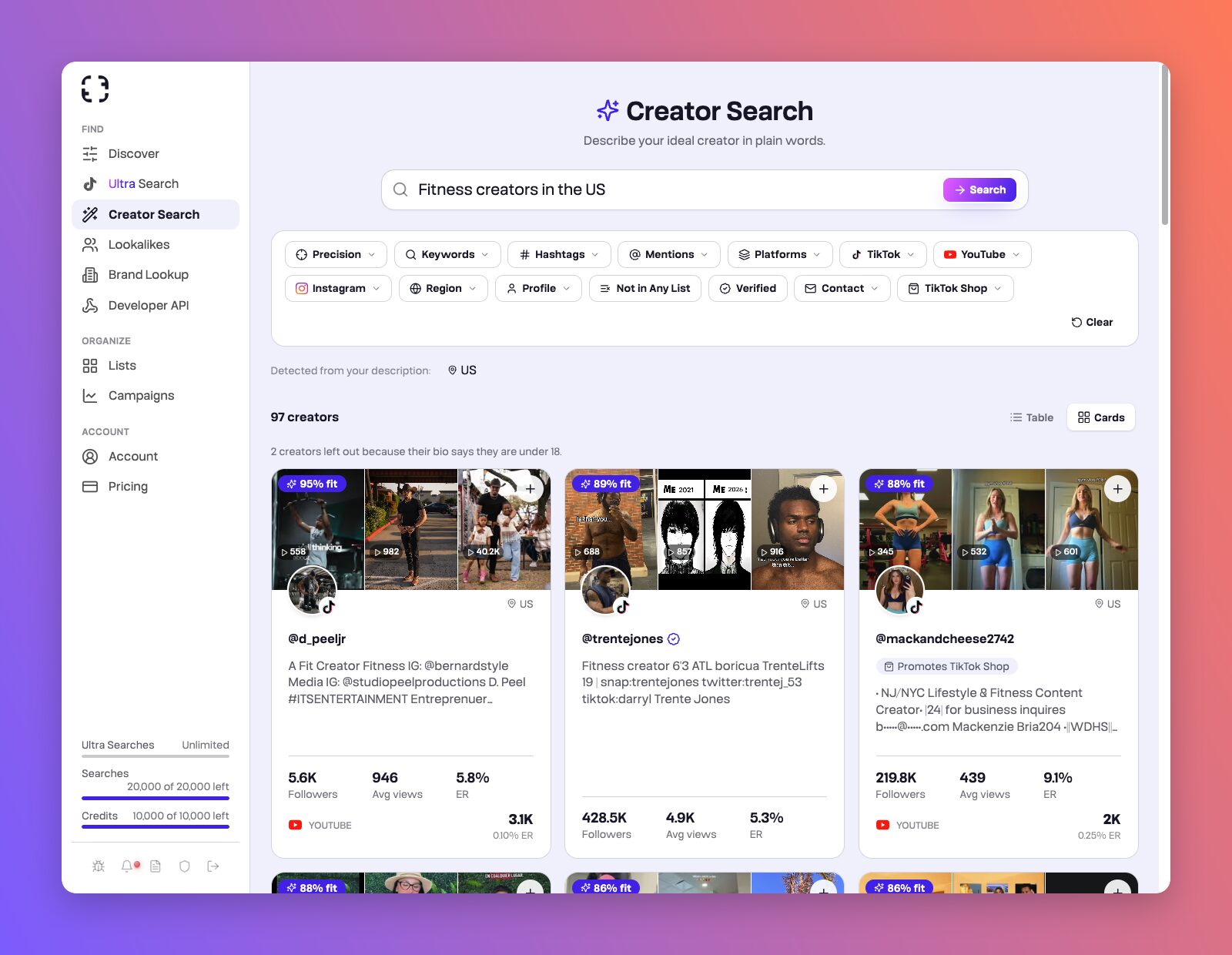
- Search by niche in plain words, for example "home workouts for beginners" or "budget skincare". Run two or three phrasings; different words find different people.
- Filter to the tier your budget fits, by followers, average views and engagement rate, and by region if your contract names a territory.
- Filter on "has email". Tokfluence shows contact details where creators publish them, so the contract goes to a real inbox rather than a DM thread.
- Check average views against followers before you agree a fee. The fee in clause 4 should follow the views a creator actually gets, not the follower count.
- Save the finalists to a list, add a note per creator with the fee and terms you agreed, and share the list by link with whoever signs off.
If your niche comes back thin, that is where Tokfluence differs from a static database: it can crawl TikTok for it on demand. API and MCP access is included in Pro, with one shared credit balance across the API, MCP, and the dashboard. A live crawl can be started from an AI assistant through our TikTok MCP server, for 250 credits, and the new creators become searchable a few hours later. Our guide to finding influencers walks through the same filters on a worked example, and our influencer outreach guide covers the first message before the contract.
| Plan | Price | What you get | Cost per 1,000 profiles |
|---|---|---|---|
| Pro | $99 a month | 10,000 credits a month, shared across email reveals, the API and MCP (1 email reveal = 1 credit), 20,000 searches, 3 Ultra Searches | API and MCP access is included in Pro |
| Agency (legacy) | not offered to new customers | existing subscribers keep their plan |
One credit is one creator profile, so a month of Pro covers far more candidates than a single campaign needs, and leaves room for the next one. There is a free plan with no card; you add a card only at checkout. Discovery Service is a legacy plan and is not offered to new customers. Details on the pricing page.
Pick something else if you want a platform that drafts the contract, collects the signature and pays the creator for you. Tokfluence finds and vets creators and shows their published contact details; it does not handle contracts or payments. A creator marketplace does the paperwork, and charges a fee on each order for it.
Sources
- US Federal Trade Commission, Disclosures 101 for Social Media Influencers, read October 2026
- Advertising Standards Authority, Recognising ads: Social media and influencer marketing, read October 2026
- TikTok Help Center, Branded content on TikTok, read October 2026
- TikTok Business Help Center, Spark Ads creation guide, read October 2026
- Gigapay, Influencer Usage Rights and Whitelisting Fees in 2026, October 2026, which compiles benchmarks from creator pricing sites. Guidance, not transaction data.
- Tokfluence pricing: plans, credits and what each includes.