
Influencer Marketing for Beauty Brands: A TikTok Playbook
Beauty creators promote TikTok Shop 10 to 29 times more often than the average creator. Here is how the four beauty niches differ, which formats work, what creators can claim, and how to find them.
TL;DR
- Beauty influencer marketing on TikTok is a sales channel, not just awareness. Beauty creators in our index are 10 to 29 times more likely than the average creator to promote TikTok Shop, led by K-beauty (15.3%) and haircare (14.1%).
- Beauty creators skew bigger than the average creator. About a quarter of skincare, haircare and K-beauty creators in our index have 50,000+ followers, against 7% of the whole index. Small creators are still the majority, but the mid-tier is unusually deep.
- Pick the sub-niche before the creator. Makeup is the biggest pool, skincare carries the most claim risk, haircare needs hair-type matching, and K-beauty is the most commerce-ready.
- Claims are the real risk. A creator saying a cream "cures acne" or "removes wrinkles" can turn a cosmetic into a drug claim under FDA rules, and UK rules ban filters that exaggerate a beauty product's effect. Disclose every paid or gifted post.
- Find creators who already talk about your category. Search competitor brand mentions, filter for TikTok Shop, and crawl TikTok live when a niche is thin.
Beauty was one of the first categories to work out TikTok, and it is still one of the most crowded. A lipstick swatch, a skincare routine or a "dupe" comparison is native content on the platform, so creators do not need to be taught the format. The hard part is choosing which creators, saying only what your product can back up, and getting the disclosure right.
This guide is a playbook for beauty and skincare brands running influencer marketing on TikTok. It covers how the four big sub-niches differ, with original data from our creator index, the formats that work, the claim and disclosure rules for cosmetics in the US, UK and EU, three real campaigns, and how to find the right creators.
What is beauty influencer marketing?
Beauty influencer marketing is paying, gifting or partnering with creators to show your cosmetics, skincare, haircare or fragrance products to their audience. On TikTok that usually means short videos: a get-ready-with-me (GRWM), a first-impressions review, a tutorial or a routine, often with a TikTok Shop link so viewers can buy without leaving the app.
It works for beauty more than for most categories for one reason: the product is visible on the creator's face, skin or hair. Viewers can judge a foundation shade or a curl cream on someone who looks like them, which is exactly what a studio ad cannot do.
Which beauty niches have the most TikTok creators?
Makeup is the biggest beauty niche in our index, about 1.7% of all creators with 1,000+ followers, followed by skincare at about 0.8%. Haircare and K-beauty are much smaller, but their creators are the most likely to sell through TikTok Shop.
We counted creators in the Tokfluence index whose bios, hashtags and captions are defined by each niche, then compared them with the index as a whole:
| Niche | Share of the index | At least, on TikTok | Under 50,000 followers | Engagement rate 5%+ | Use #tiktokshop |
|---|---|---|---|---|---|
| Makeup | 1.70% | 298,700 | 81.1% | 50.7% | 5.6% |
| Skincare | 0.78% | 137,800 | 75.7% | 45.9% | 11.6% |
| Haircare | 0.18% | 31,800 | 73.6% | 42.4% | 14.1% |
| K-beauty | 0.09% | 16,600 | 74.6% | 45.2% | 15.3% |
| Whole index (baseline) | 100% | 17.6 million | 93.0% | 41.3% | 0.5% |
Source: Tokfluence creator index, queried 16 October 2026, creators with 1,000+ followers. Our index is large but it is not all of TikTok, so read these as shares, not totals. "At least, on TikTok" applies each share to the 17.6 million creators in our index (for example 1.70% x 17.6M = 298,700 makeup creators), so it is a floor, not a census: TikTok has more creators than we have crawled. Our whole index equals at least 1.1% of TikTok's 1.59 billion ad reach (DataReportal, January 2025). Method at the end of this article.
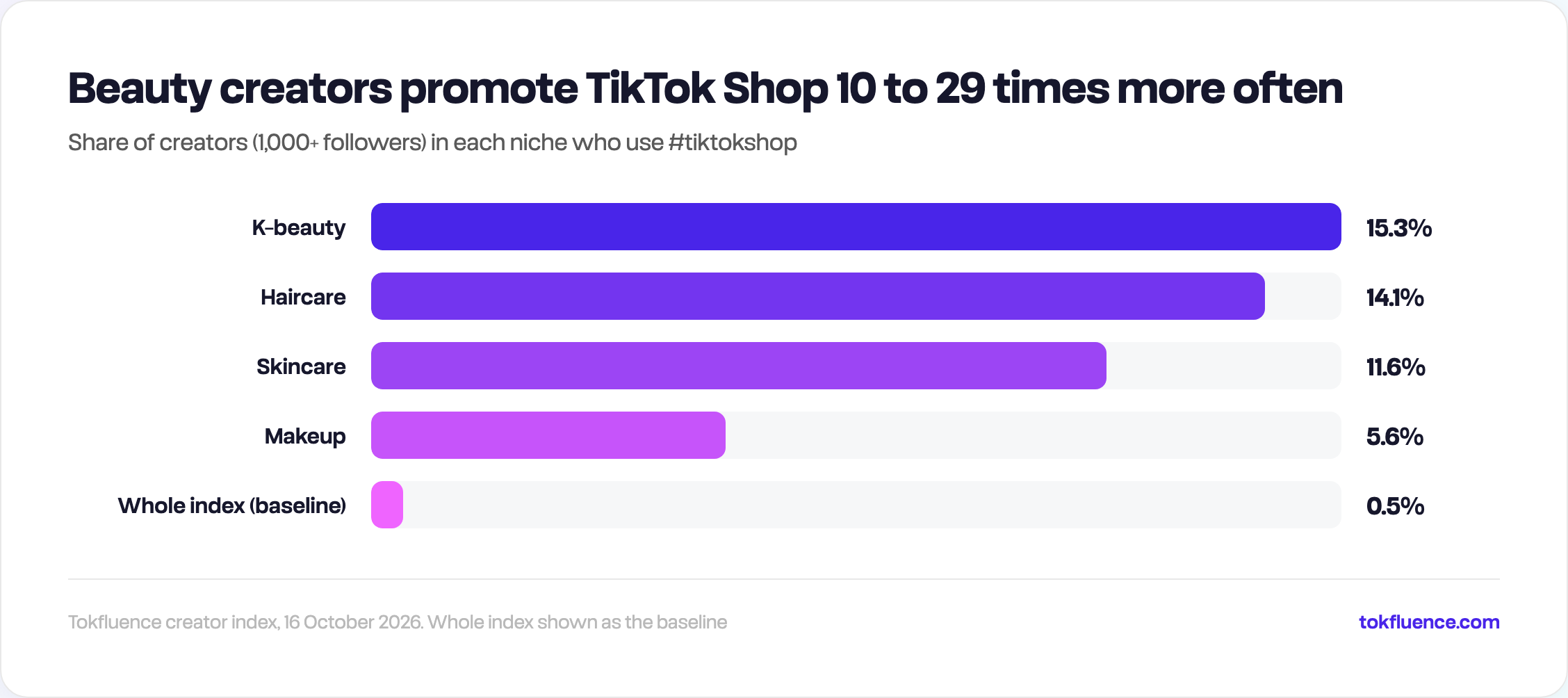
Three things stand out:
- Beauty is a commerce niche. Across the whole index, 0.5% of creators use #tiktokshop. Among K-beauty creators it is 15.3%, about 29 times the baseline; even makeup, the lowest, is about 11 times. If you sell on TikTok Shop, a beauty creator is far more likely than average to already know how the yellow basket works. Our guide to finding TikTok Shop creators covers the Affiliate Center side of this.
- The mid-tier is deep. In the whole index, 7% of creators have 50,000+ followers. In skincare, haircare and K-beauty it is about a quarter, roughly three to four times as many. That gives beauty brands an unusually large pool of creators who are big enough to move product and still small enough to book. Most beauty creators are still under 50,000 followers, so a nano influencer programme has plenty of supply too.
- Engagement is not the differentiator. Beauty creators clear a 5% engagement rate slightly more often than the index as a whole (42% to 51% against 41%), not dramatically more. Judge each creator on their own numbers, not on the niche's reputation. Our fake follower checks take two minutes per creator.
The caveat: these are keyword matches. A creator can sit in two niches (many K-beauty creators also count as skincare), the counts include some shop and brand accounts, and a hashtag is not a sale.
How do skincare, makeup, haircare and K-beauty creators differ?
Each sub-niche has its own content habits, its own audience expectations and its own risks. Brief them differently.
Skincare
Skincare creators sell through routines, ingredient explainers and long-term results ("30 days of using..."). Audiences are skin-type driven, so match creators to your target concern: acne-prone, dry, sensitive, mature. Skincare carries the highest claim risk of the four, because the line between a cosmetic claim ("hydrates") and a drug claim ("treats acne") is easy for a creator to cross. Brief what they can and cannot say before they film. In our index, 11.6% of skincare creators use #tiktokshop.
Makeup
Makeup is the biggest pool and the most visual: swatches, tutorials, GRWMs and "full face using only" challenges. Shade range is the thing to check. If you sell 40 foundation shades, recruit creators across skin tones and show it. Filters are the main risk in makeup, because a beauty filter makes any product look better than it is (see the claims section below). Makeup has the most small creators of the four: 81% are under 50,000 followers.
Haircare
Haircare audiences are organised by hair type and texture: curly, coily, fine, colour-treated, damaged. A curl cream filmed on straight hair is wasted spend. Haircare is small in our index, 0.18% of creators, but 14.1% of them use #tiktokshop, so the creators you do find are very likely to be commerce-ready. Before-and-after content is common here, and the same exaggeration rules apply as in skincare.
K-beauty
K-beauty is the smallest niche we measured and the most commerce-driven: 15.3% of K-beauty creators use #tiktokshop. Content is ingredient-led (snail mucin, centella, rice water), routine-heavy and often built around "glass skin" results. Medicube, a Korean skincare brand, sells in the US through a wide base of TikTok Shop affiliates; our influencer marketing examples break down how. Because K-beauty creators review many brands, check how often a creator posts sponsored content before you add yours.
Which beauty content formats work best on TikTok?
GRWM videos, honest reviews and tutorials are the core formats for beauty on TikTok, with dupes and TikTok Shop showcases as the sales-driven extras. Each one fits a different goal:
| Format | What it is | Best for | Watch out for |
|---|---|---|---|
| GRWM (get ready with me) | The creator does their routine while talking to camera | Making a product feel like part of daily life | Products can get lost; ask for one clear close-up |
| First impressions / review | The creator tries the product on camera and gives a verdict | Trust, launches, new audiences | Do not script the verdict; scripted reviews read as ads |
| Tutorial | Step-by-step how-to (a look, a routine, a hairstyle) | Showing how to use the product | Long tutorials need a strong first three seconds |
| Dupe comparison | "This $12 product vs the $60 one" | Budget brands taking share from premium ones | It is a comparative claim about a named competitor (see below) |
| Routine / results over time | Daily or weekly updates on a skin or hair goal | Skincare and haircare credibility | Results claims need proof; no filters |
| TikTok Shop video or LIVE | Shoppable video, LIVE selling or the creator's showcase | Direct sales through TikTok Shop | Commission and samples need setting up in Seller Center |
| PR unboxing / haul | The creator opens a gifted package | Seeding launches to many creators at once | Gifted posts still need disclosure |
Most beauty campaigns combine two or three of these: gifted products to many creators for unboxings and reviews, then paid GRWMs or tutorials from the creators whose first posts performed best. That second step is also where Spark Ads come in: boosting the creator's own post usually beats re-cutting it as a brand ad. If you are starting with free product only, our influencer gifting guide covers who to send to and what to expect back.
What claims can beauty influencers make?
A beauty creator can describe how a product looks, feels and makes them feel, but cannot claim it treats a condition or changes the body unless the product is regulated and tested for that. The brand is responsible for what the creator says in a sponsored post, so the claim rules belong in the brief.
In the US, the claim decides whether a product is a cosmetic or a drug. The FDA says the difference "is determined by a product's intended use", and that intended use can be established by claims "in advertising, on the Internet, or in other promotional materials". Claims to treat acne or dandruff, protect from the sun, restore hair growth, reduce cellulite or reduce wrinkles in the anti-ageing sense are drug claims (FDA, Is It a Cosmetic, a Drug, or Both?, updated September 2024).
The FTC adds two rules for the creator personally: "You can't talk about your experience with a product you haven't tried", and "You can't make up claims about a product that would require proof the advertiser doesn't have" (FTC, Disclosures 101 for Social Media Influencers). Since October 2024, the FTC's rule on fake reviews and testimonials also bans testimonials that misrepresent a person's actual experience with a product (FTC, final rule announced 14 August 2024).
In the UK, filters are the beauty-specific rule. The ASA advises influencers and brands "to avoid applying filters to photos or videos which are directly relevant to the product being advertised and which are likely to exaggerate the effect the product is capable of achieving" (ASA, 11 February 2021). It ruled two self-tan ads on Instagram Stories misleading for exactly this, after the #filterdrop campaign.
In the EU, every cosmetic claim must meet six common criteria: legal compliance, truthfulness, evidential support, honesty, fairness and informed decision-making (Commission Regulation (EU) No 655/2013).
In practice, give creators a short "say this, not that" list:
| What a creator might say | Why it is a problem | A safer way to say it |
|---|---|---|
| "This cleared my acne" | Treating acne is a drug claim in the US | "My skin feels less oily and looks calmer" (if true) |
| "It got rid of my wrinkles" | Changing skin structure is a drug claim | "Fine lines look softer because my skin is more hydrated" |
| "It made my hair grow back" | Restoring hair growth is a drug claim | "My hair feels thicker and less frizzy" |
| "Better than [named brand]" in a dupe | A comparison with a named competitor must be fair and verifiable | "Similar finish to [brand] at a third of the price", shown side by side, unfiltered |
| Before-and-after with a filter on | Exaggerates the result (ASA) | Same lighting, no filter, unedited footage |
| A review before trying the product | Not a genuine experience (FTC) | Send the product early enough for real use |
This is general guidance, not legal advice. If your product makes active claims (SPF, acne treatment, hair loss), have your regulatory team or a lawyer approve the brief.
How should beauty influencers disclose sponsored posts?
Every post made in exchange for something of value needs a clear disclosure, and free products count. The FTC says: "Financial relationships aren't limited to money. Disclose the relationship if you got anything of value", and for video, "The disclosure should be in the video and not just in the description" (FTC, Disclosures 101). "#ad", "advertisement", "sponsored" or "Thanks to [brand] for the free product" all work.
On TikTok, creators should also turn on the branded content toggle, which labels the post as a paid partnership. In the UK, the ASA's influencers' guide sets out how to make clear that ads are ads.
Put the disclosure in the contract and the brief, not just in a reminder email. A PR package with no strings attached is the case brands most often forget: the creator still got something of value.
What can beauty brands learn from real TikTok campaigns?
Three campaigns show the range, from one brand-made sound to thousands of affiliates:
- e.l.f. Cosmetics, #eyeslipsface (2019). e.l.f. commissioned an original song and ran a hashtag challenge on TikTok. A week after launch, e.l.f. reported the campaign had been viewed "over 1 billion times", with "over 400 thousand videos" from people joining in, and called it "the first paid ad to hold the number one trending hashtag on TikTok" (e.l.f. Beauty press release, 11 October 2019). The lesson: give creators something easy to join, and let them do the rest.
- Medicube (2025). The Korean skincare brand pairs celebrity posts with a wide base of TikTok Shop affiliates and boosts the best creator posts as ads. It reported 219% year-on-year TikTok Shop GMV growth, from a source sponsored by TikTok Shop.
- CeraVe (2024). Before its Super Bowl ad, CeraVe seeded a fake rumour on TikTok that actor Michael Cera created the brand, starting with a handful of big creators and letting hundreds of others pick it up.
Results and sources for Medicube and CeraVe, plus seven other campaigns, are in our TikTok influencer marketing examples. The common thread across beauty: start from creators who already talk about your product or category, then put money behind what is already working.
How do you find beauty influencers with Tokfluence?
Tokfluence is an independent index of public TikTok creators. You search it in plain language or by keyword, follower range, engagement rate, region, hashtags and the brands a creator mentions. We are not affiliated with TikTok; the data comes from public profiles. Here is the workflow for a beauty brand:
- Describe the creator. Type the brief in plain words, for example "curly hair creators in the UK" or "K-beauty skincare creators in the US". Tokfluence turns it into filters and detects the country.
- Search your competitors' mentions. Brand Lookup lists the creators who have tagged a brand in their posts. Run it on two or three competitors: those creators already make content in your category, and their audience already buys it. Our brand ambassador guide found that about half of the creators who tag brands such as Glossier, Gymshark or CeraVe have under 50,000 followers.
- Add the TikTok Shop filter. Tick Promotes TikTok Shop to keep only creators who use TikTok Shop hashtags or mention TikTok Shop in their bio. Leave it off to find creators who have never been pitched by other sellers.
- Narrow by size, engagement and contact. Set a follower range and a minimum engagement rate, add one or more regions, and use the Contact filter to keep creators with an email on file. Tokfluence shows contact details where creators publish them.
- Save, share and export. Add the shortlist to a list, share it by link with your team, export to CSV for outreach. Our influencer outreach guide has first-message templates.
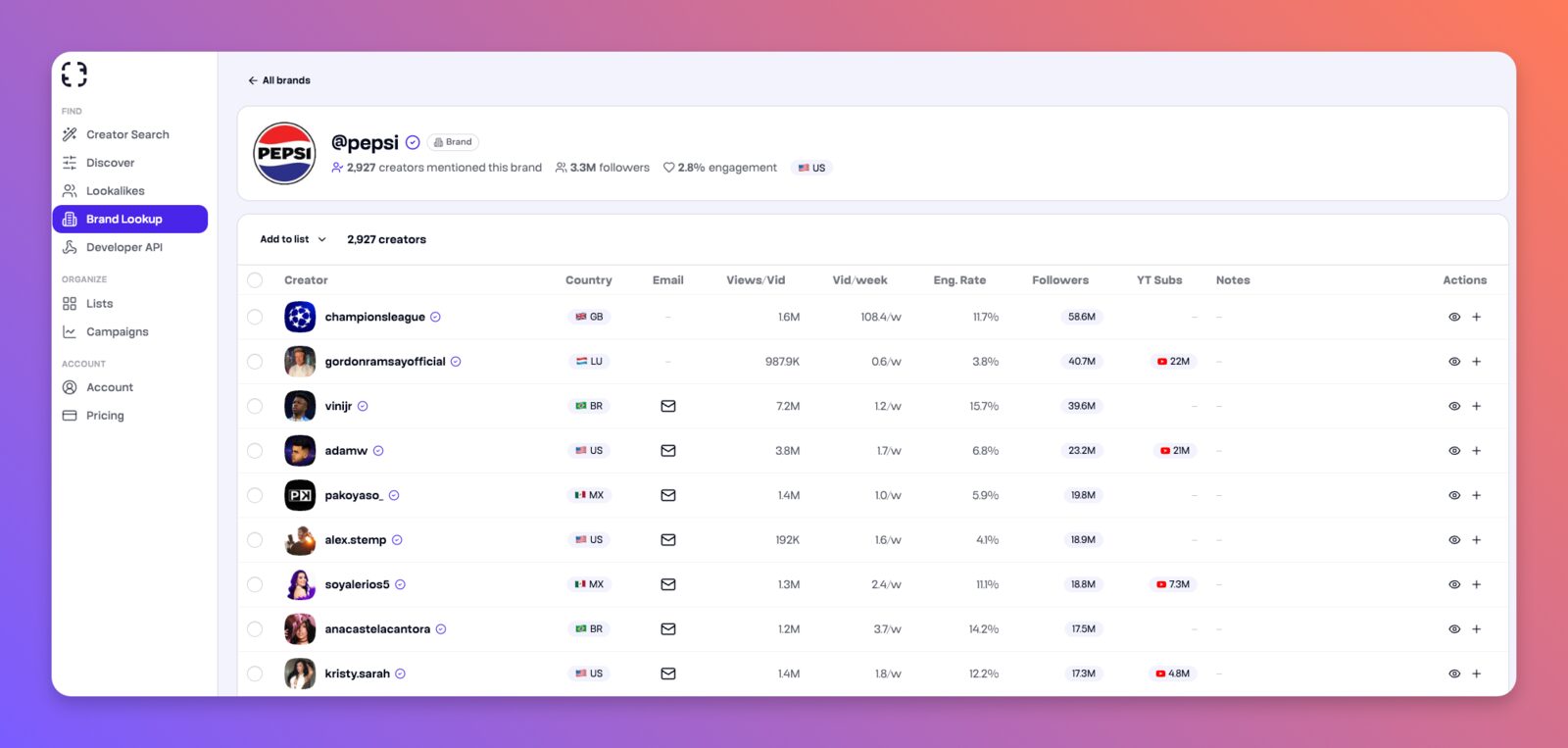
Brand Lookup lists every creator in our index who has mentioned a brand. Run it on your competitors.
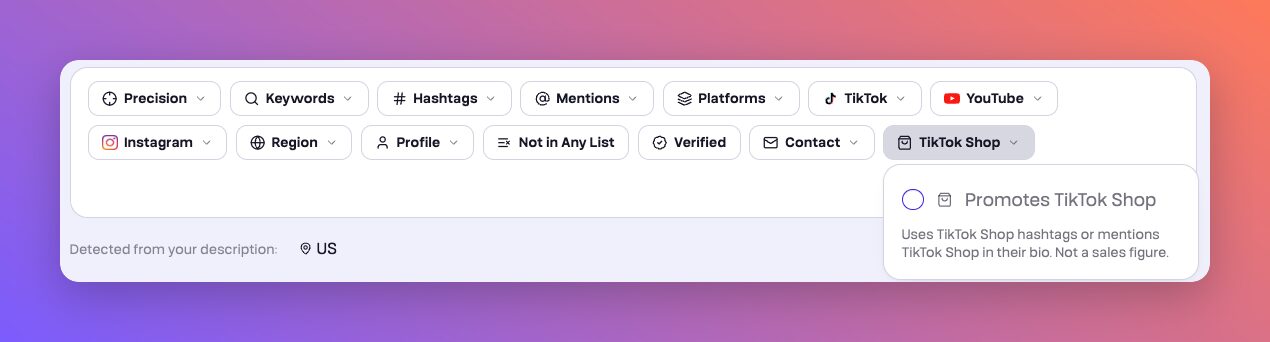
The TikTok Shop filter: "Uses TikTok Shop hashtags or mentions TikTok Shop in their bio. Not a sales figure."
If your niche is thin (a new ingredient, a specific hair type in a small country), Tokfluence can crawl TikTok for it on demand. In the app, Ultra Search starts a crawl from a one-sentence brief. API and MCP access is included in Pro, with one shared credit balance across the API, MCP, and the dashboard. Through the Tokfluence MCP server, an AI assistant can start the same live crawl from a chat for 250 credits, and the new creators become searchable a few hours later (MCP docs). Most creator databases only show you what they already hold.
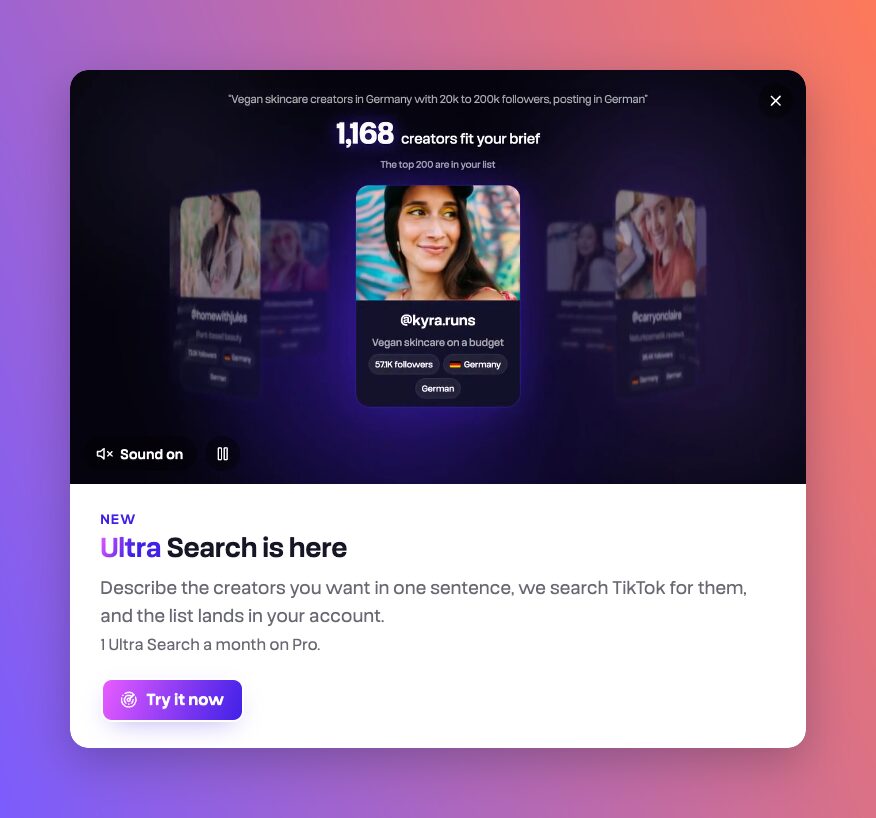
Ultra Search's own launch example: a one-sentence brief for vegan skincare creators in Germany.
What it costs: The Pro plan is $99 a month and includes 10,000 credits a month, shared across email reveals, the API and MCP (1 email reveal = 1 credit), plus three Ultra Searches a month. Existing Agency subscriptions are a legacy plan and are not offered to new customers. There is a free plan with no card; you add a card only at checkout. Discovery Service is a legacy plan and is not offered to new customers. Details on the pricing page.
How much do beauty influencers cost on TikTok?
It depends on the deal type more than on the niche. Flat fees scale with follower count; our TikTok creator rates by tier collects published ranges for each tier. On TikTok Shop, you set the commission yourself, from 1% to 80%, and agency guides put beauty and skincare among the highest-paying categories, at around 15% to 30%; the sources and the open vs target collaboration split are in our TikTok Shop creators guide. Gifting costs only product and shipping, but a post is not guaranteed.
A common beauty setup: gift widely, pay a flat fee plus commission to the creators whose first posts performed, and track cost per view and sales per creator. Our guide to influencer marketing ROI has the formulas.
When is Tokfluence not the right tool for a beauty brand?
Be honest about fit before you buy anything:
- You need deep Instagram audience analysis. Tokfluence is TikTok-first: it shows the Instagram and YouTube profiles creators link, but audience reports are for TikTok.
- You only want proven TikTok Shop sellers. TikTok Shop's own Affiliate Center shows each creator's sales and units sold, which we cannot see. Our TikTok Shop filter shows who promotes TikTok Shop, not how much they sell.
- You need seeding, payments and affiliate links in one system. Tokfluence finds and vets creators at volume and hands clean data to the tools you already run outreach and payouts in.
If what you need is outside the standard plans, such as an integration with your outreach tool, we build custom plans: contact us.
If none of those apply and you want a long list of beauty creators fast, with contact details where they publish them, Tokfluence is built for exactly that.
How we got the numbers
- Source: the Tokfluence creator index, queried on 16 October 2026.
- Niches: creators whose bios, hashtags and captions match "skincare", "makeup", "haircare" or "kbeauty" at our "niche" match level, which keeps creators the keyword defines rather than those who used it once.
- Population: creators with 1,000 or more followers. "Under 50,000" means 1,000 to 49,999 followers. Engagement rate is our stored rate for each creator.
- TikTok Shop: creators who post under the #tiktokshop hashtag.
- Limits: our index is not all of TikTok, so these are shares of the creators we hold. Niches overlap, the counts include some shop and brand accounts, and creators who sell on TikTok Shop without the hashtag are missing, so the TikTok Shop shares are a lower bound.
Sources
- Beauty niche shares: Tokfluence creator index, 16 October 2026 (method above)
- Cosmetic vs drug claims: FDA, Is It a Cosmetic, a Drug, or Both? (Or Is It Soap?), updated September 2024
- Influencer disclosure and claims: FTC, Disclosures 101 for Social Media Influencers
- Fake reviews and testimonials rule: FTC press release, 14 August 2024
- Beauty filters: ASA, The (mis)use of social media beauty filters when advertising cosmetic products, 11 February 2021
- UK ad labelling: ASA, Influencers' guide to making clear that ads are ads
- EU cosmetic claims: Commission Regulation (EU) No 655/2013
- TikTok disclosure setting: TikTok Help Center, Branded content on TikTok, read October 2026
- e.l.f. #eyeslipsface: e.l.f. Beauty press release, 11 October 2019
- Medicube and CeraVe: sources listed in our influencer marketing examples
- Tokfluence MCP server and crawls: developers.tokfluence.com/docs/mcp
- Tokfluence plans and credits: tokfluence.com/pricing, read October 2026