
Influencer Marketing for Fitness Brands
Fitness creators in our index are more than twice as likely as average to have 10k to 250k followers. Data for gym, yoga, running and home workout, formats that work, supplement rules and examples.
TL;DR
- The short answer: fitness influencer marketing works best with micro creators in one clear sub-niche (gym, yoga, running or home workout), on formats that run over weeks: challenges, programmes and ambassador codes, not one-off posts.
- Fitness creators skew bigger: 45% to 55% of the gym, yoga, running and home workout creators in our index have 10,000 to 250,000 followers, against 20.5% for our index as a whole. There is plenty of mid-sized supply to book.
- Running creators post most: in our samples, 69% of running micro creators post at least weekly, against about a third of gym and yoga creators. Median engagement sits between 4% and 6.4% in every sub-niche.
- Supplements have hard rules: TikTok bans weight loss supplements from branded content, restricts vitamin content to adults, and every health claim needs evidence (FTC) or an authorised wording (UK).
- The caveat: these are keyword and hashtag matches in our index, not all of TikTok, and the samples are 79 to 91 creators per group.
Fitness is one of the easiest niches to start influencer marketing in and one of the easiest to get wrong. There are plenty of creators, the content shows products in use, and audiences buy what their trainer wears and drinks. But a yoga audience and a gym audience want different things, a supplement post can break three sets of rules in one sentence, and the biggest accounts that mention fitness are often not fitness creators at all.
This playbook covers who the fitness creators on TikTok are, by sub-niche and size, with numbers we measured in our own index; the campaign formats that suit fitness; the rules for supplements; brand examples with sources; and how to build a shortlist.
What is fitness influencer marketing?
Fitness influencer marketing is paying or partnering with creators who post about training, movement or nutrition, so that their audience sees your product in a workout they already trust. On TikTok that usually means a short video where the product is part of the session: the leggings in the squat set, the shaker after the run, the mat in the flow.
"Fitness" is not one audience. The sub-niche decides the product fit, the tone and the format:
| Sub-niche | What creators post | Products that fit | Tone that works |
|---|---|---|---|
| Gym | Lifting splits, form tips, physique progress, gym humour | Apparel, protein, pre-workout, straps, gym bags, apps | Direct, progress-led, often funny |
| Yoga | Flows, mobility, stretching, mindfulness | Mats, blocks, apparel, recovery, wellness apps, studios | Calm, instructional |
| Running | Training logs, race days, pacing, gear reviews | Shoes, watches, hydration, gels, run clubs, race entries | Data-heavy, community, race-driven |
| Home workout | No-equipment routines, short follow-along sessions | Bands, dumbbells, mats, apps, at-home programmes | Accessible, beginner-friendly |
Pick the sub-niche first, then the creators. A protein brand briefed into yoga, or a meditation app briefed into powerlifting, gets polite views and no sales.
How big are fitness creators on TikTok?
Bigger than the average creator. In our index, 45% to 55% of creators in each fitness sub-niche have 10,000 to 250,000 followers, more than twice the 20.5% share for our index as a whole.
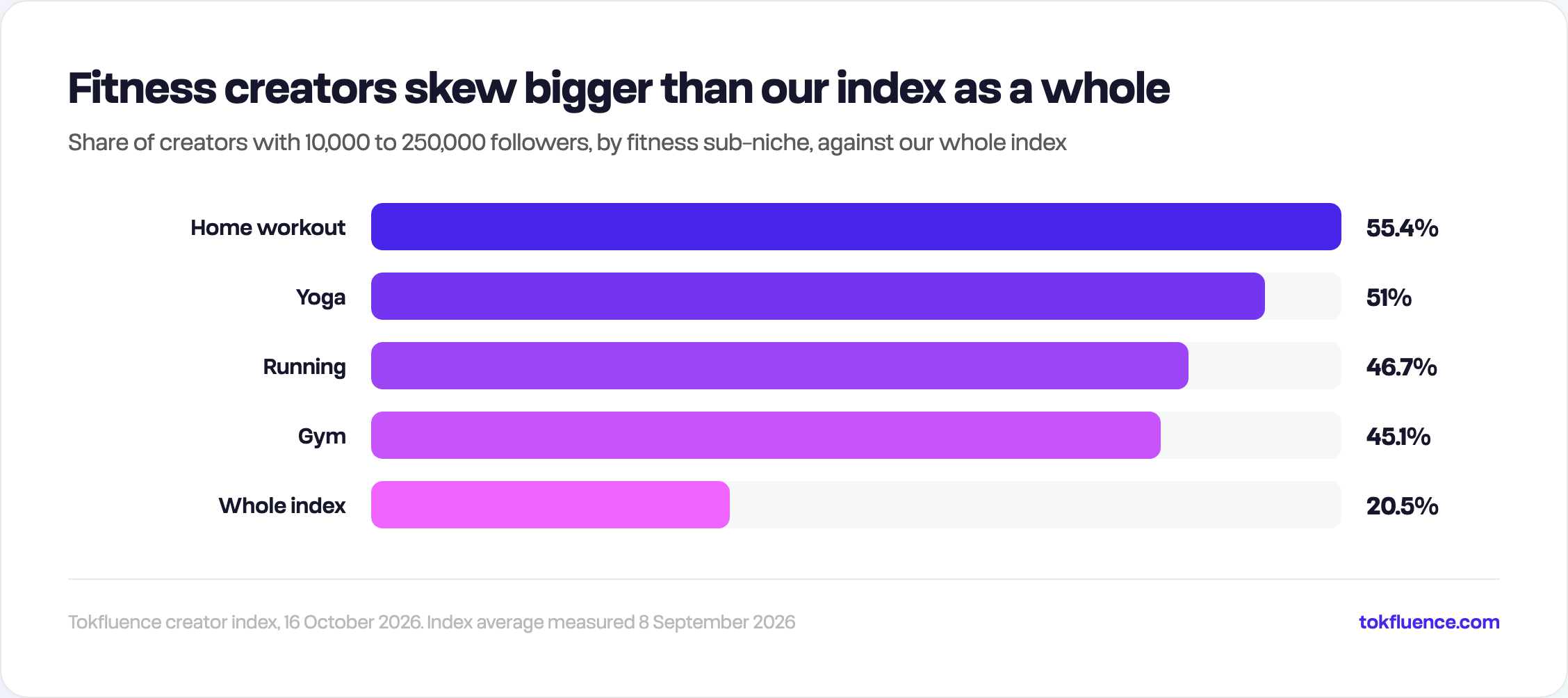
| Tier | Gym | Yoga | Running | Home workout | Whole index |
|---|---|---|---|---|---|
| Nano (1k to 10k) | 52.6% | 47.7% | 51.3% | 43.3% | 77.4% |
| Micro (10k to 50k) | 30.0% | 32.4% | 30.4% | 34.0% | 14.5% |
| Mid (50k to 250k) | 15.1% | 18.7% | 16.3% | 21.4% | 6.0% |
| Macro (250k to 1M) | 1.7% | 1.0% | 1.6% | 1.0% | 1.6% |
| Mega (1M+) | 0.5% | 0.3% | 0.5% | 0.3% | 0.4% |
| At least, on TikTok, 10k to 250k | 87,200 | 11,100 | 19,100 | 14,000 | 3.4 million |
Measured: Tokfluence creator index, 16 October 2026 (fitness) and 8 September 2026 (whole index). Each column adds up to 100%, with rounding. The last row applies the 10k to 250k share to the matching creators in our index: gym 45.1% x 193,416 = 87,200; yoga 51.1% x 21,758 = 11,100; running 46.7% x 40,898 = 19,100; home workout 55.4% x 25,216 = 14,000; whole index 2.4 million micro + 997,000 mid = 3.4 million, or at least 0.21% of TikTok's 1.59 billion ad reach (DataReportal, January 2025), about 1 in 470. It is a floor, not a census: TikTok has more creators than we have crawled. Method at the end of this article.
What follows for a brand:
- Mid-sized fitness creators are easy to find. Roughly one fitness creator in six in our index sits at 50,000 to 250,000 followers. In the average niche it is one in seventeen.
- The top is thin everywhere. Macro and mega creators together are 2.2% or less of every sub-niche. If your plan depends on a handful of million-follower names, you are competing with every other fitness brand for the same few people.
- Gym is the deepest pool. Gym creators outnumber running creators about five to one in our index, home workout creators about eight to one, and yoga creators about nine to one. A gym brief has room to be picky; a yoga brief has to be precise.
One caveat on the skew: a creator who posts more, with longer captions, is easier to match to a keyword, and those creators tend to be bigger. Part of the gap may come from matching, not from TikTok.
How do gym, yoga, running and home workout creators compare?
They engage at similar rates but differ in how often they post. Median engagement sits between 4% and 6.4% in every group we sampled; the share of creators posting at least once a week ranges from 19% to 69%.
| Sub-niche, tier | Median engagement rate | Median views per video | Median views as % of followers | Post at least weekly |
|---|---|---|---|---|
| Gym, nano | 6.2% | 765 | 15.5% | 35% |
| Gym, micro | 5.9% | 2,274 | 8.3% | 35% |
| Yoga, nano | 5.8% | 593 | 20.1% | 32% |
| Yoga, micro | 4.3% | 1,839 | 6.8% | 33% |
| Running, nano | 6.4% | 802 | 24.7% | 53% |
| Running, micro | 5.8% | 1,768 | 8.4% | 69% |
| Home workout, nano | 4.8% | 437 | 10.7% | 31% |
| Home workout, micro | 4.0% | 708 | 4.7% | 19% |
Measured: Tokfluence creator index, 16 October 2026. Samples of 79 to 91 creators per row with engagement and view data. Method at the end of this article.
Three things stand out:
- Running creators are the most consistent. 69% of running micro creators post every week, twice the gym and yoga rate. Running content follows training plans and race calendars, which makes a multi-week brief (a training block, a race build) a natural fit.
- Home workout creators are the least active. Only 19% of home workout micro creators post weekly, and their median views are the lowest. Check recent posting before you brief anyone tagged #homeworkout; many have slowed down.
- Views fall as a share of followers as creators grow. A nano gym creator's typical video reaches about 15% of their follower count; a micro creator's reaches about 8%. That is normal, and it is why you should price on views, not followers. Our fake follower guide gives the normal range by tier.
Which campaign formats work for fitness brands?
Formats that run over time. Fitness is about habits, and audiences trust a creator who uses a product for weeks more than one who unboxes it once.
| Format | How it works | Best for | Watch out for |
|---|---|---|---|
| Challenge | A set number of days or workouts, with a hashtag, posted by several creators at once | Apparel, apps, gyms, launches | Needs a reward and a clear start date |
| Programme or training block | A creator follows and documents a 4 to 12 week plan using your product | Apps, equipment, running gear, coaching | Longer contract; agree what happens if they get injured |
| Ambassador with a code | Monthly posts plus a personal discount code | Apparel, supplements, nutrition | Disclosure on every post; track code use |
| Product seeding | Send product, no post required | Equipment, apparel, new flavours | Fitness creators tag gifts less than other niches |
| Race or event content | Creators run, compete or attend with your product | Running, hybrid racing, sports nutrition | Fixed dates; brief well ahead |
| Spark Ads on a creator post | Boost a creator's best post from their account | Scaling a proven video | Needs an authorisation code from the creator |
On seeding: in our influencer gifting research, fitness creators tagged gifted products at a fifth to an eighth of the rate of skincare creators. Fitness accounts are mostly workouts, not hauls, so a free box tends to appear only if it fits the routine. Expect a lower post rate than beauty and send more boxes, or pay.
For long formats, see our brand ambassador program guide for terms and contracts, and TikTok Spark Ads explained for boosting the posts that work. For budgets, our TikTok creator rates by tier sets out what published rate surveys do and do not show.
What are the rules for supplement and fitness promotions?
Stricter than for apparel. A supplement post has to pass TikTok's branded content policy, health claim rules and disclosure rules at the same time. This is general guidance, not legal advice.
| Who | What it says | What it means for your brief |
|---|---|---|
| TikTok | Weight loss products are prohibited in branded content, "including... weight loss and weight management supplements (including fat burning pills, appetite suppressants, weight loss and detox teas or lollipops)". Vitamin supplement content is restricted to users over 18 in listed markets. (TikTok Branded Content Policy) | Do not run creator content for fat burners or weight loss teas on TikTok. Expect vitamin posts to reach adults only |
| US, FTC | Health benefit claims for dietary supplements need "competent and reliable scientific evidence", and "advertisers are liable for the misleading use of endorsements". (FTC Health Products Compliance Guidance) | You are responsible for what the creator claims. Give them approved claims and ban the rest |
| UK, ASA | Only health claims on the GB Nutrition and Health Claims Register, or claims with the same meaning, may be used for foods and supplements, including sports supplements. (ASA) | "Builds muscle" needs an authorised wording behind it. Give UK creators the exact phrases |
| Disclosure | A paid or gifted post must be clearly labelled as an ad, plus TikTok's branded content toggle. (FTC, TikTok Help Center) | Put the label and the toggle in the contract and the brief |
TikTok's policy also bars branded content that would "promote or reinforce negative or unhealthy body images" or "promote an unhealthy relationship with food or exercise". That rules out the classic before-and-after framed around weight loss. Progress framed around strength, distance or consistency is the safer version of the same story.
Which brands do fitness influencer marketing well?
The best-known examples share two habits: they started with creators before they had a big budget, and they gave creators a reason to post for weeks, not once.
- Gymshark: creators first, then a challenge. Gymshark's own history says its first products were sent to lifting creators such as Lex Griffin, Matt Ogus and Chris Lavado, "kind of like fanmail... in hope that they'd like them" (Gymshark). Its 66 Day challenge asks people to keep a habit for 66 days; Marketing Week reported 45.5 million views on #gymshark66 by May 2024 (Marketing Week). The lesson: a challenge gives every creator, big or small, the same reason to post.
- Bloom Nutrition: volume and creative freedom. Founder Mari Llewellyn told Inc. that Bloom had worked with 5,600 influencers since 2021 and spent about 75% of its marketing budget on them, giving creators wide creative freedom (Net Influencer, citing Inc.). These are the company's own figures. The lesson: in nutrition, many small creators posting in their own voice can beat a few polished ads.
- Supplement ambassador codes. Sports nutrition brands commonly run ambassador programmes with personal discount codes. In our index, a 515,000-follower home workout creator lists a supplement brand ambassador code in their bio and tags the brand's ambassador hashtag. The code is the tracking: every sale is attributable to one creator.
For more brands across niches, see our influencer marketing examples.
Who are the biggest TikTok fitness influencers?
The biggest accounts that clearly define themselves by one fitness sub-niche hold 1 to 10 million followers in our index. Here are four large public accounts, one per sub-niche, with figures from our index at the time of writing:
| Account | Sub-niche | Followers | Average views per video | Posts per week |
|---|---|---|---|---|
| @noeldeyzel_bodybuilder | Gym | 8.3M | 946,400 | 0.8 |
| @nataliyogi | Yoga | 2.1M | 97,200 | 3.2 |
| @ulrich_fitness | Home workout | 2.0M | 225,100 | 0.6 |
| @yaboyruns | Running | 1.7M | 14,950 | 0.3 |
Tokfluence creator index, 16 October 2026. Follower and view figures change daily. Tokfluence has no relationship with these creators; they are listed as examples of large public accounts, not recommendations.
Two lessons from this short list. First, followers do not predict views: the running account above has 1.7 million followers and averages about 15,000 views a video, under 1% of its audience. Second, when we sorted fitness keyword matches by followers, most of the top results were entertainers and celebrities who mention the gym once, not fitness creators. A "top fitness influencers" list built on follower count alone is mostly noise.
For most brands, these four archetypes are more useful than famous names:
| Archetype | Typical size | What they are good for |
|---|---|---|
| The coach (personal trainer, certified instructor) | Nano to micro | Credibility, programmes, equipment, apps |
| The progress journal (documents their own training) | Nano to micro | Habit products, apparel, supplements, challenges |
| The race or competition athlete (runner, hybrid racer, lifter) | Micro to mid | Performance gear, nutrition, event content |
| The entertainer (gym humour, relatable fails) | Mid to mega | Reach and awareness, low-consideration products |
How do you find fitness creators with Tokfluence?
Search by sub-niche, filter by size and region, and check recent posts before you shortlist. Tokfluence is a TikTok creator search tool, and it is the tool we build, so weigh this section accordingly.
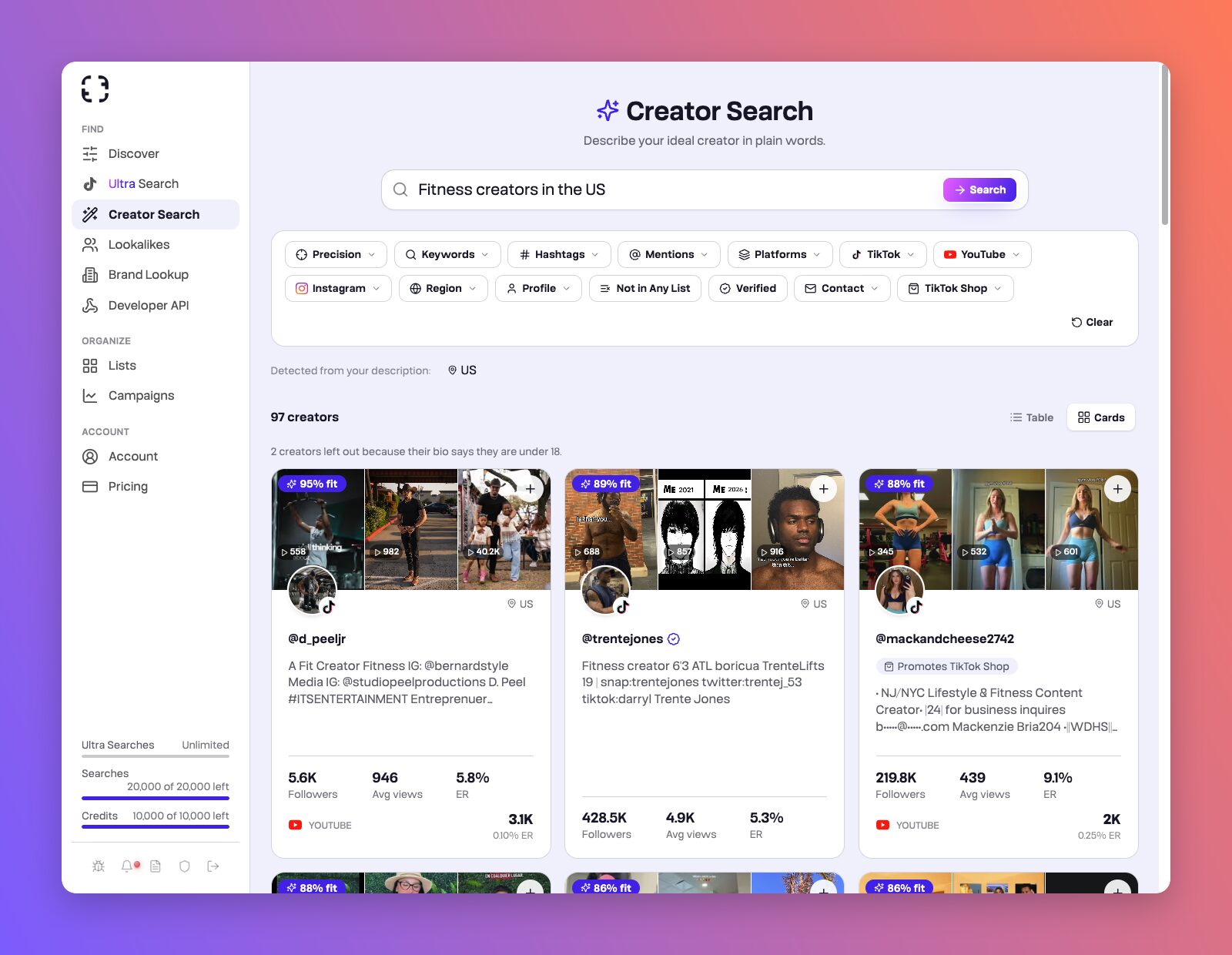
Creator Search: describe the creator in plain words, then narrow with followers, engagement, region and the TikTok Shop filter.
- Search by sub-niche, in plain words, for example "marathon training", "mobility yoga" or "powerlifting coach". Run two or three phrasings; different words find different people.
- Set followers to 10,000 to 250,000 for the deep mid-sized pool, or 1,000 to 10,000 for a seeding wave.
- Set the region to where you sell, and filter on has email. Tokfluence shows contact details where creators publish them.
- Use brand mentions to find creators already tagging you or your competitors, and the TikTok Shop filter if you sell there. Our TikTok Shop creator guide covers that route.
- Check recent posts, engagement and posting rate, save the best fits to a list, and export it for outreach.
If a sub-niche comes back thin, for example "pilates in Germany" or "hybrid racing in Australia", Tokfluence can crawl TikTok for it on demand. API and MCP access is included in Pro, with one shared credit balance across the API, MCP, and the dashboard. A live crawl can be started from an AI assistant through our TikTok MCP server, for 250 credits, and the new creators become searchable a few hours later. A static creator database cannot fill a gap on request like that. Our micro-influencer search guide walks through the same filters on a fitness example.
| Plan | Price | What you get | Cost per 1,000 profiles |
|---|---|---|---|
| Pro | $99 a month | 10,000 credits a month, shared across email reveals, the API and MCP (1 email reveal = 1 credit), 20,000 searches, 3 Ultra Searches | API and MCP access is included in Pro |
| Agency (legacy) | not offered to new customers | existing subscribers keep their plan |
One credit is one creator profile, so a month of Pro covers thousands of candidate profiles for one campaign. There is a free plan with no card; you add a card only at checkout. Discovery Service is a legacy plan and is not offered to new customers. Details on the pricing page.
Once posts go live, campaign tracking collects views and cost per view per creator, and our influencer marketing ROI guide shows how to turn that into a return.
When is TikTok fitness influencer marketing the wrong call?
When your product cannot be shown in a workout, or when the claim you need to make is not allowed. Fat burners and weight loss teas are banned from TikTok branded content outright. Medical devices and products that need a long explanation also struggle in a 30-second video.
It is also a poor fit if your buyers are mostly on Instagram or YouTube. Long-form training programmes and in-depth equipment reviews often live on YouTube.
Pick something else if you need an all-in-one system with gifting and seeding logistics, payments and affiliate links, or deep Instagram audience analysis. Tokfluence is TikTok-first: it finds, vets and tracks TikTok creators, then hands clean data to the tools you already use for outreach and payments. For needs the plans do not cover, such as a custom campaign tracking view, we build custom plans: contact us.
How we got these numbers
- Source: the Tokfluence creator index, queried on 16 October 2026. The whole-index tier split was measured on 8 September 2026.
- Sub-niches: gym, yoga and running are creators matching that keyword strictly (our "niche" match level) in their bio, hashtags or captions. Home workout is creators who post under #homeworkout: the phrase "home workout" matched too loosely at the large tiers to give a stable split. Brand accounts were excluded.
- Tier shares: matching creators in each follower band divided by all matching creators across the five bands.
- Medians: the first 100 relevance-ranked creators in each sub-niche and tier, keeping those with engagement and view data (79 to 91 per row). Engagement rate and average views are as stored in our index. "Post at least weekly" is one or more posts per week on average.
- Large accounts: the biggest accounts matching each sub-niche, checked by hand to keep only creators whose bio and content are about that sub-niche.
What these numbers do not prove:
- Our index is not all of TikTok. These are shares of the creators we hold. TikTok's ad reach alone was 1.59 billion people in January 2025 (DataReportal), far more than any index covers.
- Keyword matches are loose. Each group includes some gyms, shops and creators who mention the topic in passing.
- Samples are small. About 80 to 90 creators per row, ranked by relevance, not chosen at random. Treat the medians as a guide to the shape, not exact benchmarks.
- Stats age. Some profiles were last analysed months ago; check recent posts before you brief anyone.
Sources
- TikTok, Branded Content Policy, updated 4 August 2026, read October 2026
- US Federal Trade Commission, Health Products Compliance Guidance, read October 2026
- US Federal Trade Commission, Disclosures 101 for Social Media Influencers, read October 2026
- TikTok Help Center, Branded content on TikTok, read October 2026
- Advertising Standards Authority, Food: Sports supplements and associated products, September 2025
- Gymshark, The Official Gymshark Story, read October 2026
- Marketing Week, Why It Works: How Gymshark employs behavioural science to form a habit, January 2025
- Net Influencer, Bloom Nutrition and Mari Llewellyn, 12 billion views on TikTok, August 2024, citing Inc.
- DataReportal, Essential TikTok stats, January 2025 figures
- Tokfluence pricing, tokfluence.com/pricing, read October 2026
- Tier shares, medians and account figures: Tokfluence creator index, 16 October 2026 (method above)